



Table of contents: Checking the fuel level in the float… ↓ Adjusting the idle speed of a cold… ↓ Adjusting the starting clearances of… ↓ Checking the pneumatic drive of the… ↓ Adjusting the opening of the… ↓ Adjusting the opening of the… ↓ Adjusting the accelerator pump ↓ Checking the operation of the… ↓ Adjusting the idle speed of a warm… ↓
Checking the fuel level in the float chamber
The position of the float in the float chamber is not adjustable. If a malfunction is detected, check the tightness of the float and the condition of the needle valve, replace the faulty parts.
Adjusting the idle speed of a cold engine
Warm up the engine to operating temperature.
Connect the tachometer.
Remove the air filter and plug the vacuum supply hose to the thermostat.
Disconnect the vacuum hose tee connecting the three-piece pneumatic drive of the 1st chamber throttle valve and the pneumatic valve with a thermal time relay.
Close the hose coming from the pneumatic drive of the 1st chamber throttle valve with a plug.
Check and, if necessary, adjust the crankshaft speed within 3000±200 rpm using the screw on the 1st chamber throttle control lever, which rests on the movable rod of the pneumatic drive.
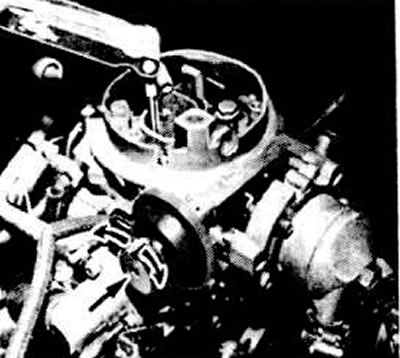
The arrow shows the adjusting screw of the starting clearance of the first stage of the air damper of the Pierburg 2E2 carburetor
After adjustment, lock the stop screw with a drop of paint.
Adjusting the starting clearances of the air damper
Remove the starter cover.
Pull the choke control lever down and secure it in this position.
Connect a vacuum gauge and a vacuum pump to the air damper pneumatic drive.
Create a vacuum of 100 mbar in the air damper pneumatic drive.
Check the tightness of the air damper pneumatic drive; the vacuum in it should not fall by more than 5 mbar per minute and decrease to less than 40 mbar.
Bring the vacuum in the air damper pneumatic drive to 200-300 mbar.
Using a set of feeler gauges, measure the starting gap of the first stage of the air damper, which should be 1.8±0.15 mm.
If necessary, set the correct clearance using the air damper pneumatic drive diaphragm stroke adjustment screw (see photo).
Close the atmospheric hole of the air damper pneumatic drive with a plug, create a vacuum of 200 mbar in it. If it is maintained for at least 1 minute, then the pneumatic drive is sealed
Measurements with a set of feeler gauges of the starting gap of the second stage of the air damper, which should be within 4.0±0.15 mm for cars with a manual transmission and 3.9±0.15 mm for cars with an automatic transmission.
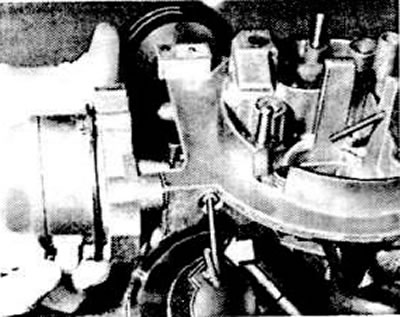
The arrow shows a device for adjusting the starting gap of the second stage of the air damper of the Pierburg 2E2 carburetor
If necessary, adjust the nominal clearance using the adjusting screw on the end of the air damper pneumatic actuator rod (see photo).
Checking the pneumatic drive of the throttle valve of the 2nd chamber
Connect a vacuum gauge and a vacuum pump to the pneumatic drive of the 2nd chamber throttle valve and create a vacuum of 50 mbar in the pneumatic drive. If it does not drop within 2 minutes, the pneumatic drive is sealed.
Fully open the throttle valve of the 1st chamber, maintaining a vacuum of 50 mbar in the pneumatic drive of the throttle valve of the 2nd chamber.
Make sure that the throttle valve of the 2nd chamber is fully open.
Adjusting the opening of the throttle valve of the 1st chamber
The position of the throttle valve of the 1st chamber is adjusted at the factory, but if the adjustment is disturbed, it can be restored as follows:
- connect the vacuum pump to the pneumatic drive of the throttle valve of the 1st chamber and close the atmospheric hole of the pneumatic drive with a plug (see photo);
- turn the cam of the heating system so as to release the throttle valve of the 1st chamber and set it to the closed position;
- apply a vacuum to the pneumatic drive sufficient to fully retract the throttle valve stop of the first chamber,
- set the throttle valve of the 1st chamber to the closed position.
- loosen the throttle valve limit screw so that it moves away from the 1st chamber throttle valve control lever, then screw in the limit screw until it touches the lever.
- turn the limit screw another 1/4 turn and lock it in this position.
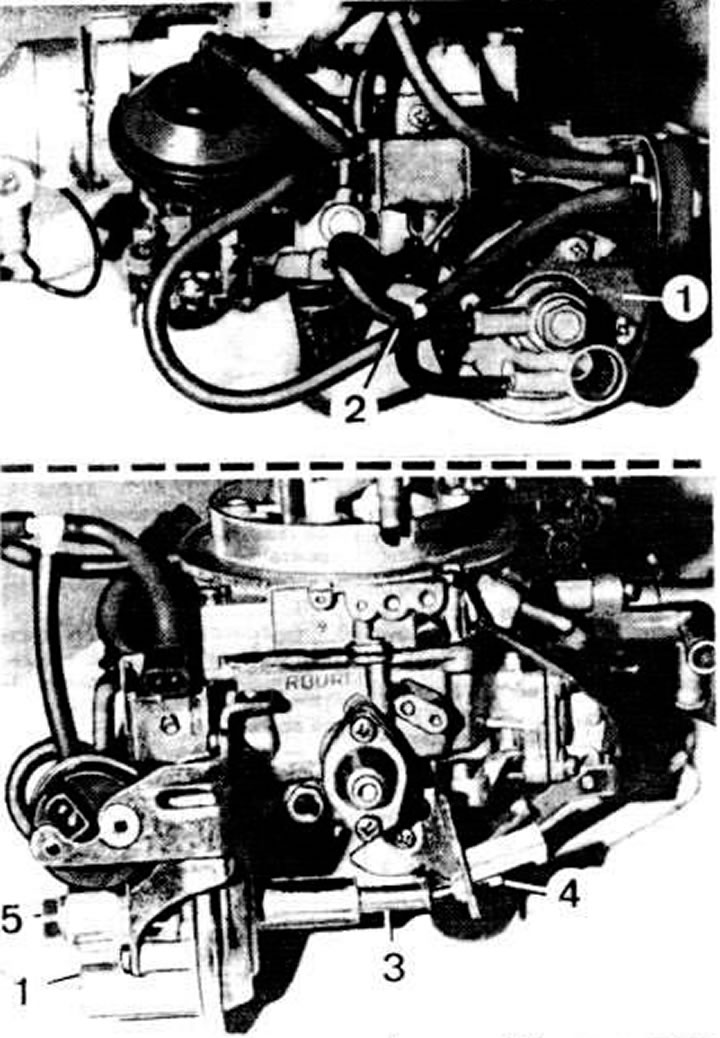
Adjusting the slightly open throttle valve of the 1st chamber and the position of the pneumatic drive rod of the throttle valve of the 1st chamber at forced idle: 1 - pneumatic drive of the throttle valve of the 1st chamber; 2 - tee of vacuum hoses of pneumatic drive of throttle valve of 1st chamber and pneumatic valve with thermal time relay; 3 - movable rod of the pneumatic drive of the throttle valve of the 1st chamber; 4 - throttle valve limit screw; 5 - adjusting screw for the protrusion of the throttle valve pneumatic drive rod of the 1st chamber at forced idle
Adjusting the opening of the throttle valve of the 2nd chamber
The position of the throttle valve of the 2nd chamber is adjusted at the factory, but in case of a violation of the adjustment it can be restored on a previously removed carburetor as follows:
- fully open the throttle valve of the 1st chamber and fix it in this position;
- set the throttle control lever of the 2nd chamber to the closed position;
- unscrew the limit screw of the 2nd chamber throttle valve so that it moves away from the stop. Then screw in the limit fork so that it barely touches the stop;
- turn the limit screw another 1/4 turn and lock it in this position,
- return the throttle valve of the 1st chamber to the closed position;
- measure the free travel of the 2nd chamber throttle control lever on its drive fork, which should be 0.4±0.1 mm on the inner side and 1.0i0.1 mm on the outer side;
- adjust the correct amount of free play of the lever if necessary by bending the ends of the fork.
Adjusting the accelerator pump
Remove the carburetor.
Fully retract the movable rod of the pneumatic drive of the 1st chamber throttle valve, turn the cam of the heating system so as to release the throttle valve of the 1st chamber and open it fully.
Place a measuring cup under the carburetor.
Smoothly open and close the throttle valve of the 1st chamber completely, thereby activating the accelerator pump.
Measure the amount of fuel in the measuring cup and compare it with the nominal capacity of the accelerator pump (see subsection ("Detailed technical specifications").
Achieve the desired performance if necessary by moving the actuator cam on the 1st chamber throttle control lever.
Checking the operation of the pneumatic drive of the throttle valve of the 1st chamber at forced idle speed
Disconnect the vacuum hoses from the pneumatic drive.
Attach a vacuum pump in place of the hose going through the tee from the pneumatic valve with a thermal time relay (see photo).
Create a vacuum in the pneumatic drive to simulate its idle operation.
Measure the size of the pneumatic actuator's movable rod output relative to the edge of the guide sleeve, which should be 15 mm.
Increase the vacuum in the pneumatic drive to simulate its operation at forced idle.
Measure the amount of the rod extension relative to the edge of the guide bushing, which should be 10 mm.
Adjusting the idle speed of a warm engine
Adjusting the engine idle speed must be done on a warm engine (with the air damper fully open) with the ignition timing set correctly and with the current consumers switched off. Connect the tachometer.
Using the stop screw of the 1st chamber throttle control lever, which rests on the movable rod of the 1st chamber throttle pneumatic drive, set the engine crankshaft speed within 750±50 rpm.
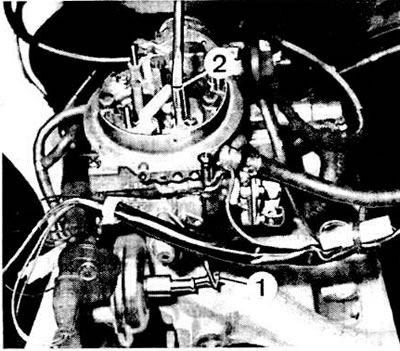
Pierburg 2E2 carburetor idle speed adjustment screws: 1 - throttle control lever stop screw of the 1st chamber (determines the amount of idle mixture); 2 - adjusting screw for mixture quality (composition)
Check the carbon monoxide (CO) content in the exhaust gases using a gas analyzer and, if necessary, adjust it.
Remove the air cleaner cover and disconnect the crankcase ventilation hose.
Adjust the engine idle speed as described above.
Using the mixture quality (composition) adjustment screw, achieve a CO content within 1.0±0.5%, and when the screw is screwed in, the combustible mixture is enriched, and vice versa.
Check and, if necessary, restore the engine idle speed to 750±50 rpm.
Note. When servicing the Pierburg 2E2 carburetor, in order to more accurately adjust the CO content, it is recommended to replace the perforated emulsion tubes with slotted ones supplied as spare parts. In this case, it is necessary to replace the seal above the emulsion tube.