
Repair Chevrolet Repair Toyota Repair Honda Repair AvtoVAZ Repair Mercedes-Benz Repair BMW Repair Opel
Home  |  Contacts  |  Sitemap  |    
English Русский
Български
Беларускі
Український
Српски
Hrvatski
Română
Polski
Slovenský
Magyar
AudiManual.ru


  • AUDI 80
  • AUDI 100
  • AUDI A3
  • AUDI A4
  • AUDI A6
  • AUDI A8
  • AUDI Q
  • OTHER
  • ARTICLES
C4 (1990-1994) C4 (1990-1994, petrol) C3 (1982-1990) C3 (1982-1990, petrol) C3 (1982-1990, diesel)

Carburetor Pierburg 2E2 — operating principle (Audi 100 C3)

  • Home
  • Audi 100
  • C3 (1982-1990, petrol)
  • 4 cylinder engine
  • Supply system
  • Carburetor Pierburg 2E2 — operating principle
            0
Table of contents: Starting device ↓ Idle and transition system ↓ Main dosing system ↓ Accelerator pump ↓
The design features and specifications of the carburetor are given in the subsection "Detailed technical specifications".

Starting device


Under the action of the thermostatic bimetallic spring of the automatic starting device, the air damper 1 (see diagrams) blocks the air supply to the carburetor duct. The throttle valve 2 of the 1st chamber is held in a slightly open position simultaneously by the three-nozzle pneumatic actuator 3, the rod 4 of which is retracted by the spring from the stop of the throttle valve of the 1st chamber, and the thermal power element 5 of the liquid heating system of the starting device, acting on the cam for opening the throttle valve of the 1st chamber. Due to the opening of the throttle valve of the 1st chamber, a significant vacuum is created in the main metering system of the 1st chamber, which is necessary for starting a cold engine and increasing the crankshaft speed at idle (see diagram "A").

After the engine starts, the vacuum created in the intake manifold acts on the pneumatic actuator 6 (see diagram "B"), which slightly opens the air damper. With the transition to the operating mode, the rods, driven by the throttle valve of the 1st chamber, open the air damper, as a result of which the fuel-air mixture becomes leaner and uninterrupted operation of the engine is ensured.

Idle and transition system


After the engine is started, the time relay thermal valve closes the connection between the pneumatic drive 3 of the throttle valve of the 1st chamber and the atmospheric air, and its rod returns to the position corresponding to the idle speed of the warmed-up engine. During engine warm-up, the throttle valve of the 1st chamber is held in a slightly open position due to the smooth heating of the thermal power element of the liquid heating system of the automatic starting device.


Fuel from the float chamber enters through the main fuel jet 7 into the emulsion tube well and the idle jet. Fuel mixes with air entering through the opening regulated by the screw 2 of the mixture quality (composition). The fuel-air mixture exits under the throttle valve through the slot 10 of the idle and transition system, which leads to a gradual increase in the engine crankshaft speed.

The transition system of the 2nd chamber operates in a similar manner, ensuring an increase in the crankshaft rotation frequency as the throttle valve of the 2nd chamber opens.
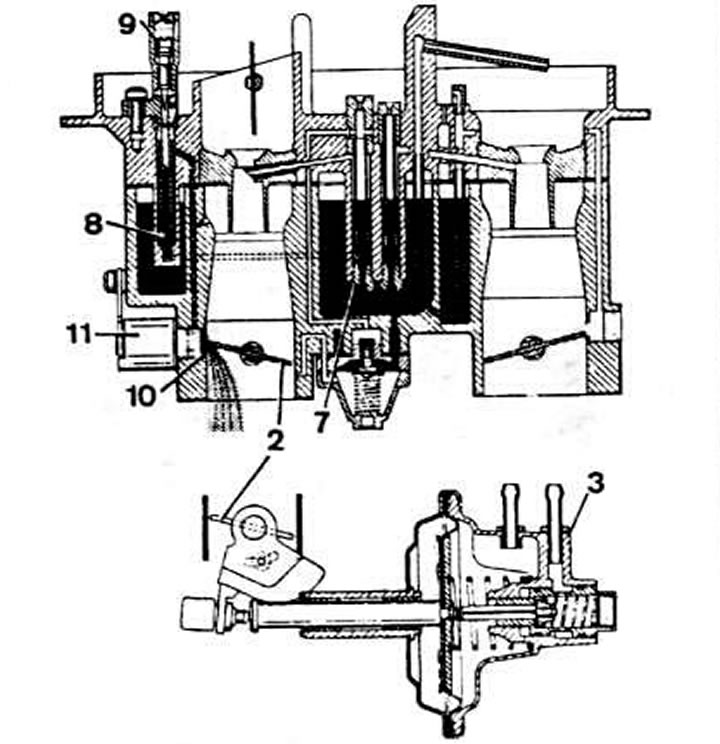
Diagram of the idle system and transition system of the 1st chamber of the Pierburg 2E2 carburetor:…

Diagram of the idle system and transition system of the 1st chamber of the Pierburg 2E2 carburetor: 2 - throttle valve 1st chamber; 3 - pneumatic drive of the throttle valve of the 1st chamber; 7 - main fuel jet of the 1st chamber; 8 - idle fuel jet; 9 - mixture quality (composition) adjustment screw; 10 - idle and transition system fuel-air mixture injection slot; 11 - pneumatic valve of the mixture heating system with a thermal time relay
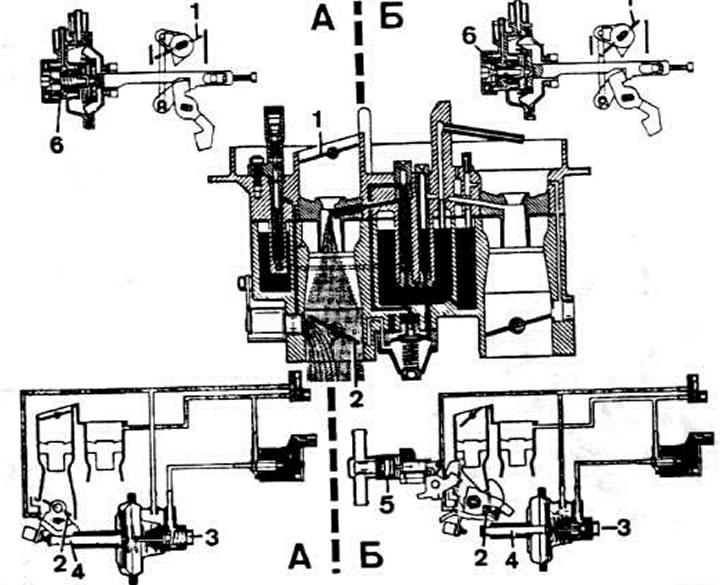

The Pierburg 2E2 carburetor operation diagram when starting a cold engine: 1 - air damper; 2 -…

The Pierburg 2E2 carburetor operation diagram when starting a cold engine: 1 - air damper; 2 - throttle valve 1st chamber; 3 - pneumatic drive of the throttle valve of the 1st chamber; 4 - 1st chamber throttle pneumatic actuator rod: 5 - heat power element; 6 - pneumatic drive of the air damper


Main dosing system


Fuel through a needle valve, the flow area of which is regulated by a float, fills the float chamber and is held here at a constant level. The needle valve is connected to the float tongue by a hook.

From the float chamber, under the action of vacuum, the fuel enters the well of the emulsion tube through the main fuel jet 7 (see diagram) of the 1st chamber, where it mixes with air coming out of the opening of the main air jet 12. The resulting emulsion is sprayed by the air flow passing through the small and large diffusers 13.

The main metering system of the 1st chamber includes a power mode economizer. When the vacuum in the area of the throttle valve 2 of the 1st chamber drops, caused by a significant opening of the throttle valve, there is no vacuum in the diaphragm cavity of the housing of the power mode economizer 14, the valve 15 of which, under the action of the spring, opens the channel 16 for supplying additional fuel to the fuel jet of the main metering system of the 1st chamber.

The main dosing system of the 2nd chamber operates similarly, in which an economizer is included instead of a power mode economizer. Enrichment of the fuel-air mixture in the full load mode in the 2nd chamber is ensured by spraying under the action of a strong vacuum of pure fuel through the injection tube 17 of the economizer, the outlet of which is located above the mixture formation zone.
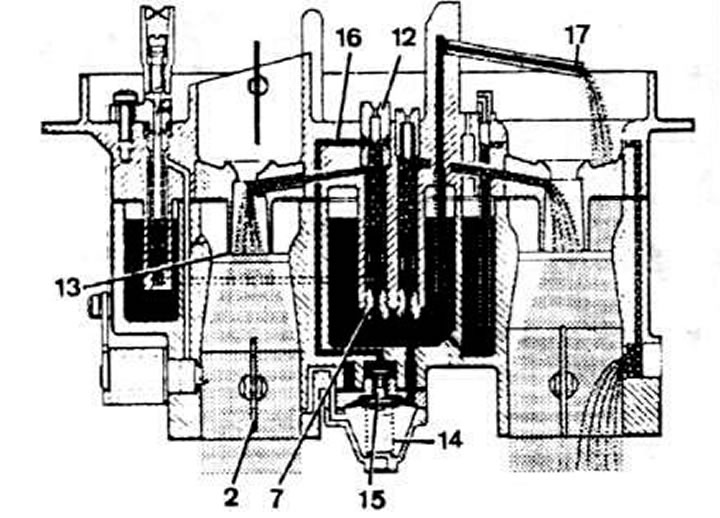
Diagram of the main metering systems of the Pierburg 2E2 carburetor: 2 - throttle valve 1st…

Diagram of the main metering systems of the Pierburg 2E2 carburetor: 2 - throttle valve 1st chamber; 7 - main fuel jet of the 1st chamber; 12 - main air jet of the 1st chamber; 13 - diffuser; 14 - housing of the pneumatic drive of the power mode economizer; 15 - economizer valve; 16 - fuel supply channel from the economizer; 17 - economizer injection tube


Accelerator pump


When the throttle valve 2 (see diagram) of the 1st chamber is opened, the cam 18 actuates the lever 19 of the accelerator pump drive and the pump 20 pumps the fuel sucked into the float chamber into the mixture formation zone through the check valve and the sprayer 21.
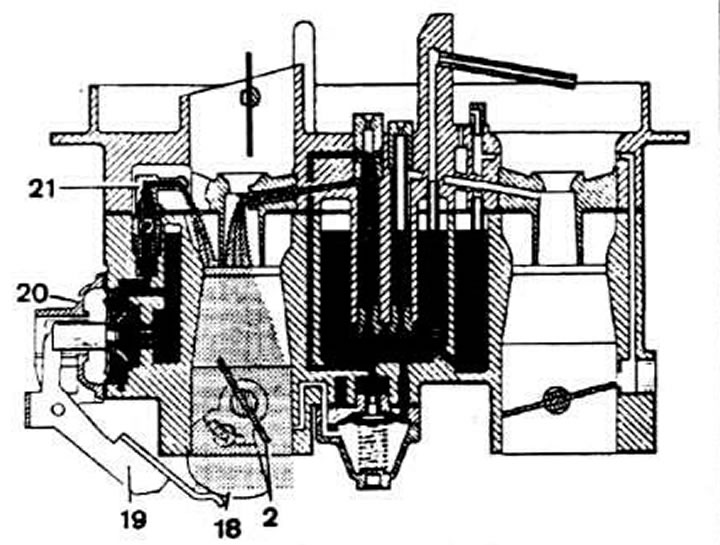
Accelerator pump diagram of the Pierburg 2E2 carburetor: 2 - throttle valve 1st chamber; 16 -…

Accelerator pump diagram of the Pierburg 2E2 carburetor: 2 - throttle valve 1st chamber; 16 - accelerator pump drive cam; 19 - drive lever; 20 - accelerator pump; 21 - sprayer
The article was checked by auto expert Maxim Rybakov
This article is available at russian, bulgarian, belarusian, ukrainian, serbian, croatian, romanian, polish, slovak, hungarian

Share information:
Previous articles
Audi 100 C3: Supply system
Next articles

Main parts of the Pierburg 1B3 carburetor
Checking and adjusting the Pierburg 1B3 carburetor
Carburetor Pierburg 1B3 — operating principle
Checking the fuel pump discharge pressure
Checking and adjusting the Pierburg 2E2 carburetor
Pierburg 2E2 Carburetor Parts
Air filter, intake manifold and fuel system parts
Keihin 26-30 DC Carburetor Parts


Similar articles on other Audi car models:
Operating principle of the Pierburg 2E2 carburetor Audi 80 B2 (1979-1986)
Operating principle of the electronic engine management system Audi A4 B6 (2000-2006, petrol)
Operating principle of the catalyst Audi A6 C5 Allroad (1999-2005)
Operating principles of the engine management system Audi Q7 Typ 4L (2005-2015, diesel)
Design and operating principle of the steering system Audi A2 (1999-2005)
Link to this page in different formats


Visitor comments

No comments yet


How much will 14 + 36 =


100(C4, 1990-1994) 
  • General information
  • User manual
  • Power unit
  • Engine repair
  • Ignition system
  • Fuel system (gasoline)
  • Fuel system (diesel)
  • Lubrication system
  • Cooling system
  • Exhaust system
  • Transmission
  • Clutch
  • Car gearbox
  • Drive shafts
  • Chassis
  • Car suspension
  • Steering
  • Wheels and tires
  • Brake system
  • Body
  • Ventilation and heating
  • Body repair
  • Electrical equipment
  • Power devices
  • Lighting and appliances
  • Electrical circuits
 
100(C4, 1990-1994, petrol) 
  • General information
  • Operation and maintenance
  • Power unit
  • Engine repair
  • Exhaust system
  • Cooling system
  • Supply system
  • Air filter
  • Mono-Motronic injection system
  • Digifant injection system
  • KE-III-Jetronic and KE-Motronic
  • MPI and MPFI injection system
  • Transmission
  • Clutch
  • Car gearbox
  • Chassis
  • Suspension and steering
  • Brake system
  • Wheels and tires
  • Body
  • Exterior
  • Interior
  • Electrical equipment
  • Fuses and relays
  • Power devices
  • Ignition system
  • Lighting and signaling
  • Equipment and devices
  • Electrical circuits
 
100(C3, 1982-1990) 
  • General information
  • User manual
  • Maintenance
  • Specifications
  • Power unit
  • Engines 4-cylinder
  • Engines 5-cylinder
  • Diesel engine
  • Cooling system
  • Power system (carburetor)
  • Power system (injector)
  • Fuel system (diesel)
  • Transistor ignition system
  • Electronic ignition system
  • Transmission
  • Clutch
  • 4 speed gearbox 014
  • 5 speed gearbox 013 and 093
  • 5 speed gearbox 016 and 012
  • Shift mechanism KP 016
  • Automatic transmission
  • Front wheel drive
  • Chassis
  • Front suspension
  • Rear suspension
  • Steering
  • Brake system
  • Body
  • Body elements
  • Electrical equipment
  • Lighting and appliances
  • Power devices
  • Electrical circuits
 
100(C3, 1982-1990, petrol) 
  • General information
  • Maintenance and operation
  • 4 cylinder engine
  • Engine repair
  • Cooling and lubrication system
  • Supply system
  • Ignition system
  • 5 cylinder engine
  • Engine repair
  • Cooling and lubrication system
  • Supply system
  • Ignition system
  • Transmission
  • Clutch and drive shafts
  • 4 speed gearbox 014
  • 5 speed gearbox 013 and 093
  • 5 speed gearbox 016 and 012
  • Automatic gearbox
  • Chassis
  • Steering
  • Front suspension
  • Rear suspension
  • Brake system
  • Body
  • Body elements
  • Doors, locks and windows
  • Body repair
  • Electrical equipment
  • Equipment and devices
  • Power devices
  • Electrical circuits
 
100(C3, 1982-1990, diesel) 
  • General information
  • User manual
  • Maintenance
  • Troubleshooting
  • Power unit
  • Engine in a car
  • Engine removed
  • Cooling system
  • Fuel system
  • Exhaust system
  • Starting and charging
  • Preheating
  • Transmission
  • Clutch
  • Mechanical gearbox
  • Automatic gearbox
  • Drive shafts
  • Chassis
  • Brake system
  • Suspension
  • Steering
  • Body
  • Exterior
  • Interior
  • Electrical equipment
  • Equipment and devices
  • Electrical circuits
 
AudiManual.ru © 2017-2026 · Mobile version · Feedback · Sitemap: EN BG BY UA RS HR RO PL SK HU · Site search · News and articles
80 B2 · 80 B3 petrol · 80 B3 · 80 B4 · 100 C3 diesel · 100 C3 petrol · 100 C3 · 100 C4 petrol · 100 C4 · A3 Type 8L · A4 B5 petrol · A4 B5 · A4 B6 petrol · A4 B6 · A4 B7 · A4 B8 · A6 C4 · A6 C5 · A6 C5 Allroad · A8 D2 · Q5 Type 8R · Q7 Typ 4L · Audi A2 ·
This site uses cookies 🍪. Click the button to accept this fact.