Check whether the driven disk springs are still in good condition and whether the disk splines are too damaged. Since oily driven disk linings cannot be cleaned, the driven disk should be replaced in such cases.
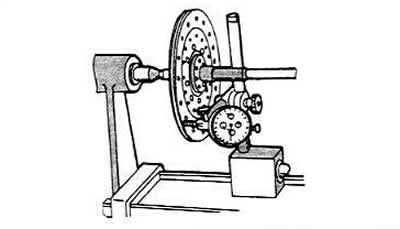
To check the clutch slave disc for runout, clamp it on a suitable rod or shaft between the ends of the rotating device (lathe).
Place a dial indicator with a suitable holder next to the disk so that the indicator probe is adjacent to the edge of the disk, namely the outer edge. Slowly rotate the dial indicator and observe the indicator readings. If the readings are more than 0.4 mm, you can carefully align the disk with pliers, although this does not always give the desired result. If alignment fails, the disk should be replaced.
Check the clutch linings for reuse by measuring the distance from the lining surface to the top of the rivet head with a depth gauge. If this distance is less than 0.3 mm, the disc must be replaced. This should also be done if this value is reached soon.
Check the movement of the clutch driven disk hub on the shaft splines. To do this, put the disk on and grab its outer edge with your thumb and forefinger. Turn the disk back and forth. If the play is more than 0.4 mm, then there is wear in the spline connection. The reason for this is most often in the driven disk.
Check the inner ends of the diaphragm spring for wear in the areas shown by the arrows. If deep worn areas are visible, the clutch should be replaced completely.
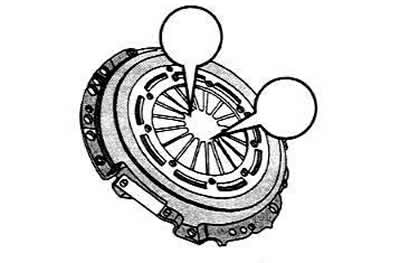
In general, the following rule applies: The ends of the spring may be worn to half their original thickness when a new clutch needs to be installed.
The ends of the diaphragm spring should differ from each other in installation height by no more than 0.5 mm. Bent petals can be straightened back. Special devices are used for this, but you can also use steel strips with cuts and bend the petals.
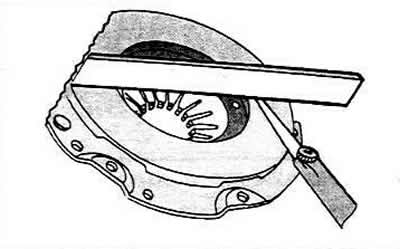
Place a ruler on the friction surface of the pressure plate and measure the gap with a flat feeler gauge. If it is more than 0.3 mm, the pressure plate must be replaced.