



Attention. During the operation of the clutch, the friction linings wear out, resulting in dust containing asbestos, which is harmful to health, so when cleaning the clutch, do not use compressed air or inhale the dust. Cleaning the clutch parts from dust must be done using brake fluid or methyl alcohol. After cleaning the parts, wipe them dry.
Removal
Remove the gearbox.
Use a marker or paint to mark the position of the pressure plate in relation to the flywheel.
Using a special tool AUDI 3067 or a screwdriver, lock the flywheel from turning by the teeth of the flywheel ring gear (see fig. 5.4).
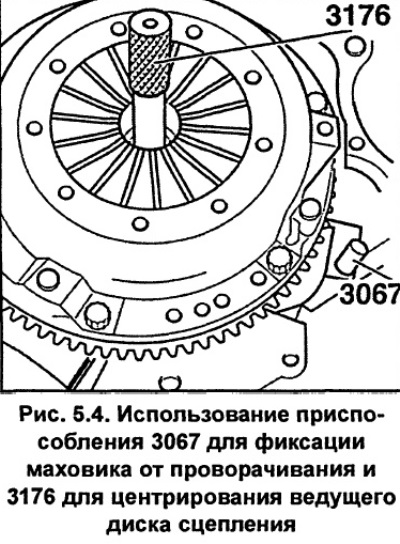
Gradually loosen the pressure plate mounting bolts diagonally, turning each bolt 1 or ½ turn until the diaphragm spring releases and remove the bolts.
Remove the pressure plate, while protecting the drive plate from falling.
Wipe the clutch release bearing clean, but do not rinse it in solvent.
Wipe the flywheel.
Examination
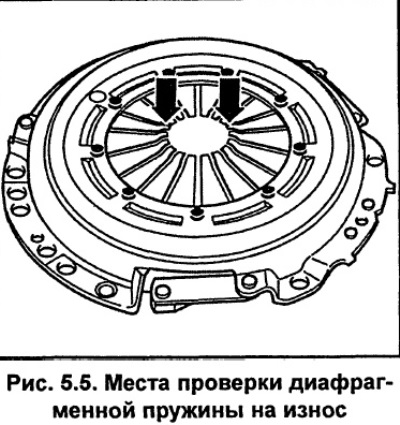
Check the condition of the clutch pressure plate. The wear marks on the ends of the pressure spring should be half the thickness of the material from which the spring is made (see fig. 5.5).
Check the reliability of the riveted connection between the pressure plate and the housing.
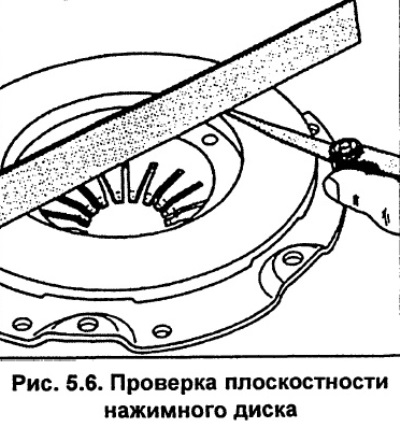
Check the pressure plate for cracks, burns and surface wear. Using a steel ruler and feeler gauge, check the flatness of the working surface of the pressure plate. The deviation from flatness should be less than 0.2 mm (see fig. 5.6).
Check the condition of the flywheel friction surface for cracks, burns and surface wear.
Check the condition of the friction linings of the drive disk and if there are traces of oil or mechanical damage, replace the disk.
Measure the thickness of the drive disc linings. If they are less than the specified thickness or if the rivet heads are close to the working surface, replace them or the disc.
Check the end runout of the drive disk, which at a distance of 2.5 mm from the outer diameter should be less than 0.8 mm.
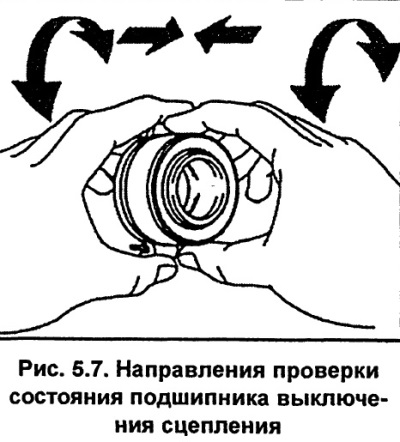
Check the condition of the clutch release bearing, which should rotate easily, evenly and silently and should have no play. The working surface of the bearing, acting on the diaphragm spring, should not have any defects (see fig. 5.7).
The condition of the clutch release bearing can be determined without removing it from the vehicle by pressing the clutch pedal while the engine is running. If additional noise occurs when the clutch pedal is pressed, the bearing is faulty and must be replaced.
Installation
Attention. If the clutch master disk was replaced and its friction linings were burnt due to overloads, it is necessary to first check the condition of the mating surfaces of the flywheel and pressure plate.
When installing a new clutch master or pressure plate, remove the anti-corrosion protection from them.
When installing the drive disc, make sure that no oil gets on its friction linings, even in small quantities. Before installing the drive disc, clean the mating surface of the flywheel and pressure plate with a clean rag, and install the drive disc with clean hands.
Apply a thin coat of molybdenum disulphide grease or AUDI G000100 to the splines in the drive disc hub. Install the drive disc onto the transmission input shaft and slide it back and forth on the shaft until it moves easily. Remove the drive disc from the input shaft and wipe off any excess grease from the disc and shaft.
Install the drive disc onto the pressure plate, with the protruding part of the clutch disc hub facing the pressure plate. If there are marks on the drive disc, they should be on the side opposite the pressure plate (see fig. 5.8).
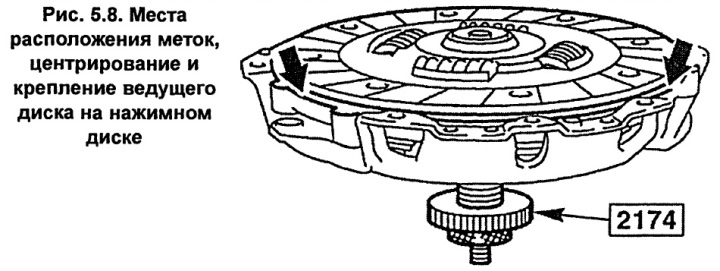
Using a special tool HAZET-2174 or AUDI-3176, center and secure the drive disc on the pressure plate (see fig. 5.8).
Install the drive and pressure plates onto the flywheel guide pins.
When installing the pressure plate on models with V6 engines, except for the 2.4-I engine, align the marks on the flywheel and the pressure plate housing (see fig. 5.2).
Bolt the pressure plate housing to the flywheel, tightening the bolts diagonally, turning each bolt 1 or ½ turn until the pressure plate housing is firmly pressed against the flywheel, then tighten the bolts to 25 Nm.
Remove the mandrel that centers the driven disk.
Lubricate the clutch release bearing guide bushing with a thin layer of special molybdenum disulfide based grease.
Install the gearbox.