
Repair Chevrolet Repair Toyota Repair Honda Repair AvtoVAZ Repair Mercedes-Benz Repair BMW Repair Opel
Home  |  Contacts  |  Sitemap  |    
English Русский
Български
Беларускі
Український
Српски
Hrvatski
Română
Polski
Slovenský
Magyar
AudiManual.ru


  • AUDI 80
  • AUDI 100
  • AUDI A3
  • AUDI A4
  • AUDI A6
  • AUDI A8
  • AUDI Q
  • OTHER
  • ARTICLES
C4 (1990-1994) C4 (1990-1994, petrol) C3 (1982-1990) C3 (1982-1990, petrol) C3 (1982-1990, diesel)

Checking the tightness and servicing the cooling system (Audi 100 C4)

  • Home
  • Audi 100
  • C4 (1990-1994)
  • Power unit
  • Cooling system
  • Checking the tightness and servicing the cooling system
            0
Table of contents: Radiator cleaning ↓ Replacing coolant hoses ↓ Draining the coolant ↓ Filling the cooling system ↓
The hoses on the radiator and engine should be tightly fitted, as should the thin hoses going to the heater or to the intake pipe and starting automation.

Check for cracks in the hoses. Press on the hoses to check for hardened areas, if any, replace them

Check that the hoses are not pushed too deeply into the fittings.

Check the tightening of the clamp bolts.

Rusty clamps may suddenly burst while driving when the pressure in the system is high, so they should be replaced.

In the workshop, the tightness of the cooling system is checked using a special hand-held air pump and a pressure gauge.

This device is placed on the opening of the expansion tank and creates a pressure of 1 bar.
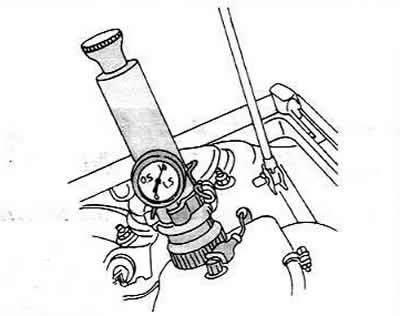
This device is placed on the opening of the expansion tank and creates a pressure of 1 bar.


If the pressure does not drop within 1-2 minutes, the cooling system is sealed.

Radiator cleaning


Before and after the warm season, it is necessary to clean the radiator fins from insects that have gotten there, since their presence worsens heat exchange. On a four-cylinder engine, sow the radiator grille, on a five-cylinder engine, remove the radiator lining from above.


Remove traces of dried insects with a protein dissolving agent, for example "Summer Screen".

After the time has elapsed, rinse the radiator from the rear with water. Do not allow too much pressure to pass through the radiator fins. A hard brush or a sharp tool may damage the radiator. Rinse the radiator from the inside with water from a hose through the fan holes. On a five-cylinder engine, lift the rubber plugs on the right and left of the radiator trim and rinse the radiator through the holes under the plugs.

Replacing coolant hoses


When replacing hoses, pay attention to the shape of the bends of the original hoses and replace all clamps.

Drain the coolant, collecting it. Loosen the hose clamps, disconnect the hoses.

Loosen tightly seated ends of hoses by inserting a screwdriver between the hose and the nipple and gently prying. Push new hoses onto the nipples far enough so that they cannot slip off.

Do not tighten the clamps with too much force, otherwise the threads may be stripped.

Attention. You can try to seal a hose with a crack using a special tape "Pan-pen-band" or "Hoseweld Bandage". Either one is glued to a clean and dry hose. If there is a large leak, you must first release the pressure in the cooling system, turn the cover of the distribution tank one turn, otherwise the bandage will not hold.


Draining the coolant


Allow the engine to cool down, otherwise there is a risk of liquid splashing out.

Open the expansion tank cap.

Place a tray under the engine to collect the coolant. On a four-cylinder engine, disconnect the thick radiator hose on the engine on the left in the direction of travel and the thin hose to the heater heat exchanger on the coolant pump housing and drain the liquid.


On a five-cylinder engine, disconnect the hose on the left in the direction of travel between the thermostat housing and the coolant pipe. Loosen the coolant pipe mounting bolt and pull off the hose.

If necessary, also remove the hose between the radiator and thermostat.

On a six-cylinder engine, unscrew the drain plug (2) in the desired part of the radiator.
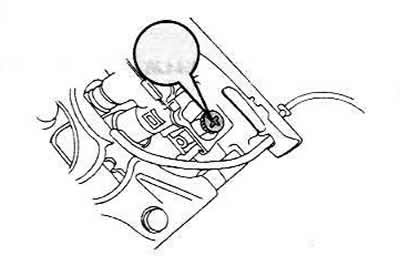
On a six-cylinder engine, unscrew the drain plug (2) in the desired part of the radiator.


Caution. Particles of the corrosion protection agent contained in the additives in the coolant settle on the light alloy cooling system parts over time, forming a protective layer. If a large-surface part included in the cooling system is replaced, the corrosion protection agent remaining in the fluid may not be sufficient to protect the new part from corrosion. Therefore, when replacing the cylinder head, radiator, heat exchanger or the entire engine, it is necessary to completely replace the coolant.


Filling the cooling system


Add coolant until the expansion tank is filled to the brim.

On a four-cylinder engine, unscrew the large thermal switch in the hose connection on the left side of the cylinder head. Screw the thermal switch back in when coolant starts to leak out at this point.


On a six-cylinder engine, unscrew the air bleed plug located on the main cooling system line.

Tighten the tank cap.

Start the engine and let it run until the electric radiator fan comes on.

Turn off the engine and add coolant. When the engine is warm, the coolant level should be approximately 2 cm above the mark on the expansion tank.
The article was checked by auto expert Georgy Rodionov
This article is available at russian, bulgarian, belarusian, ukrainian, serbian, croatian, romanian, polish, slovak, hungarian

Share information:
Previous articles
Audi 100 C4: Cooling system
Next articles

Overpressure cooling system
How cooling is carried out
Coolant expansion tank cap
Thermostat
Water pump
Water pump belt


Similar articles on other Audi car models:
Checking the cooling system Audi 80 B3 (1986-1991)
Checking the functioning of the cooling system Audi A3 Type 8L (1996-2003)
Checking the tightness of the cooling system Audi A4 B6 (2000-2006, petrol)
Checking the tightness of the cooling system Audi A6 C5 (1997-2004)
Checking the exhaust system Audi A8 D2 (1994-2002)
Replacing the coolant, checking and adjusting its level,… Audi Q7 Typ 4L (2005-2015, diesel)
Cooling system — checking and refilling fluid Audi A2 (1999-2005)
Link to this page in different formats


Visitor comments

No comments yet


How much will 17 + 19 =


100(C4, 1990-1994) 
  • General information
  • User manual
  • Power unit
  • Engine repair
  • Ignition system
  • Fuel system (gasoline)
  • Fuel system (diesel)
  • Lubrication system
  • Cooling system
  • Exhaust system
  • Transmission
  • Clutch
  • Car gearbox
  • Drive shafts
  • Chassis
  • Car suspension
  • Steering
  • Wheels and tires
  • Brake system
  • Body
  • Ventilation and heating
  • Body repair
  • Electrical equipment
  • Power devices
  • Lighting and appliances
  • Electrical circuits
 
100(C4, 1990-1994, petrol) 
  • General information
  • Operation and maintenance
  • Power unit
  • Engine repair
  • Exhaust system
  • Cooling system
  • Supply system
  • Air filter
  • Mono-Motronic injection system
  • Digifant injection system
  • KE-III-Jetronic and KE-Motronic
  • MPI and MPFI injection system
  • Transmission
  • Clutch
  • Car gearbox
  • Chassis
  • Suspension and steering
  • Brake system
  • Wheels and tires
  • Body
  • Exterior
  • Interior
  • Electrical equipment
  • Fuses and relays
  • Power devices
  • Ignition system
  • Lighting and signaling
  • Equipment and devices
  • Electrical circuits
 
100(C3, 1982-1990) 
  • General information
  • User manual
  • Maintenance
  • Specifications
  • Power unit
  • Engines 4-cylinder
  • Engines 5-cylinder
  • Diesel engine
  • Cooling system
  • Power system (carburetor)
  • Power system (injector)
  • Fuel system (diesel)
  • Transistor ignition system
  • Electronic ignition system
  • Transmission
  • Clutch
  • 4 speed gearbox 014
  • 5 speed gearbox 013 and 093
  • 5 speed gearbox 016 and 012
  • Shift mechanism KP 016
  • Automatic transmission
  • Front wheel drive
  • Chassis
  • Front suspension
  • Rear suspension
  • Steering
  • Brake system
  • Body
  • Body elements
  • Electrical equipment
  • Lighting and appliances
  • Power devices
  • Electrical circuits
 
100(C3, 1982-1990, petrol) 
  • General information
  • Maintenance and operation
  • 4 cylinder engine
  • Engine repair
  • Cooling and lubrication system
  • Supply system
  • Ignition system
  • 5 cylinder engine
  • Engine repair
  • Cooling and lubrication system
  • Supply system
  • Ignition system
  • Transmission
  • Clutch and drive shafts
  • 4 speed gearbox 014
  • 5 speed gearbox 013 and 093
  • 5 speed gearbox 016 and 012
  • Automatic gearbox
  • Chassis
  • Steering
  • Front suspension
  • Rear suspension
  • Brake system
  • Body
  • Body elements
  • Doors, locks and windows
  • Body repair
  • Electrical equipment
  • Equipment and devices
  • Power devices
  • Electrical circuits
 
100(C3, 1982-1990, diesel) 
  • General information
  • User manual
  • Maintenance
  • Troubleshooting
  • Power unit
  • Engine in a car
  • Engine removed
  • Cooling system
  • Fuel system
  • Exhaust system
  • Starting and charging
  • Preheating
  • Transmission
  • Clutch
  • Mechanical gearbox
  • Automatic gearbox
  • Drive shafts
  • Chassis
  • Brake system
  • Suspension
  • Steering
  • Body
  • Exterior
  • Interior
  • Electrical equipment
  • Equipment and devices
  • Electrical circuits
 
AudiManual.ru © 2017-2026 · Mobile version · Feedback · Sitemap: EN BG BY UA RS HR RO PL SK HU · Site search · News and articles
80 B2 · 80 B3 petrol · 80 B3 · 80 B4 · 100 C3 diesel · 100 C3 petrol · 100 C3 · 100 C4 petrol · 100 C4 · A3 Type 8L · A4 B5 petrol · A4 B5 · A4 B6 petrol · A4 B6 · A4 B7 · A4 B8 · A6 C4 · A6 C5 · A6 C5 Allroad · A8 D2 · Q5 Type 8R · Q7 Typ 4L · Audi A2 ·
This site uses cookies 🍪. Click the button to accept this fact.