



Checking the functioning of the cooling system and frost resistance of the coolant
Execution order
1. Many serious engine malfunctions are related to cooling system malfunctions. If the car is equipped with an automatic transmission, its operation and service life are also directly related to the operation of the cooling system.
2. The cooling system should be checked when the engine is cold, so it is best to do this before the first trip of the day or no earlier than three hours after turning off the engine.
3. Slowly, being careful in case the engine is still warm, remove the radiator cap. Rinse it thoroughly inside and out with clean water. Also rinse the radiator filler neck. The presence of traces of corrosion in the filler neck means that the coolant should be replaced (refer to subsection Replacing the coolant). The coolant inside the radiator should be relatively clean and transparent. If it is brownish in color, drain the system and fill it with new coolant.
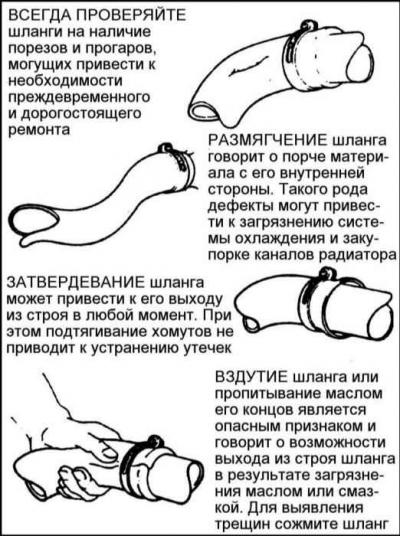
4. Carefully inspect the radiator hoses, as well as the heater hoses, which have a smaller diameter. Check the entire length of the coolant hoses, replacing any cracked, bulging or worn hoses. Cracks are easier to spot if you squeeze the hose with your hand. Pay special attention to the clamps that hold the hoses to the cooling system components. These clamps can cut or puncture the hoses, causing coolant to leak.
5. Make sure all hose connections are securely fastened. Coolant leaks usually show up as white or rust-colored deposits in the area of the leak. If your vehicle uses wire-type clamps, it may be worth replacing them with screw-type clamps.
6. Using compressed air or a soft brush, clean the front of the radiator (and also the air conditioner condenser, where available). Remove any insects, leaves, or other foreign objects that may have gotten onto the radiator fins. Be very careful not to damage the fins or cut your fingers on them.
7. If the coolant level is constantly dropping and you have not found any leaks, you should pressure test the radiator cap and the entire cooling system.
Checking the frost resistance of the coolant
Warning: Do not allow antifreeze to come into contact with your skin or painted surfaces of your vehicle. If contact occurs, rinse immediately with plenty of water. Antifreeze is extremely toxic and fatal if ingested. Do not leave antifreeze in an open container or spilled on the floor; its sweet smell can easily attract children or pets. Check your local regulations for disposal of used antifreeze. Many areas have special collection centers for it.
Before the start of the winter season, it is necessary to check the concentration of antifreeze in the coolant, especially if clean water was poured into the system during operation.
Special tool required:
- Frost resistance meter. There is also an optical device for checking the HAZET level No.4810.
Required operating materials and spare parts:
- Antifreeze with corrosion protection agent "G12" (red, designation "G 012 A8D according to TLAUDI 774 D") and clean, lime-free water.
Examination
8. Warm up the engine slightly so that the upper radiator hose is warm. When measuring the concentration of antifreeze, the temperature of the liquid should be about +20°C.
Safety Note
When the engine is hot, the expansion tank cap should be opened carefully. There is a risk of burns! It is necessary to put a rag on the cap. Open the cap only when the liquid temperature is no more than + 90°C.
9. Carefully unscrew the expansion tank cap.
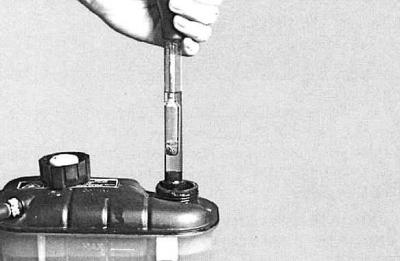
10. Draw up the liquid using the hydrometer bulb.
11. In our latitudes, the concentration of antifreeze is sufficient to provide protection for the system down to a temperature of –25°C, and in particularly cold climates down to –35°C.
Adding antifreeze
If engine protection is required down to a temperature of –25°C, the antifreeze concentration in the coolant should be 40%. If protection is required down to a temperature of –35°C, the antifreeze concentration should be 50%.
Warning: If a higher degree of protection against freezing is required, the concentration level of antifreeze can be increased to 60%. This concentration will provide protection down to -40°C. If the concentration is increased to a higher level, the degree of engine protection begins to decrease and, in addition, the heat-dissipating properties of the coolant are impaired.
For cars up to the chassis number "8LVA006233" (release date approximately before the end of 1996) the G11-ABC antifreeze or any other antifreeze marked "according to TL-VW 774 C" is used in series. It can be recognized by its green color.
Starting from chassis number "8LVA006234" aUDI G12 antifreeze is used in series. G12 or any other antifreeze marked "according to TL-VW 774 D" can be used to fill the system. G12 antifreeze is red.
Warning: G11 and G12 must not be mixed. This may cause severe engine damage. Brown coolant (mixture of G11 and G12) should be replaced immediately.
Warning: Engines designed to use G11 may be converted to modified G12 antifreeze.
12. Close the radiator cap and after a test drive check the antifreeze concentration again, referring to the Specifications.