



Front wheel suspension
The central part of the front suspension is the so-called shock absorber strut, to which the wheel is directly attached and it serves to spring and cushion jolts and impacts. An elastically "suspended" bearing connects the shock absorber strut in its upper part to the body. At the bottom, the strut is connected to the front axle beam by a hinge, through the so-called transverse suspension arm.
Attached to both wishbones is also a round spring steel rod, bent several times, called the anti-roll bar. It works as follows: when the inner wheel is spring loaded during a turn, the anti-roll bar twists. The resulting spring force supports the suspension of the outer wheel (relative to the rotation) wheels and thus its spring is strengthened to a certain extent. The result: the car leans significantly less when turning. If the car springs - for example, when braking, evenly at the front, then the stabilizer does not work. Due to its location, the anti-roll bar also takes on the shocks acting on the suspension from the front.
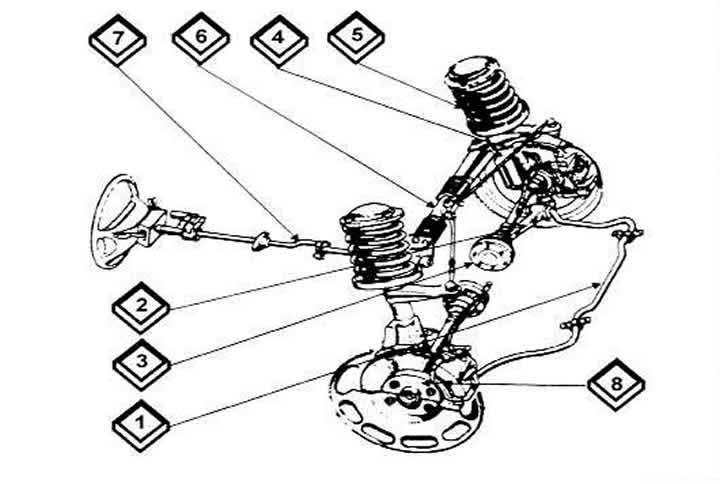
1 Anti-roll bar
2 Transverse suspension arm
3 Drive shaft
4 Suspension strut steering knuckle arm
5 Shock absorber strut
6 Rack and pinion steering
7 Steering shaft
8 Brake disc
Rolling shoulder
There is another design feature of the front suspension: the steering kinematics that stabilizes the direction. For example, it ensures safety when braking on different road surfaces between the left and right front wheels.
This is achieved by the so-called rolling shoulder, which is negative on Audi cars. You can imagine it like this: connect the upper and lower support points of the shock absorber with an imaginary line and see where it is (continued downwards) will touch the ground.
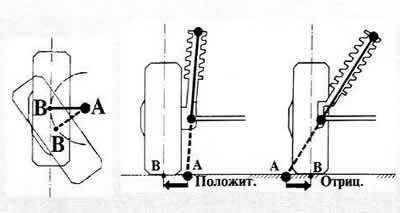
In Audi models, the contact point is outside the center of the wheel, so we are talking about a negative rolling arm. If this point were closer to the center of the car, the rolling arm would be positive.
When turning, the front wheel moves along the arc of point (a). There, the continuation of the imaginary line touches the road (shown in the central and right figures). Point (b) denotes the center of the tire contact surface. The radius (a-b) of the arc is the rolling shoulder. This rolling shoulder depends on the position of the pivot axis: if the pivot axis touches the road inside the car wheels (wheel center distance), then the rolling shoulder will be positive. It is negative when the turning axis touches the road outside the wheels.
The front wheels must be set at certain angles in the longitudinal and lateral directions for safe driving conditions. Some concepts are explained below:
Convergence
Unlike many other cars, the front wheels are exactly parallel to each other when stationary, i.e. the toe-in is neutral. Under the action of the friction force between the wheel and the road, the left wheel is pressed to the left, and the right wheel to the right. This is compensated by the force of the front drive, which tries to squeeze the wheels together again. When the car turns and moves around a curve, the neutral toe-in changes due to the trapezoidal arrangement of the steering rods into negative toe-in or toe-out. The inner wheel relative to the turn turns more than the outer one. This is also necessary because when turning, the inner wheels must describe a smaller circle than the outer ones. This automatically provides support when moving around a curve and additional turning force.
Collapse
This is the name for the slight outward tilt of the front wheels - at the top of the wheel well, there is less space between the wheels on an Audi than at the bottom near the road surface. This is called negative camber.
Rear axle
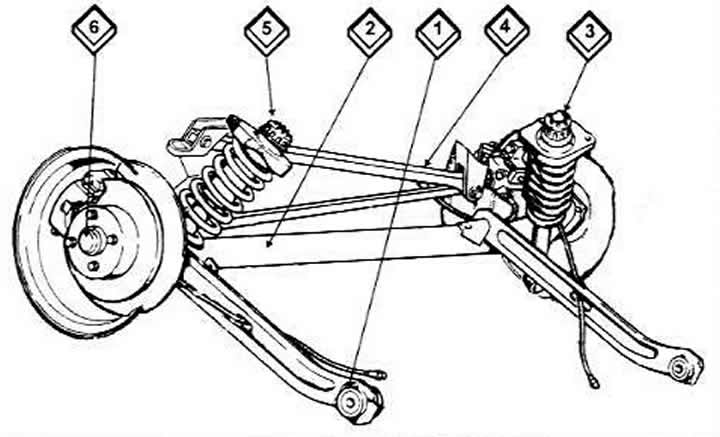
1 Longitudinal lever ("crank")
2 V-shaped bridge beam
3 Right shock absorber strut
4 Panhard rod
5 Left shock absorber strut
6 Wheel hub
Transverse inclination of kingpin (axis of rotation)
This concept refers to camber. This is a slight tilt of the pivot axis around which the entire unit rotates when turning. Between these two axes, the distance at the top is smaller than at the bottom. Camber and lateral tilt of the kingpin prevents wheel vibration.
Longitudinal inclination of kingpin (axis of rotation)
This refers to the inclined position of the axis of rotation in the longitudinal direction (along the car). This helps stabilize straight-line motion and prevents wheel vibration. In addition, it helps return the steering to the straight-line position after a turn.
Steering
The rotation of the steering wheel is transmitted to the steering gear, which is located behind the engine in front of the partition wall to the body, converts it into lateral movements so that the front wheels can be turned to the side. The Audi car has a rack and pinion steering. The pinion at the end of the steering column is engaged with the toothed rack and moves it depending on the steering wheel turn to the right or left. These movements are transmitted to two steering rods, fixed at the ends of the toothed rack and then to the steering knuckles of the wheels (steering knuckles) and from them onto the wheels.
To reduce the transmission of road irregularities to the steering wheel, a vibration damper is mounted on the steering mechanism on vehicles without steering.
Power steering
If there is a power steering, the steering rack also serves as a piston. It moves to the right or left under the action of the hydraulic fluid pumped by the pump. The direction in which the fluid is pumped is determined by the rotation of the steering wheel. This movement is transmitted to the valve system, which regulates the direction and amount of fluid flow.
The pressure in the hydraulic system is created by the impeller of the pump of the central hydraulic device, which is driven by a V-belt.
The suspensions of both wheels are connected by means of an open-bottomed steel support. It, in turn, is held by a crank, which is hinged at the front to the body. The properties similar to those of a stabilizer. The bridge has due to the fact that the cross beam (support) is not rigid, but bends to a certain extent.
The rear axle control during curved driving on Audi models is taken over by the so-called Panhard rod. It lies parallel to the axle cross beam and is pivotally connected to it and to the body. Thus, it can take the lateral force of the axle, but also, due to its position, can follow all changes in driving conditions.
To provide spring support and dampen vibrations, the same shock absorber struts located at the ends of the axle serve here as on the front axle.
(The original article is available on the website AudiManual)