



The engine is pulled out upwards without the gearbox. To do this, you will need a pulley block (hoist), which you can hang firmly at a sufficient height. It is even better if you have an assistant who already has experience.
Before starting the actual work of removing the engine, it is necessary to remove all interfering parts of the car: the hood, lower engine protection, air filter housing, battery and, if necessary, the radiator.
Since there are a huge number of electrical wires and vacuum lines installed in the Audi-100, you should first mark them all in order to finally install them all in the right place.
Before disconnecting the battery, you must make sure that you have the anti-theft code number for your car radio.
The battery should only be disconnected when the ignition is switched off, otherwise the control units may be damaged.
Before finally disconnecting the engine, it is necessary to place a support underneath the gearbox or slightly lift it together with the still-built engine. In the workshop, a special tool is used for this, which rests against the edge of the car wing mount.
The engine itself is equipped with suspension eyes, into which a lifting tool can be inserted. Make sure that the cable is carefully secured.
Tightening torques

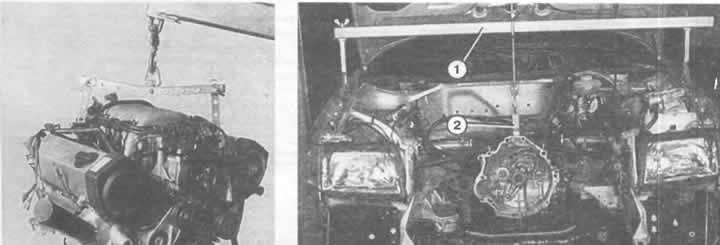
Both illustrations show two important steps in removing the engine (6-cylinder engine shown): in the workshop the engine is removed using such a device for lifting the engine (fig. on the left). For this purpose only, the engine has mounting eyes, into which, of course, both chains and ropes can be inserted. The image on the right shows the so-called support device (1), which is connected to the gearbox holder (2). The idea is to support the gearbox, which would otherwise sink downwards when the engine is removed. The same effect can be achieved by placing a support underneath the gearbox.