



Table of contents: Models with 2.8-liter 6-cylinder… ↓ Removal a variable length intake… ↓ Removal (with a 2.6-liter 6-cylinder… ↓
A long intake manifold with a small diameter provides high torque already at low speeds. For high engine power at high speeds, on the contrary, a short intake manifold with a large cross-section is required.
Models with 2.8-liter 6-cylinder engine
To combine the two, Audi engineers have developed a new variable-length intake manifold. Depending on the operating mode, six flaps are opened and closed inside it. This means that each cylinder is provided with an intake manifold of different lengths and cross-sections, or an intake manifold for torque (long pipe with small diameter), or a power intake manifold (short pipe with large cross-section).
All six flaps are vacuum-actuated and controlled depending on engine speed: up to 4,000 rpm they remain closed to achieve high torque. Above 4,000 rpm they are fully open to achieve high power. Below 4,000 rpm, the torque intake manifold can achieve up to 30 Nm compared to the power intake manifold.
The 2.8-liter engine develops its maximum torque of 245 Nm at 3000 rpm, provided that AI-95 gasoline is used; with the use of AI-98 its torque increases to 250 Nm. In the range from 2000 rpm to 5500 rpm the torque develops to be not less than 220 Nm.
Checking the operation of the variable length intake manifold
Start the engine and increase the speed to more than 4000 rpm.
Observe the membrane mechanism of the intake manifold switch: the drive rod should now move back.
If this is not the case, you need to check the vacuum hoses for leaks. If they are OK:
Check the membrane mechanism: attach a spare vacuum hose to the mechanism connection and suck it in firmly with your mouth.
If the rod does not move and/or a lot of air is sucked in, the membrane mechanism is faulty. Replace it. If the mechanism is OK.
Check the variable intake manifold switching valve: remove both vacuum hoses from the valve. Attach a spare vacuum hose to the tip of the valve intake pipe.
Forcefully suck air from the spare vacuum hose with your mouth. It should be impossible to suck air in (obstruction).
Start the engine and increase the speed to significantly exceed 4000 rpm.
Again, suck in air strongly through your mouth. Now sucking in air should be possible (cross-country ability).
If you still haven't been able to find out where the fault is hiding (which in itself is quite incredible), then the workshop should check the controls.
Remove the engine protection.
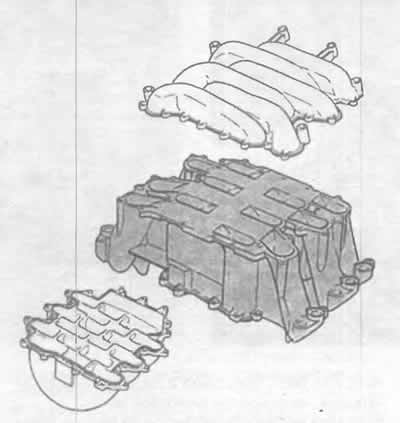
The 2.6-liter 6-cylinder engine does not have a variable-length intake manifold. Its intake manifold consists of the parts shown in the figure. During the design, special attention was paid to the low weight of the manifold.
Removal a variable length intake manifold with a 2.8L V8 engine
Remove the spark plug caps and take the high-voltage wires out of the holders.
Remove the fuel distribution line together with all injection nozzles.
Remove the air intake hose.
Remove the idle speed control valve or disconnect the plug.
Remove all vacuum/PCV hoses from the intake manifold and throttle body.
Remove the throttle cable and the throttle potentiometer plug.
Loosen the bolts in the opposite order to that shown in the figure below on the right.
Remove the intake manifold together with the throttle body.
Installation: Replace sealing gaskets.
Tighten the intake manifold mounting bolts in the four-step sequence shown in the illustration below.
First stage: 5 Nm, second stage: 10 Nm, third stage: 20 Nm, fourth stage: 20 Nm again.
Removal (with a 2.6-liter 6-cylinder engine)
Logically, the removal process is identical to the similar process for the 2.8-liter engine.
The tightening sequence for the mounting bolts should be the same as for the 2.8-liter engine.
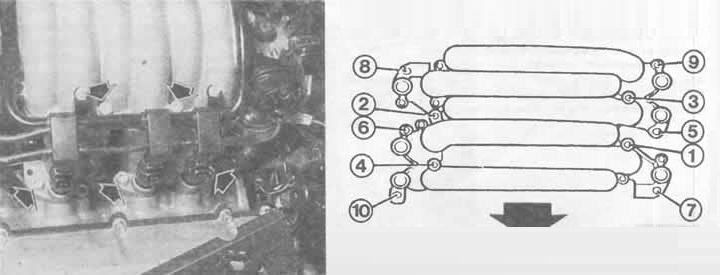
The intake manifold mounting bolts for the 2.6L and 2.8L 6-cylinder engines must be tightened in the sequence shown in the illustration below. This is the only way to prevent the intake manifold from being tilted during installation. The illustration on the left shows the same mounting bolts again in the engine.
(The original article is located on the online resource: AUDImanual)