Repair Chevrolet Repair Toyota Repair Honda Repair AvtoVAZ Repair Mercedes-Benz Repair BMW Repair Opel
Home  |  Contacts  |  Sitemap  |    
English Русский
Български
Беларускі
Український
Српски
Hrvatski
Română
Polski
Slovenský
Magyar
AudiManual.ru


  • AUDI 80
  • AUDI 100
  • AUDI A3
  • AUDI A4
  • AUDI A6
  • AUDI A8
  • AUDI Q
  • OTHER
  • ARTICLES
B8 (2007-2015) B7 (2004-2008) B6 (2000-2006) B6 (2000-2006, petrol) B5 (1994-2001) B5 (1994-2001, petrol)

Switchable intake manifold (Audi A4 B5)

  • Home
  • Audi A4
  • B5 (1994-2001, petrol)
  • Power unit
  • Fuel system
  • Switchable intake manifold
            0
Table of contents: Six-cylinder engine with a… ↓ Checking the operation of the… ↓ Removal the switching intake manifold ↓ Removal the intake manifold of a… ↓
Switchable intake manifold


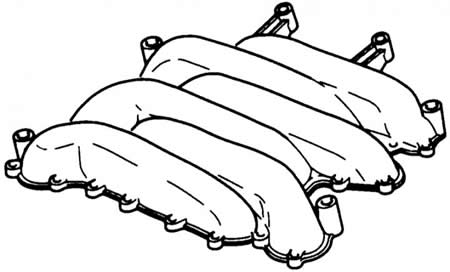
The 2.6-liter six-cylinder engine does not have a switchable intake manifold. Its intake manifold consists of the units shown here. Particular attention has been paid to the low weight of the design.

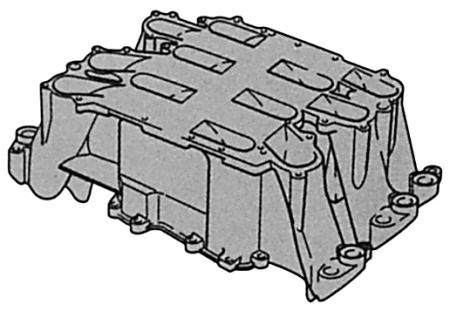
The 2.6-liter six-cylinder engine does not have a switchable intake manifold. Its intake manifold…


The 2.6-liter six-cylinder engine does not have a switchable intake manifold. Its intake manifold…


The 2.6-liter six-cylinder engine does not have a switchable intake manifold. Its intake manifold…


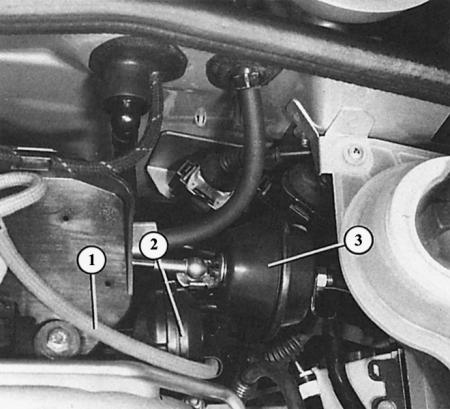
The flaps of the variable intake manifold on the 2.8-liter six-cylinder engine are actuated by a vacuum box (2) via a vacuum hose (1). This box should not be confused with the vacuum box (3) of the cruise control system (additional equipment).


The flaps of the variable intake manifold on the 2.8-liter six-cylinder engine are actuated by a…


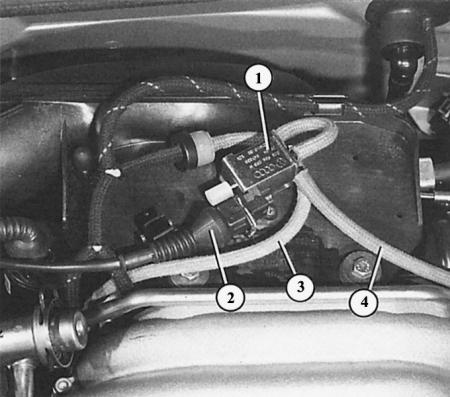
The valve (1) of the changeover of the register intake manifold determines whether there should be a vacuum in the vacuum box. It receives a signal about the changeover via the line (2) from the injection control unit. Then the vacuum from the pipe (3) of the intake manifold can move to the pipe (4) of the vacuum box. The valve is installed behind the intake manifold on the so-called noise absorber of the intake air.
The valve (1) of the changeover of the register intake manifold determines whether there should be…


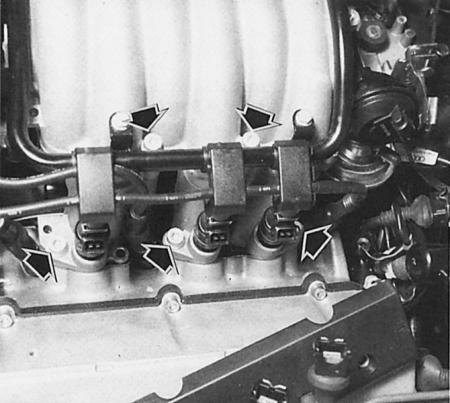
The photograph shows the intake manifold mounting bolts (arrows).
The photograph shows the intake manifold mounting bolts (arrows).


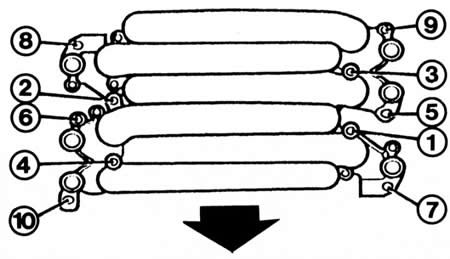
Shown here is the sequence in which the intake manifold mounting bolts of the 2.6 and 2.8 liter six-cylinder engine are tightened. This is the only way to avoid deformation of the intake manifold during installation.


Six-cylinder engine with a displacement of 2.8 liters


A long intake pipe with a small diameter ensures high torque even at low engine speeds. In contrast, a short intake pipe with a large cross-section is required to ensure high engine power at high engine speeds. In order to combine both, Audi has developed a switchable intake manifold. It closes and opens six flaps depending on the situation. This means that each cylinder has one of the intake pipes with different lengths and diameters at its disposal: either an intake manifold for torque (long tube with small diameter) or intake manifold to support power (short tube with large diameter).

All six flaps are actuated by negative pressure and are controlled depending on engine speed: up to 4,000 rpm they are closed to ensure high torque. Above 4,000 rpm they are fully open to support power. Below 4,000 rpm, the intake manifold gains up to 30 Nm of torque compared to the power intake manifold.

The 2.8-litre engine produces a maximum torque of 245 Nm at 3,000 rpm when using Euro-Super petrol (euro-Super); with super plus petrol (98 ROZ) the torque increases to 250 Nm. In a wide range from 2000 to over 5500 rpm, at least 220 Nm are available.

Checking the operation of the switching intake manifold


The intake manifold switch should only be checked if there is a lack of power. First, check the ease of movement of the lever mechanism by hand. After that, the functional ability should be checked: this is done with the engine warmed up:

1. Start the engine, raise the speed significantly above 4000 rpm.


2. Observe the vacuum box: the control rod should be pulled back.

3. If not, check the vacuum hoses for leaks. If they are OK:

4. Check the vacuum box: put the spare hose on the box connection unit, suck vigorously with your mouth.

5. If the control rod does not move and/or a lot of air can be sucked in, the box is faulty. Replace it. But if the box is in good condition:

6. Check the intake manifold changeover valve: Remove both vacuum hoses from the valve. Attach a replacement hose to the intake manifold changeover valve connector.

7. Vigorously suck on the spare vacuum hose with your mouth. No air should be sucked in (no passability).

8. Start the engine, raise the speed significantly above 4000 rpm.

9. Suck vigorously on the hose again. Air should now be sucked in (there is cross-country ability).

10. If the source of the malfunction has not yet been found (which is pretty incredible), then you need to check the settings in the workshop.

Removal the switching intake manifold


Six-cylinder engine with a displacement of 2.8 liters


1. Remove the engine cover.

2. Disconnect the spark plug connectors and remove the high-voltage wires from the brackets.

3. Remove the fuel distribution pipe together with all injection valves (section MPI/MPFI injection system).

4. Remove the inlet hose.

5. Remove the idle speed control valve or disconnect the connector.

6. Remove all vacuum hoses/crankcase vent hoses at the intake manifold and throttle body.

7. Remove the throttle cable and its potentiometer connector.


8. Loosen the bolts in the reverse order of tightening in the photo above.

9. Remove the intake manifold with the throttle valve pipe.

10. Installation: replace the gaskets.

11. Tighten the intake manifold mounting bolts according to the sequence in the figure above in four stages. Stage 1: 5 Nm, Stage 2: 10 Nm, Stage 3: 20 Nm, Stage 4: 20 Nm again.

Removal the intake manifold of a 2.6L V6


1. Dismantling is carried out in the same way as for an engine with a working volume of 2.8 liters.

2. The same rules apply to the tightening sequence of the mounting bolts as for the 2.8L engine.

[The text is based on materials from the website «AudiManual»]
The article was checked by auto expert Georgy Rodionov
This article is available at russian, bulgarian, belarusian, ukrainian, serbian, croatian, romanian, polish, slovak, hungarian

Share information:
Previous articles
Audi A4 B5: Fuel system
Next articles

Preheating of intake air
Blowing out the air filter insert
Removal the air filter insert
Replacing the fuel filter


Similar articles on other Audi car models:
Intake manifold — removal and installation Audi 80 B3 (1986-1991, petrol)
Air filter, intake manifold and fuel system parts Audi 100 C3 (1982-1990, petrol)
Intake manifold Audi A6 C4 (1994-1997)
Intake manifold Audi A8 D2 (1994-2002)
Upper part of the intake manifold Audi Q5 Type 8R (2008-2017)
Removal and installation the intake manifold Audi A2 (1999-2005)
Link to this page in different formats


Visitor comments

No comments yet


How much will 23 + 48 =


A4(B8, 2007-2015) 
  • General information
  • Operating instructions
  • Power unit
  • Petrol engines 1.8 l
  • Petrol engines 1.8/2.0 l
  • Petrol engines 3.0 l
  • Petrol engines 3.2 l
  • Fuel system (petrol)
  • Diesel engines 2.0 l (CA*)
  • Diesel engines 2.0 l (CJCB)
  • Diesel engines 2.7/3.0 l
  • Diesel engines 3.0 l
  • Fuel system (diesel)
  • Transmission
  • Manual gearbox 0B1
  • Manual gearbox 0B2
  • Manual gearbox 0B3
  • Manual gearbox 0B4
  • Automatic transmission 0B5
  • Automatic transmission 0B6
  • Automatic transmission 0AW
  • All-wheel drive system
  • Chassis
  • Front suspension
  • Rear suspension
  • Brake system
  • Steering system
  • Body
  • Exterior
  • Interior
  • Seats
  • Doors, locks and windows
  • Security system
  • Heating and air conditioning
  • Electrical equipment
  • Audio system
  • Power devices
  • Equipment and devices
  • Lighting and lamps
  • Electrical circuits
 
A4(B7, 2004-2008) 
  • General information
  • Introduction to manual
  • Troubleshooting
  • Operating instructions
  • Maintenance
  • Power unit
  • Petrol engines 2.0 (ALT)
  • Petrol engines 2.0 (TFSI)
  • Petrol engines 1.8 (MPI)
  • Diesel engines
  • Cooling system
  • Air conditioner
  • Fuel and exhaust system
  • Ignition system
  • Starting and charging
  • Transmission
  • Clutch
  • Manual gearbox
  • Automatic gearbox
  • Drive shafts
  • Chassis
  • Brake system
  • Front suspension
  • Rear suspension
  • Steering
  • Body
  • Exterior
  • Interior
  • Electrical equipment
  • Equipment and devices
  • Lighting and signaling
  • Windscreen wipers and washers
  • Electrical diagrams
  • Electrical diagrams (since 2007)
 
A4(B6, 2000-2006) 
  • General information
  • Vehicle Description
  • User manual
  • Maintenance
  • Power unit
  • Gasoline engine
  • Diesel engine
  • Lubrication system
  • Cooling system
  • Supply system
  • Injection system
  • Exhaust system
  • Ignition and control
  • Transmission
  • Gear box
  • Clutch and drive shafts
  • Chassis
  • Brake system
  • Car suspension
  • Steering
  • Body
  • Heating and ventilation
  • Exterior (external elements)
  • Interior (internal elements)
  • Electrical equipment
  • Power devices
  • Lighting and appliances
  • Electrical circuits
 
A4(B6, 2000-2006, petrol) 
  • General information
  • Introduction to the guide
  • Car care
  • Power unit
  • Engine repair
  • Lubrication system
  • Cooling system
  • Injection and control system
  • Ignition system
  • Power and exhaust system
  • Transmission
  • Clutch and drive shafts
  • Car gearbox
  • Chassis
  • Suspension and wheels
  • Steering
  • Brake system
  • Body
  • Interior
  • Exterior
  • Electrical equipment
  • Equipment and devices
  • Lighting and signaling
  • Power devices
  • Electrical circuits
 
A4(B5, 1994-2001) 
  • General information
  • Introduction to the guide
  • Car care
  • Maintenance (gasoline)
  • Maintenance (diesel)
  • Power unit
  • Gasoline engines
  • Diesel engines
  • Engine overhaul
  • Cooling system
  • Fuel injection (gasoline)
  • Fuel system (diesel)
  • Exhaust system
  • Ignition system
  • Transmission
  • Clutch
  • Mechanical gearbox
  • Automatic gearbox
  • Drive shafts
  • Chassis
  • Brake system
  • Car suspension
  • Steering
  • Body
  • Exterior
  • Interior
  • Doors, locks and windows
  • Heating and ventilation
  • Electrical equipment
  • Power devices
  • Equipment and devices
  • Electrical circuits
 
A4(B5, 1994-2001, petrol) 
  • General information
  • Vehicle description
  • Maintenance
  • Power unit
  • Engine repair
  • Turbocharging
  • Exhaust system
  • Cooling system
  • Ignition system
  • Fuel system
  • Motronic injection system
  • MPI and MPFI injection system
  • Transmission
  • Clutch
  • Gearbox and shafts
  • Chassis
  • Steering
  • Car suspension
  • Brake system
  • Wheels and tires
  • Body
  • Heating and ventilation
  • Body parts
  • Electrical equipment
  • Fuses and relays
  • Power devices
  • Lighting and lamps
  • Tools and devices
  • Electrical circuits
 
AudiManual.ru © 2017-2026 · Mobile version · Feedback · Sitemap: EN BG BY UA RS HR RO PL SK HU · Site search · News and articles
80 B2 · 80 B3 petrol · 80 B3 · 80 B4 · 100 C3 diesel · 100 C3 petrol · 100 C3 · 100 C4 petrol · 100 C4 · A3 Type 8L · A4 B5 petrol · A4 B5 · A4 B6 petrol · A4 B6 · A4 B7 · A4 B8 · A6 C4 · A6 C5 · A6 C5 Allroad · A8 D2 · Q5 Type 8R · Q7 Typ 4L · Audi A2 ·
This site uses cookies 🍪. Click the button to accept this fact.