



Table of contents: Problems with gear shifting ↓ Gear shift adjustment ↓
Torque from the engine is transmitted through the clutch to the primary shaft of the gearbox. This primary or drive shaft contains six gear wheels (including reverse gear), which are in constant engagement with six gears on the secondary shaft. The gears can rotate freely until one of them, when a certain gear is engaged, connects with the corresponding gear on the primary shaft. The ratio of the number of teeth of the corresponding pair of gears forms the required gear ratio. The Audi-100 is equipped, like all passenger cars, with fully synchronized gears for forward movement. In addition, the reverse gear is synchronized to prevent grinding when it is engaged.
The gears on the primary and secondary shafts are located on needle bearings. Therefore, there is no rigid connection between the shafts and the gears. The gears always remain in mesh. When shifting gears, a connection is formed not between the gears, but between the gear and the shaft. In order to synchronize the revolutions of the shaft and the gear, the following technique is used: one part of the shaft slides against a part of the other shaft using friction elements. Due to friction, the faster shaft is slowed down until it becomes possible to create a torque-transmitting connection during synchronous movement. Since fractions of a second are still needed for synchronization, the driver should not "tear" the gearshift handle with force, especially when starting a cold engine with still thick transmission oil.
Problems with gear shifting
If the gears are difficult to engage or shifting becomes difficult after a long drive, the cause of these problems is most likely the clutch, not the gearbox (see the list of faults in Chapter "Clutch"). The adjustment of the shift mechanism described below only serves to bring the shift lever to the correct position and thus optimize the shift stroke.
Gear shift adjustment
Set the gear shift lever to neutral position.
Unscrew the ball head.
Remove the gear shift lever cover.
Under the car, remove the cross member at the front and rear and unscrew the heat shield to expose the gearshift lever.
Under the vehicle, loosen the Allen bolt at the bottom end of the shift lever slightly to allow the shift lever and shift fork shaft to rotate relative to each other.
Position the gear shift lever vertically and adjust it so that both protrusions of the ball joint are at the same distance from the bearing housing.
Carefully tighten the screw under the vehicle so as not to change the adjusted position.
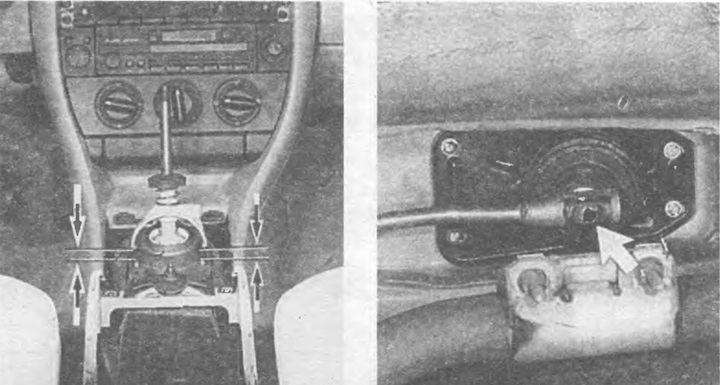
Gear shift adjustment
Left: The distance between the limiter and the body should be the same on both the right and left.
Right: To adjust, loosen the screw marked with an arrow on the gearshift control rod and lever system underneath the vehicle.
Finally, check the functionality:
The gear shift lever handle in the idle position should be at the level of third or fourth gear.
Shift all gears. While doing this, keep an eye on the reverse gear lock function.
If necessary, loosen the hinge housing screws and turn it slightly.