



Table of contents: Hydraulically operated switches ↓ Troubleshooting ↓ Checking the control unit ↓ Replacing a hydraulic switch ↓
The engine oil pressure in the Audi-100 is controlled by two hydraulically operated switches and a control unit with a buzzer (the latter two are combined in a mini-check system). In simple terms, control is carried out as follows:
When the ignition is on, power is constantly supplied to one of the contact terminals of the oil pressure indicator.
If the oil pressure (with the engine not running) below 0.3 bar - the contacts of the switch with a 0.3 bar hydraulic drive are closed, due to which a connection to the "ground" is created to the second contact terminal of the indicator, the lamp lights up (flashes).
If the oil pressure rises after the engine starts, the contacts in the switch open and the lamp goes out.
Additional monitoring is performed on models with 4- and 5-cylinder engines, as well as on 6-cylinder engines up to 7/91 by means of a 1.8 bar hydraulic switch, on models with 6-cylinder engines from 8/91 by means of a 2.5 bar hydraulic switch. The hydraulic switch and control unit are part of the mini-check system: if the oil pressure drops below the switching pressure of 1.8 or 2.5 bar, its contacts close, thereby creating a ground connection to the control unit in the mini-check system, the 0.3 bar hydraulic switch is not yet switched on at this time.
The mini-check system allows the indicator lamp to flash only when the oil pressure drops below the switching pressure for longer than 1 second, and the engine speed is more than 2100 rpm.
In addition, the mini-check system emits a warning noise signal. The purpose of all this is to prevent engine damage due to too low oil pressure (for example, because its level is too low).
Hydraulically operated switches
There is a significant difference in the switches with the 6-cylinder engine: Up to 7/91, the 1.8 bar switch was mounted at the rear of the left cylinder head. Since 8/91, it has been moved down to the left side of the engine cylinders, where, however, higher oil pressure exists, which necessitates the installation of a 2.5 bar hydraulic switch.
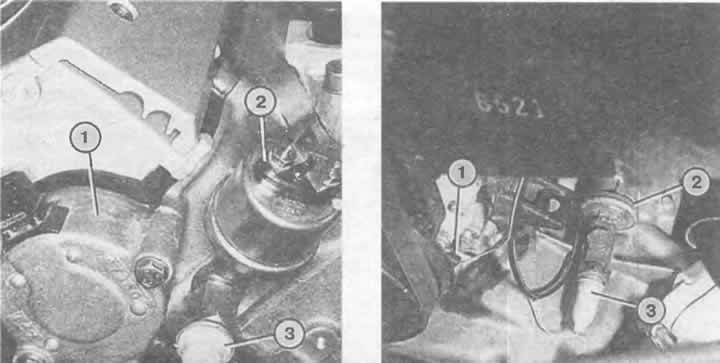
The insulators of hydraulically operated switches are painted in different colours.
The switch with a hydraulic drive of 0.3 bar is painted brown. In cars equipped with a pressure gauge, in place of this switch there is an oil pressure sensor, additionally equipped with a switching contact for the indicator.
Hydraulic switch 1.8 bar painted white (with 4- and 5-cylinder engines and 6-cylinder engines up to 7/91).
The switch with hydraulic drive 2.5 bar is painted red (with 6-cylinder engine from 8/91).
Troubleshooting
If the indicator flashes (possibly with additional buzzer) with the engine running, stop immediately!
Stop the engine immediately, check the oil level. If it is normal:
Disconnect the wire from the 0.3 bar hydraulic switch, turn on the ignition: if the indicator continues to light, this means that there is a short circuit to ground in the wiring - not dangerous for the engine.
Disconnect the wire from the 1.8 bar hydraulic switch (or 2.5 bar) and connect to ground, turn on the ignition: if the indicator continues to light or the warning buzzer continues to sound, then the malfunction concerns the mini-check system or wiring - not dangerous for the engine.
If you observe other effects not listed above, then you can suspect that the engine oil supply is disrupted. Then the car must be towed!
One of the hydraulic switches may be faulty. Sometimes it will turn back on if you wiggle its plug tab.
If the oil pressure indicator does not flash after the ignition is turned on:
First check the fuse (chapter "Body electrical system").
Disconnect the wire from the 0.3 bar hydraulic switch and connect it to ground: if the indicator now lights up, the switch was faulty. If it still does not respond, the wiring or the bulb itself is faulty.
Checking the control unit
Disconnect the wire from the 1.8 bar hydraulic switch and let it hang in the air. Start the engine and let it run at about 2500 rpm.
After 2 seconds of operation, the indicator should flash and the buzzer should sound three times. Otherwise, the mini-test system is faulty - replace!
If only the indicator flashes, but the buzzer does not sound, then the wiring from the generator terminal 61 (D+) is interrupted.
If the indicator light flashes and the buzzer sounds with the wire connected to the hydraulic switch at an engine speed of approximately 2500 rpm, then the 1.8 bar (2.5 bar) switch is faulty - provided that the engine oil level is OK.
Leave the engine running at idle speed, disconnect the wire from the 1.8 bar switch (or 2.5 bar) and leave it hanging in the air. If the light and buzzer are now triggered, then the wiring from terminal 1 is interrupted (rotation speed signal) to the mini-check system.
Replacing a hydraulic switch
Purchase the required switch with brown, white or red insulation and one sealing ring.
Tighten the hydraulic switch to 25 Nm.