



Table of contents: TO #24 ↓ Tire wear pattern ↓
TO #24
It is best to carry out such inspection with the vehicle raised, for example, when changing the oil at a gas station.
Rotate each wheel completely.
You can remove foreign bodies such as small stones from the tread profile slots using a narrow screwdriver without damaging the tire.
According to regulations, since 1992 the profile depth of tyres must be at least 1.6 mm across the entire width.
For safety reasons, you should change your tires when they are worn down to 3 mm, because the wide tires on the Audi 100 "float" on wet road surfaces earlier than the narrower tires on older models.
To monitor wear, there are elevations in the tread grooves that run at regular intervals perpendicular to the tread running track. They are marked on the sidewall of the tire with the letters "TWI" (tread wear indicator).
If these elevations are at the same level as the profile grooves, then the remaining profile is 1.6 mm and the tire must be changed immediately.
You can understand a lot from the type of wear on the profile, described in the next section.
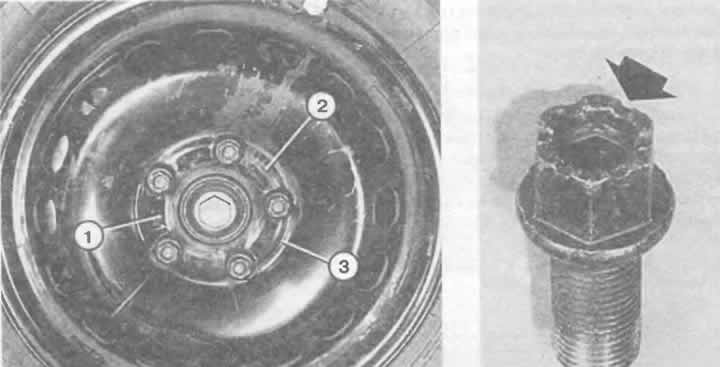
Left: This is what a steel rim for an Audi-100 looks like. The following markings are stamped into the metal:
1 - rim designation;
2 — overhang value;
3 — part number.
Right: Suitable wheel bolts for steel and alloy wheels from Audi can be identified by the recesses on the bolt head.
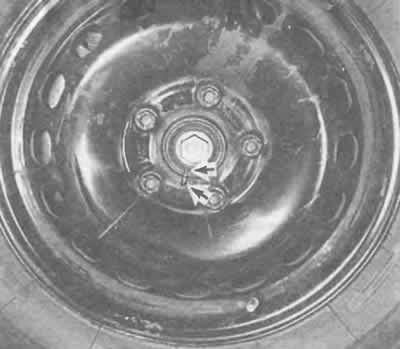
If a wheel is installed that is in good condition and balanced on the car - for example after checking the brakes, it should be tightened on the wheel hub in the same position as before removal. To do this, mark the position on the rim and wheel hub. The arrows show the mark made by the driver.
Tire wear pattern
Front tires that are more worn on the outside are not unusual in the Audi 100. The reason is the increased load on this area of the tread when cornering.
Tires that are worn on one side, however, may also indicate improper wheel alignment; especially if only one tire is worn in this way.
Heavy wear in the middle of the tire indicates overinflation. This effect is especially noticeable on the rear wheels. Or you drive a lot at high speed, causing the tread to curve.
If the tire's profile is more worn on both outer sides than in the middle, the tire pressure has been too low for a long time
Uneven, spotty wear on the tire profile indicates a defective shock absorber.
If uneven wear appears only in certain areas, the wheel is not balanced or the tire frame is damaged.
The only spot with severe profile wear was formed as a result of braking with a locked wheel, the so-called "brake mark". Only for models not equipped with ABS, with a faulty ABS or with the ABS turned off.
[The original text of the material can be found on the website: Audimanual.ru]