



If the coolant temperature gauge needle does not move to the right when the engine overheats in diesel models, the coolant temperature gauge sensor needs to be checked.
Execution order
1. Disconnect the wiring harness from the coolant temperature sensor.
Models with petrol engines
2. Short the yellow-blue wire to ground using an additional wire and turn on the ignition. If the coolant temperature indicator light on the instrument cluster lights up, the sensor is faulty and needs to be replaced.
3. If the lamp does not light, check it. To do this, remove the instrument cluster (see subsection 12.1.5.15).
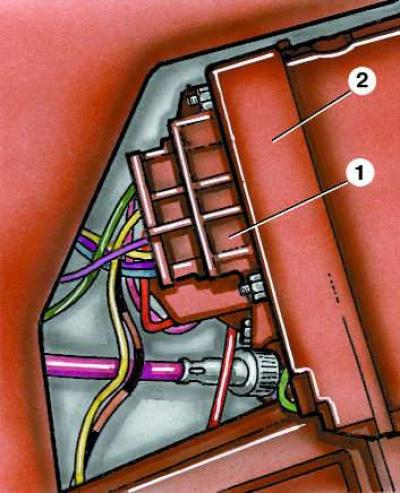
4. If the lamp has not burned out, check the electrical circuit. To do this, disconnect the wire from the negative terminal of the battery. Then disconnect the 12-pin connector (1) from the instrument cluster (2) and check the circuit resistance with an ohmmeter by connecting it to contact "2" of connector 1 and the yellow-blue wire connected to the sensor. The resistance should be zero. If it is infinity, there is a break in the circuit.
Models with diesel engines
5. Short the yellow-blue wire to ground using an additional wire and turn on the ignition. If the coolant temperature gauge needle on the instrument cluster moves to the right, the sensor is faulty and must be replaced.
6. If the pointer does not move to the right, you need to check the electrical circuit. To do this, disconnect the wire from the negative terminal of the battery. Then disconnect the 12-pin connector from the instrument cluster and check the circuit resistance with an ohmmeter, connecting it to contact "2" of the connector and the yellow-blue wire connected to the sensor. The resistance should be zero; if it is infinity, there is a break in the circuit.
7. If there is no break in the circuit, then the fuel level indicator is faulty and needs to be replaced.