
Repair Chevrolet Repair Toyota Repair Honda Repair AvtoVAZ Repair Mercedes-Benz Repair BMW Repair Opel
Home  |  Contacts  |  Sitemap  |    
English Русский
Български
Беларускі
Український
Српски
Hrvatski
Română
Polski
Slovenský
Magyar
AudiManual.ru


  • AUDI 80
  • AUDI 100
  • AUDI A3
  • AUDI A4
  • AUDI A6
  • AUDI A8
  • AUDI Q
  • OTHER
  • ARTICLES
C4 (1990-1994) C4 (1990-1994, petrol) C3 (1982-1990) C3 (1982-1990, petrol) C3 (1982-1990, diesel)

Adjusting the Keihin 26-30 DC carburetor (Audi 100 C3)

  • Home
  • Audi 100
  • C3 (1982-1990, petrol)
  • 4 cylinder engine
  • Supply system
  • Adjusting the Keihin 26-30 DC carburetor
            0
Table of contents: Adjusting the starting clearance of… ↓ Adjusting the opening of the… ↓ Adjusting the opening of the… ↓ Adjusting the accelerator pump ↓ Adjusting engine idle speed ↓ Adjusting CO content without a gas… ↓ Adjusting CO content using a gas… ↓

Adjusting the starting clearance of the air damper


Pull the choke control handle out fully; in this case, the air damper control lever should be at the stop.

Press the trigger rod all the way down.

Measure the starting gap of the air damper with a set of feeler gauges, which should be within 4.6±0.15 mm

If the starting clearance of the air damper does not fit within the specified limits, achieve the required clearance by bending the adjusting fork on which the curved end of the starting device rod rests (see photo).
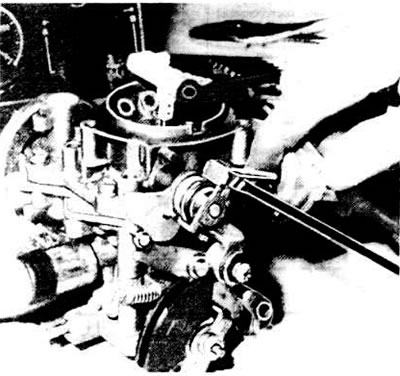
Adjusting the starting gap of the air damper

Adjusting the starting gap of the air damper


Adjusting the opening of the throttle valve of the 1st chamber at idle speed of a cold engine


Start and warm up the engine.

Attach the tachometer and remove the air filter.

Pull the choke control handle out fully.

Turn the control lever to completely close the air damper.


Measure the engine crankshaft speed, which should be within 4200±200 rpm.

If necessary, set the required engine mode by moving the throttle control levers of the 1st chamber.
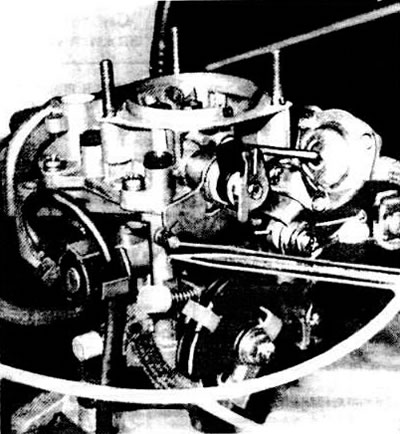
Adjusting the opening of the throttle valve of the 1st chamber in the idle mode of a cold engine

Adjusting the opening of the throttle valve of the 1st chamber in the idle mode of a cold engine


Adjusting the opening of the throttle valve of the 2nd chamber


The position of the throttle valve of the 2nd chamber is adjusted at the manufacturer, but if the adjustment is disturbed, the position can be restored as follows:
  • remove the carburetor;
  • open the air damper fully;
  • set the throttle valve of the 1st chamber to the idle position and fix it;
  • unscrew the 2nd chamber throttle valve limit screw so that it moves away from the 2nd chamber throttle valve control lever. Then screw in the limit screw until it touches the lever, then screw in the limit screw another 3/4 turn;
  • lock the limit screw with a drop of paint or a special compound;
  • put the carburetor back in place;
  • adjust the engine idle speed.

Adjusting the accelerator pump


Remove the carburetor.

Place a measuring cup with a funnel under the carburetor.

Slowly open and close the throttle valve of the first chamber ten times, thereby activating the accelerator pump.


Measure the amount of fuel flowing into the measuring cup, which should be within 7.8±1.2 cm³, i.e. 0.78±0.12 cm per cycle.

If there is a deviation from the norm, achieve the required performance of the accelerator pump by changing the position of the pump drive lever stop.

Adjusting engine idle speed


Before adjusting the engine idle speed, perform the following operations:
  • make sure the choke control handle is fully depressed;
  • warm up the engine. To do this, let the engine run at about 2000 rpm until the thermostat opens. Never warm up the engine at idle, as if the engine runs for several minutes at idle, the carbon monoxide measurements in the exhaust gases will be distorted;
  • check the air filter element for cleanliness and replace it with a new one if necessary (when adjusting the engine idle speed, do not remove the air filter);
  • check the functionality of the ignition system and the ignition timing;
  • check for air leaks, paying particular attention to the connection of the vacuum hoses and the condition of the throttle body gasket;
  • make sure there are no significant exhaust leaks in the exhaust tract;
  • make sure that powerful current consumers (electric fan of the engine cooling system, headlights, rear window heating element, etc.) turned off.

Using the mixture quantity adjusting screw (see photo), set the crankshaft speed within 700-800 rpm.

Precise adjustment of the carbon monoxide (CO) content in exhaust gases is performed only with the help of special equipment. If it is not available, it is permissible to regulate the CO content by acting as indicated below.
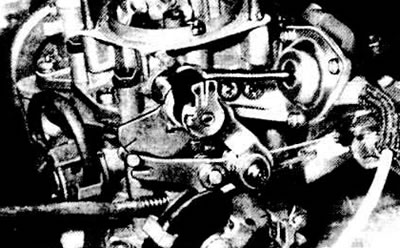


Adjusting the idle mixture quantity

Adjusting the idle mixture quantity


Adjusting CO content without a gas analyzer


Set the engine crankshaft speed to 700-800 rpm.

Remove the plug of the mixture quality (composition) adjusting screw (see photo) and, by turning it, achieve the maximum crankshaft speed at idle.
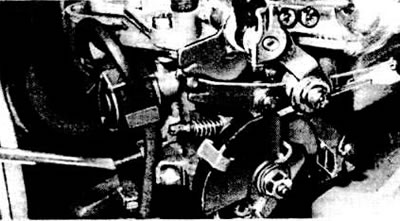
Adjusting the quality (composition) of the idle mixture

Adjusting the quality (composition) of the idle mixture


Use the mixture quantity adjusting screw to restore the crankshaft speed to 700-800 rpm. Repeat the above operations until the engine runs stably at idle.

Using the mixture quality (composition) adjusting screw, reduce the crankshaft speed by 50 rpm.

Place a plug on the mixture quality (composition) adjustment pint.

Adjusting CO content using a gas analyzer


Set the engine crankshaft speed to 700-800 rpm.


Remove the plug of the mixture quality (composition) adjustment screw and, by turning it, achieve a CO content in the exhaust gases within 0.5-1.5%.

If necessary, restore the crankshaft speed to 700-800 rpm using the mixture quantity adjusting screw.

Repeat these operations until the specified values of crankshaft speed and CO content are obtained.

After adjustment, replace the plug of the mixture quality (composition) adjustment screw.
The article was checked by auto expert Maxim Rybakov
This article is available at russian, bulgarian, belarusian, ukrainian, serbian, croatian, romanian, polish, slovak, hungarian

Share information:
Previous articles
Audi 100 C3: Supply system
Next articles

Keihin 26-30 DC Carburetor — Operating Principle
Keihin 26-30 DC Carburetor Parts
Air filter, intake manifold and fuel system parts
Pierburg 2E2 Carburetor Parts
Exhaust system Details


Similar articles on other Audi car models:
Checking and adjusting the Keihin 26-30 DC carburetor Audi 80 B2 (1979-1986)
Checking the condition, adjusting and replacing windshield wipers Audi A3 Type 8L (1996-2003)
Adjusting the handbrake Audi A4 B5 (1994-2001, petrol)
Checking and adjusting idle speed, ignition timing and CO content Audi A6 C5 (1997-2004)
Adjusting the position of the cardan shaft Audi A8 D2 (1994-2002)
Adjusting the gear shift mechanism Audi Q5 Type 8R (2008-2017)
Headlights — checking adjustment, adjusting if necessary Audi A2 (1999-2005)
Link to this page in different formats


Visitor comments

No comments yet


How much will 21 + 44 =


100(C4, 1990-1994) 
  • General information
  • User manual
  • Power unit
  • Engine repair
  • Ignition system
  • Fuel system (gasoline)
  • Fuel system (diesel)
  • Lubrication system
  • Cooling system
  • Exhaust system
  • Transmission
  • Clutch
  • Car gearbox
  • Drive shafts
  • Chassis
  • Car suspension
  • Steering
  • Wheels and tires
  • Brake system
  • Body
  • Ventilation and heating
  • Body repair
  • Electrical equipment
  • Power devices
  • Lighting and appliances
  • Electrical circuits
 
100(C4, 1990-1994, petrol) 
  • General information
  • Operation and maintenance
  • Power unit
  • Engine repair
  • Exhaust system
  • Cooling system
  • Supply system
  • Air filter
  • Mono-Motronic injection system
  • Digifant injection system
  • KE-III-Jetronic and KE-Motronic
  • MPI and MPFI injection system
  • Transmission
  • Clutch
  • Car gearbox
  • Chassis
  • Suspension and steering
  • Brake system
  • Wheels and tires
  • Body
  • Exterior
  • Interior
  • Electrical equipment
  • Fuses and relays
  • Power devices
  • Ignition system
  • Lighting and signaling
  • Equipment and devices
  • Electrical circuits
 
100(C3, 1982-1990) 
  • General information
  • User manual
  • Maintenance
  • Specifications
  • Power unit
  • Engines 4-cylinder
  • Engines 5-cylinder
  • Diesel engine
  • Cooling system
  • Power system (carburetor)
  • Power system (injector)
  • Fuel system (diesel)
  • Transistor ignition system
  • Electronic ignition system
  • Transmission
  • Clutch
  • 4 speed gearbox 014
  • 5 speed gearbox 013 and 093
  • 5 speed gearbox 016 and 012
  • Shift mechanism KP 016
  • Automatic transmission
  • Front wheel drive
  • Chassis
  • Front suspension
  • Rear suspension
  • Steering
  • Brake system
  • Body
  • Body elements
  • Electrical equipment
  • Lighting and appliances
  • Power devices
  • Electrical circuits
 
100(C3, 1982-1990, petrol) 
  • General information
  • Maintenance and operation
  • 4 cylinder engine
  • Engine repair
  • Cooling and lubrication system
  • Supply system
  • Ignition system
  • 5 cylinder engine
  • Engine repair
  • Cooling and lubrication system
  • Supply system
  • Ignition system
  • Transmission
  • Clutch and drive shafts
  • 4 speed gearbox 014
  • 5 speed gearbox 013 and 093
  • 5 speed gearbox 016 and 012
  • Automatic gearbox
  • Chassis
  • Steering
  • Front suspension
  • Rear suspension
  • Brake system
  • Body
  • Body elements
  • Doors, locks and windows
  • Body repair
  • Electrical equipment
  • Equipment and devices
  • Power devices
  • Electrical circuits
 
100(C3, 1982-1990, diesel) 
  • General information
  • User manual
  • Maintenance
  • Troubleshooting
  • Power unit
  • Engine in a car
  • Engine removed
  • Cooling system
  • Fuel system
  • Exhaust system
  • Starting and charging
  • Preheating
  • Transmission
  • Clutch
  • Mechanical gearbox
  • Automatic gearbox
  • Drive shafts
  • Chassis
  • Brake system
  • Suspension
  • Steering
  • Body
  • Exterior
  • Interior
  • Electrical equipment
  • Equipment and devices
  • Electrical circuits
 
AudiManual.ru © 2017-2026 · Mobile version · Feedback · Sitemap: EN BG BY UA RS HR RO PL SK HU · Site search · News and articles
80 B2 · 80 B3 petrol · 80 B3 · 80 B4 · 100 C3 diesel · 100 C3 petrol · 100 C3 · 100 C4 petrol · 100 C4 · A3 Type 8L · A4 B5 petrol · A4 B5 · A4 B6 petrol · A4 B6 · A4 B7 · A4 B8 · A6 C4 · A6 C5 · A6 C5 Allroad · A8 D2 · Q5 Type 8R · Q7 Typ 4L · Audi A2 ·
This site uses cookies 🍪. Click the button to accept this fact.