



2. Wheel installation involves four factors:
Collapse— the angle at which the front wheels are tilted from the vertical when viewed from the front of the vehicle. "Positive camber" is the value (in degrees) on which the wheels are tilted from the vertical outward from above.
Longitudinal inclination of kingpin — the angle between the kingpin axis and a vertical line when viewed from each side of the vehicle. "Positive caster" is the angle when the kingpin axis is tilted rearward.
Kingpin axis tilt - corner (if you look from the front of the car) between the vertical and an imaginary line drawn through the upper suspension strut mount and the lower suspension arm ball joint.
Setting the convergence — the amount by which the distance between the front inner edges of the wheels differs (measured at hub height) from the diametrically opposite distance measured between the rear of the inner edges of the front wheels.
3. The longitudinal inclination of the kingpin and the inclination of the pivot axis are determined during production and cannot be changed.
4. Camber is adjusted by loosening the three upper suspension strut mounting nuts and moving the strut within the elongated holes in the mounting plate.
5. There are two methods available to the home mechanic to check the alignment. One method is to use a template to measure the distance between the front and rear inner edges of the wheels. The other method is to use a rolling plate, in which each front wheel is rolled across a plate that records any deviation. Relatively inexpensive equipment of both types will allow you to check and then adjust the alignment.
6. If necessary, make adjustments as follows.
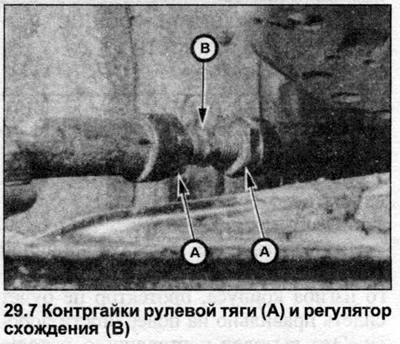
7. Loosen the two nuts on each tie rod, turn the adjusters as needed to complete the installation (photo). Turn both adjusters evenly, each time a quarter turn, check the installation. After installation, lock the clamps.

(The original article is available on the online resource: «AUDImanual.ru»)