



Table of contents: Wheel alignment angles ↓ Conditions for checking wheel… ↓
Wheel alignment angles
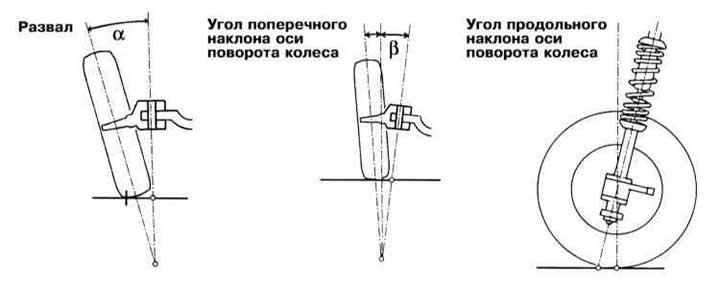
Wheel alignment angles have a significant impact on vehicle stability, tire wear, and fuel consumption. The following wheel alignment angles are distinguished:
Camber is the tilt of the wheel in a vertical plane relative to the centerline of the car. It can be positive if the wheels are tilted outward or negative if the wheels are tilted inward. The camber angle mainly affects the uniformity of wear of the front tires. If the camber of one wheel is positive and the other is negative, the car will pull to one side when driving straight.
Toe-in is the lateral distance between the wheels. Positive toe-in means the front wheels are closer together than the rear wheels when measured at the wheel's midpoint height. Negative toe-in means the front wheels are further apart than the rear wheels.
The lateral inclination of the steering axis is the angle between the inclination axis of the steering knuckle and the vertical drawn through the wheel mounting point, looking in the longitudinal direction of the vehicle.
Due to the camber angles and the transverse tilt of the steering axis, the points of contact of the wheels with the road are located closer to the axis of the steering knuckle. This supports the so-called "rolling shoulder", the easier it is to control the car. Also, impacts from uneven surfaces are less transmitted to the steering.
The longitudinal tilt angle of the wheel turning axis. The axis around which the wheel turns is positioned in space so that its lower part is directed forward. This longitudinal tilt angle is called positive. With a positive angle, the self-return of the wheel to the middle position after turning is improved.
Conditions for checking wheel alignment angles
Checking the vehicle's installation angles requires an inspection pit or a special measuring lift. When taking measurements, the following conditions must be met:
- The air pressure in the tires corresponds to the specified one.
- The front wheels are positioned straight.
- The car is not loaded, the fuel tank is full.
- The car's suspension is very compressed.
- The steering has been adjusted.
- The clearances in the steering rod connections are within the permissible limits
- The gaps in the suspension joint are within the permissible limits
- The tread depth of the tires on the same axle is the same.
Wheel alignment angle values are given in Specifications.
[Content source: the specified website «AUDIMANUAL.RU»]