



Note: Only the toe-in of the front and rear wheels can be adjusted.
1. The geometry of the suspension and its rigidity determine the ability to limit vertical movements of the body and reduce angular vibrations around the transverse and longitudinal axes.
2. The front wheels rotate around inclined axles, whose position is determined by the hinges and suspension components of the vehicle.
3. The most important are the following kinematic settings of the wheel assemblies in relation to steering and the transmission of forces between the tires and the road surface. Wheel alignment has a significant impact on vehicle stability, tire wear and fuel consumption. The nominal values of the wheel alignment angles subject to inspection and adjustment for the vehicles covered in this Manual are given in Specifications at the beginning of the chapter.
4. Convergence (convergence) is the angle between the lines formed by the intersection of the horizontal plane of the planes of the wheel assemblies of one axle of the vehicle; toe-in can also be defined as the difference in distances between the front and rear flanges of the wheel rims (see illustration).
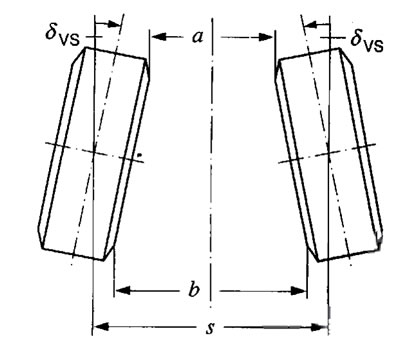
19.4. Front wheel toe-in:
δvs - Wheel toe angle;
a - Distance between the front edges of the wheels;
b - Distance between the rear edges of the wheels;
s - Track;
b-a - Convergence.
Toe-in affects the vehicle's straight-line motion and handling, and on front-wheel drive models, it compensates for the resulting kinematic changes in suspension geometry caused by the traction force. At zero toe-in, the distance between the front edges of the wheels is equal to the distance between their rear edges.
5. Collapse (see illustration) is called the angle between the lines formed by the intersection of the following three planes:
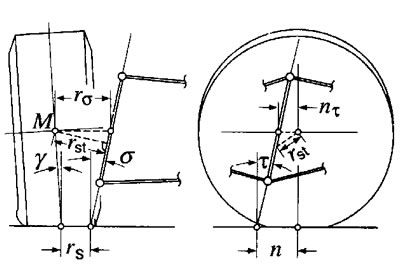
19.5. Wheel alignment angles:
M - Wheel Assembly Center;
rst - Kinematic length of the journal;
nτ - Longitudinal displacement of the wheel pivot axis;
n - Positive stabilization arm;
τ - Angle of longitudinal inclination of the wheel turning axis;
rσ - Transverse displacement of the wheel rotation axis;
rs - Rolling shoulder;
γ - Camber angle;
σ - Angle of transverse inclination of the wheel turning axis.
- A vertical plane drawn through the centers of the wheel assemblies of one axle of a vehicle;
- Plane of symmetry of the car;
- Wheel disk plane.
If the top of the wheel is tilted towards the car's axis of symmetry, the camber is called negative, and vice versa. Correct camber adjustment determines the size and position of the contact patch of the tire treads with the road surface and allows for compensation for changes in suspension geometry that occur during turns and when the vehicle is moving on uneven road surfaces.
6. The kinematic length of the journal is the shortest distance between the center of the steering wheel and its axis of rotation (see illustration 19.5).
7. The stabilization shoulder is the distance between the point of contact of the wheel and the point of intersection of its axis of rotation with the road surface in the side view (see illustration 19.5), determining the magnitude of the stabilizing moment and influencing the directional stability of the vehicle and the distribution of forces in the steering when turning.
8. Wheel yaw angle - the angle between the wheel yaw axis and the vertical in the side view (see illustration 19.5). Together with the lateral tilt angle of the axle (see below), the coasting affects the change in wheel camber when measuring the steering wheel angle, as well as the stabilizing moment.
9. The rolling shoulder is defined as the distance between the point of contact of the wheel with the road surface and the point of intersection of its turning axis with the road surface in the front view (see illustration 19.5). The leverage is considered negative when the last of the above mentioned points is between the center and the outside of the wheel. The parameter influences the degree of impact of braking forces on the steering wheel and the magnitude of the stabilizing moment, with a negative rolling arm increasing the latter.
10. The angle of the transverse inclination of the wheel turning axis is the angle between the wheel turning axis and the vertical in the cross-sectional plane of the vehicle (see illustration 19.5). Along with the coasting (see above) and the magnitude of the longitudinal displacement of the axis of rotation (see ibid) affects steering sensitivity.
Conditions for checking wheel alignment angles
11. Before checking the wheel alignment angles of models with air suspension, the initial position (unloaded position of the suspension, see Section 2).
12. If the car pulls to one side, first check the steering gear centering.
13. Checking the vehicle's wheel alignment requires a specially equipped lift. Before beginning the check, ensure the following conditions are met:
- Fuel, coolant and lubricants are full (if the tank is not full, compensate for the lack of weight by placing an appropriate weight on the center rear seat, assuming that half a tank corresponds to 24 kg);
- There should be no people or luggage in the cabin or luggage compartment;
- The on-board tool kit and spare tire are in their place;
- The air pressure in the tires corresponds to the nominal;
- The tread depth of tires mounted on wheels of the same axle differs by more than 2 mm;
- The runout and play of the wheel rims, hub assemblies, front suspension ball joints and steering rod ends are within normal limits;
- The front wheels are set in the straight-ahead position;
- The steering column is set to the middle height adjustment position;
- The car is leveled, i.e. the suspension is rocked several times.
14. When adjusting, it is necessary to check both axles, otherwise the steering rack may be offset from the center. It is not recommended to check the wheel alignment angles before the 2000 km mark, as the suspension springs may not have settled yet.
15. Check/adjust the front wheel angles only after performing work on the lower control arm, tie rod end, steering gear or subframe (unless it was recorded).
16. Check/adjust the rear wheel angles after completing work on all rear suspension components except the struts (spring or pneumatic) and anti-roll bar.
17. Checking/adjusting the wheel alignment angles is performed in the following order: (you should move on to the next point only after completing the current point):
- Front wheel runout;
- Front wheel alignment;
- Front wheel toe-in;
- Rear wheel alignment;
- Rear wheel toe-in;
- Front wheel alignment control.
(The original article is available on the website AUDIMANUAL.ru)