



Table of contents: Examination ↓ Removal ↓
Examination
1. In the event of a malfunction in the system, checking the serviceability ultimately comes down to replacing it with known good units, but some preliminary checks can be made as described in the following points.
2. Connect a voltmeter or test lamp between the glow plug supply cable and the engine ground.
3. Have an assistant activate the glow plug system with the ignition key and check that battery voltage is present at the glow plug bus. Note that the voltage will drop to zero when the glow plug period ends.
4. If there is no supply voltage to the glow plug, then the glow plug relay or supply wiring is faulty.
5. To find a faulty glow plug, first disconnect the negative cable from the battery.
6. Remove the power wire from the glow plug terminal. Measure the electrical resistance between the glow plug terminal and the engine ground. If the resistance is more than a few ohms, the glow plug is faulty.
7. If a suitable ammeter is available, connect it between the glow plug and the supply cable and measure the current drawn (ignoring the initial surge). Compare the result with Specifications - high current consumption (or no current) indicates a faulty glow plug.
8. To complete the inspection, remove the glow plugs and inspect them as described in the following paragraphs.
Removal
9. Disconnect the negative cable from the battery.
10. Remove the nuts and washers from the glow plug terminal and disconnect the cable.
11. Unscrew and remove the glow plug from the cylinder head (see illustration).
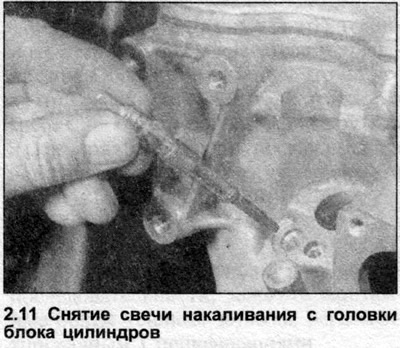
12. Inspect the glow plug tip for damage. If the tip is badly burned or charred, it may be due to a faulty fuel injector; for more details see. Section FOR.
Installation
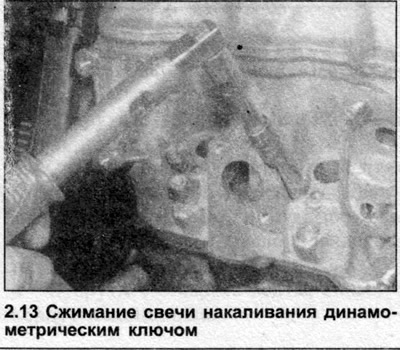
13. Perform installation in reverse order; tighten the glow plug to the specified tightening torque Specifications (see illustration).
(The original article is located on the online resource: audimanual.ru)