
Repair Chevrolet Repair Toyota Repair Honda Repair AvtoVAZ Repair Mercedes-Benz Repair BMW Repair Opel
Home  |  Contacts  |  Sitemap  |    
English Русский
Български
Беларускі
Український
Српски
Hrvatski
Română
Polski
Slovenský
Magyar
AudiManual.ru


  • AUDI 80
  • AUDI 100
  • AUDI A3
  • AUDI A4
  • AUDI A6
  • AUDI A8
  • AUDI Q
  • OTHER
  • ARTICLES
B8 (2007-2015) B7 (2004-2008) B6 (2000-2006) B6 (2000-2006, petrol) B5 (1994-2001) B5 (1994-2001, petrol)

Checking, removing and installing the thermostat (Audi A4 B7)

  • Home
  • Audi A4
  • B7 (2004-2008)
  • Power unit
  • Cooling system
  • Checking, removing and installing the thermostat
            0
Table of contents: 2.0 TFSI engines ↓ 2.0 MPI engine ↓ Engines 1.6 and 1.8 l ↓ Petrol engine 3.0 l ↓ Petrol engine 3.2 l ↓ 4-cylinder diesel engines ↓

2.0 TFSI engines


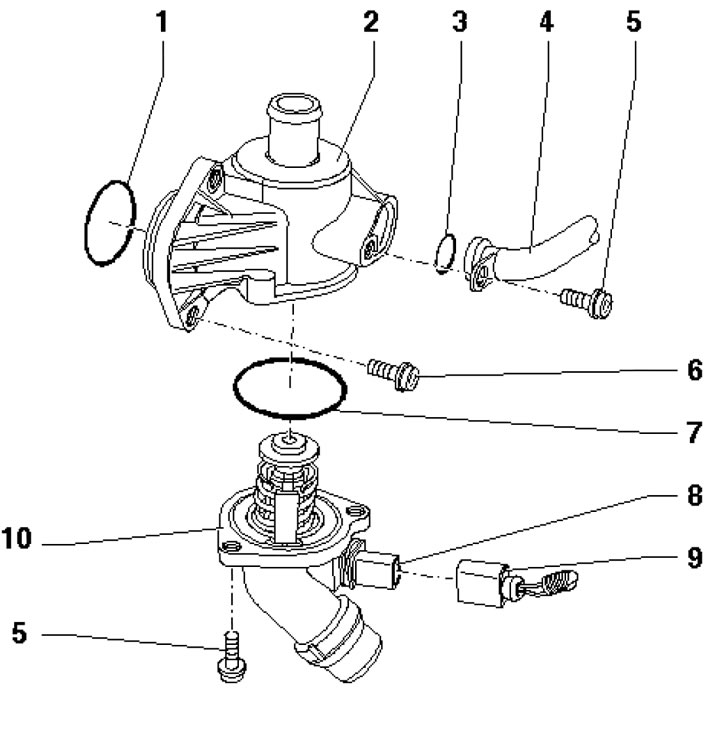
1. The thermostat installation details are shown in the illustration. To check the thermostat, follow the steps in paragraphs 2-4. To remove the thermostat, go to paragraph 5.
5.1 Thermostat installation details 1, 3. Sealing ring, subject to replacement; 2. Coolant…

5.1 Thermostat installation details 1, 3. Sealing ring, subject to replacement; 2. Coolant distributor; 4. Lower coolant hose; 5/6. Bolt, 10 // 15 Nm; 7. Gasket, subject to replacement; 8. Heating element connector; 9. Electrical wiring connector; 10. Thermostat


2. Measure the resistance at the thermostat contacts at a temperature of 25°C - it should be 14÷16 Ohm. Otherwise, replace the thermostat.

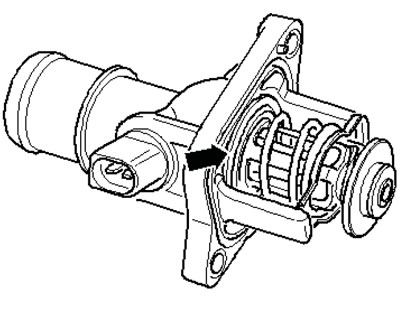
3. Make sure the sealing ring (see illustration) fits tightly to the thermostat housing around the entire circumference. Otherwise, replace the thermostat.
5.3. Checking the thermostat seal

5.3. Checking the thermostat seal


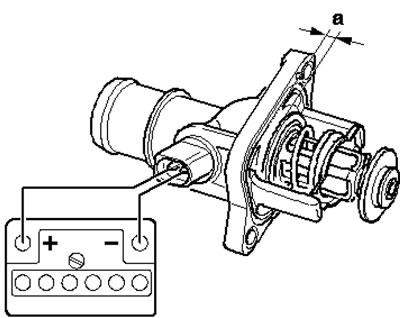
4. Apply 12 V to the thermostat contacts and lower the thermostat up to the flange into a container with boiling coolant. In this case, the wax in the thermostat is additionally heated by electricity. After 10 minutes, the thermostat valve should extend at least 7 mm (and in the illustration). Otherwise, replace the thermostat.
5.4. Checking the thermostat valve stroke

5.4. Checking the thermostat valve stroke


5. Disconnect the negative cable from the battery.

6. Remove the upper engine cover and unscrew the expansion tank cap.

7. Drain the coolant (see Section 2).

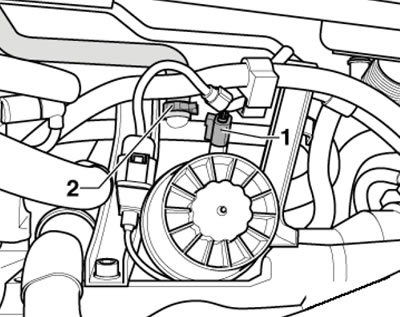
8. Disconnect the electrical wiring connector (1 in the illustration) engine oil pressure sensor, disconnect the lower coolant hose from the tube (2) and drain the remaining coolant.
5.8. Oil pressure sensor connector and lower coolant hose

5.8. Oil pressure sensor connector and lower coolant hose


9. Pull the EVAP canister up out of the holder (see illustration) and set it aside without disconnecting the tubes.
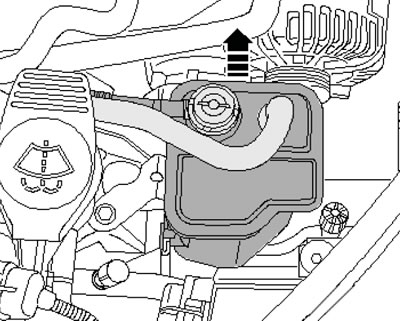
5.9. Removing the EVAP canister

5.9. Removing the EVAP canister


10. Remove the accessory drive belt and its tensioner (see Chapter 2).

11. Remove the generator (see Chapter 5).

12. Disconnect the connector (1 in illustration 5.49 Chapter 2) refrigeration unit compressor couplings, unscrew the bolts (arrows) securing the compressor to the bracket and tie the compressor to the side with a wire without disconnecting the refrigerant lines from it.

13. Disconnect the coolant hose (2 in the illustration), by pulling out the lock (1).
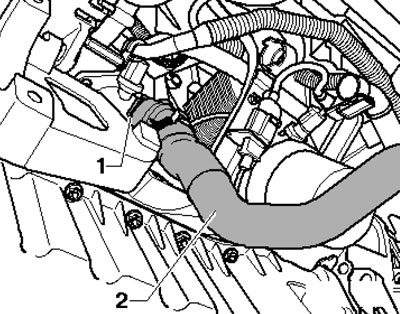
5.13. Coolant hose

5.13. Coolant hose


14. Remove the bolts (1-6 in Illustration 21.9 Chapter 2) and remove the accessory bracket.


15. Disconnect the connector (1 in the illustration), unscrew the bolts (arrows) and remove the thermostat.
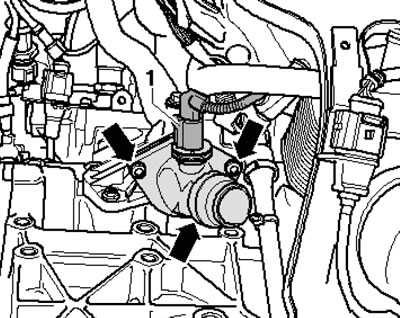
5.15. Thermostat mounting

5.15. Thermostat mounting


16. Installation is carried out in the reverse order of dismantling the components.

2.0 MPI engine


17. The thermostat installation details are shown in Illustration 5.1. To check the thermostat, follow the steps in paragraphs 2-4. The procedure for removing the thermostat is described below.

18. Drain the coolant (see Section 2).

19. Disconnect the air hoses at the locations shown in the illustrations 13.6 and 5.28 Chapter 2, and also in the illustration.
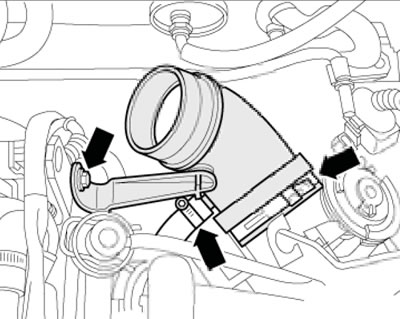
5.19. Fastening the air hose to the throttle body

5.19. Fastening the air hose to the throttle body


20. Disconnect the hose from the fuel pressure regulator (see illustration).
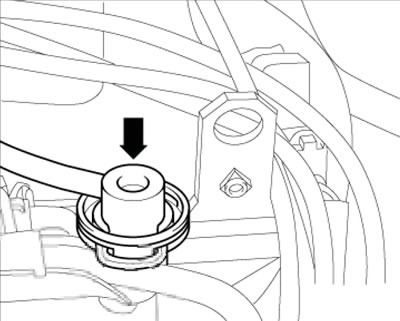


5.20. Hose on the fuel pressure regulator

5.20. Hose on the fuel pressure regulator


21. Remove the bolts (1 and 2 in the illustration) and separate the upper coolant pipe from the coolant hoses (arrows).
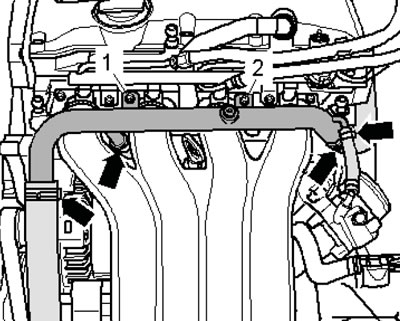
5.21. Fastening the upper coolant pipe

5.21. Fastening the upper coolant pipe


22. Remove the intake manifold (see Chapter 4).

23. Remove the bolts (3 in the illustration) and remove the resonator. Disconnect the hoses (arrows) from the lower coolant pipe, unscrew the bolts (1 and 2) and remove the lower coolant pipe.
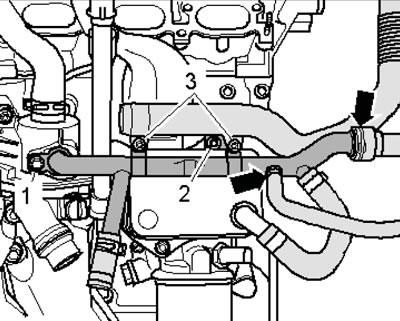
5.23. Removing the lower coolant pipe

5.23. Removing the lower coolant pipe


24. Disconnect the connector (5 in the illustration), disconnect the hoses (1 and 4), unscrew the bolts (2 and 3) and remove the thermostat housing.
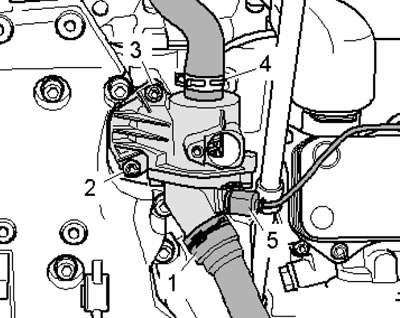
5.24. Removing the thermostat housing

5.24. Removing the thermostat housing


25. Remove the bolts (5 in illustration 5.1) and remove the thermostat (10) with the gasket (7) from the housing (2).

26. Installation is carried out in the reverse order of dismantling the components. Use new sealing rings.

Engines 1.6 and 1.8 l


27. The thermostat installation details are shown in Illustration 5.1. To check the thermostat, follow the steps in paragraphs 2-4. The procedure for removing the thermostat is described below.

28. Drain the coolant (see Section 2).

29. Remove the intake manifold support (see illustration 31.5 Chapter 2).

30. Move the electrical wiring away from the lower coolant pipe, disconnect the coolant hoses from this pipe (arrows in the illustration), unscrew the bolts (1 and 2) and remove the lower coolant pipe from the thermostat housing.
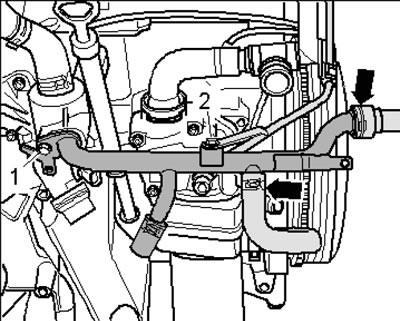
5.30. Fastening the lower coolant pipe

5.30. Fastening the lower coolant pipe


31. Perform the actions described in paragraphs 24-26.

Petrol engine 3.0 l


32. The details of the thermostat and water pump installation are shown in the illustration.
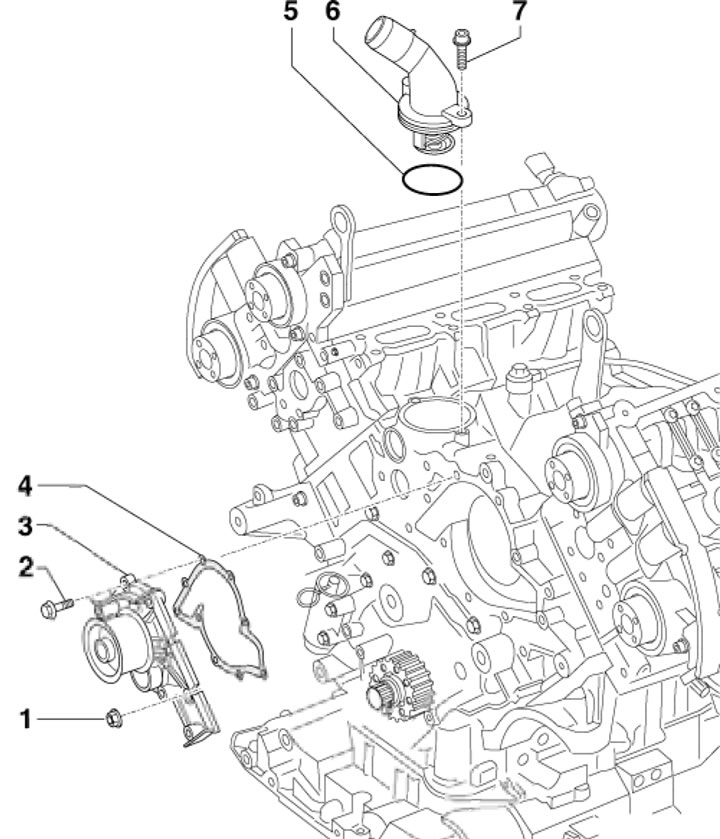
5.32. Thermostat and water pump installation details for 3.0 MPI engine 1/2. Nut/bolt, 10 Nm; 3.…

5.32. Thermostat and water pump installation details for 3.0 MPI engine 1/2. Nut/bolt, 10 Nm; 3. Water pump; 4. Gasket, subject to replacement; 5. Sealing ring, subject to replacement; 6. Thermostat; 7. Bolt, 10 Nm


33. Drain the coolant (see Section 2).

34. Remove the intake manifold (see Chapter 4).

35. Remove the bolts (1 and 2 in the illustration), loosen the clamps (arrows) and remove the coolant hose, then remove the thermostat.

36. Installation is carried out in the reverse order of dismantling the components. Use a new sealing ring.

Petrol engine 3.2 l


37. The details of the thermostat and water pump installation are shown in the illustration.
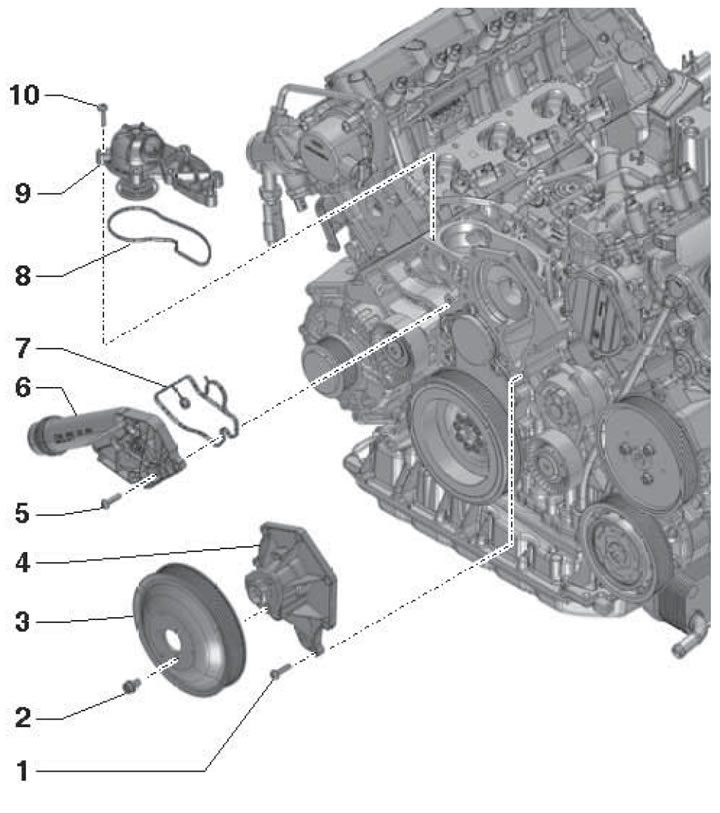
5.37. Details of the installation of the thermostat of the 3.2 FSI engine 1//2. Bolt, 9 //20 Nm; 3.…

5.37. Details of the installation of the thermostat of the 3.2 FSI engine 1//2. Bolt, 9 //20 Nm; 3. Water pump pulley; 4. Water pump; 5. Bolt, 9 Nm; 6. Connecting coolant hoses; 7, 8. Gasket, subject to replacement; 9. Thermostat; 10. Bolt, 9 Nm


38. Remove the front decorative engine cover (see Chapter 2).

39. Remove the air cleaner air intake (see Section 16 Chapter 1).

40. Drain the coolant (see Section 2).

41. Remove the front bumper cover (see Chapter 11).

42. Bring the radiator frame to the service position (see Chapter 2).

43. Remove the upper section of the intake manifold (see Chapter 4) and the front water pipe.

44. Remove the bolts (10 in illustration 5.37) and remove the thermostat.

45. Installation is carried out in the reverse order of dismantling the components.

4-cylinder diesel engines


46. Remove the top engine cover (see Chapter 2).

47. Drain the coolant (see Section 2).

48. Disconnect the coolant hose from the thermostat housing (see illustration 29.15 Chapter 2).

49. Remove the bolts (1 in the illustration) thermostat housing fasteners (2) and remove it together with the thermostat (4) and sealing ring (3).
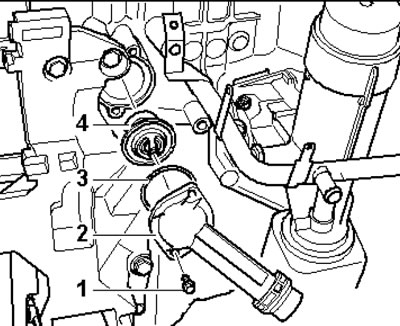
5.49. Thermostat housing installation details

5.49. Thermostat housing installation details


50. Turn the thermostat (2 in the illustration) approximately 90° counterclockwise and remove it from the housing. Replace the sealing ring (1)
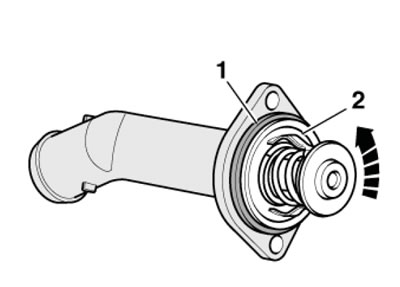
5.50. Removing the thermostat

5.50. Removing the thermostat


51. Installation is carried out in the reverse order of dismantling the components. Use a new sealing ring.

(This article was copied from an online resource: audimanual)
The article was checked by auto expert Timur Bazhenov
This article is available at russian, bulgarian, belarusian, ukrainian, serbian, croatian, romanian, polish, slovak, hungarian

Share information:
Previous articles
Audi A4 B7: Cooling system
Next articles

Removal and installation the radiator
Removal and installation the radiator shroud and fan assembly
Replacing the coolant, bleeding the cooling system
General information and precautions
Removal and installation the water pump


Similar articles on other Audi car models:
Cooling Fan Thermal Switch — Checking, Removing and Installing Audi 80 B3 (1986-1991, petrol)
Steering Damper — Checking, Removing and Installing Audi 100 C3 (1982-1990, diesel)
Checking, removing and installing the starter traction relay Audi A3 Type 8L (1996-2003)
Thermostat — Removal, Installation and Checking Audi A6 C5 Allroad (1999-2005)
Checking the exhaust system Audi A8 D2 (1994-2002)
Checking, cleaning, removing the water drainage box and… Audi Q5 Type 8R (2008-2017)
Engine — Checking Oil Level Audi A2 (1999-2005)
Link to this page in different formats


Visitor comments

No comments yet


How much will 46 + 22 =


A4(B8, 2007-2015) 
  • General information
  • Operating instructions
  • Power unit
  • Petrol engines 1.8 l
  • Petrol engines 1.8/2.0 l
  • Petrol engines 3.0 l
  • Petrol engines 3.2 l
  • Fuel system (petrol)
  • Diesel engines 2.0 l (CA*)
  • Diesel engines 2.0 l (CJCB)
  • Diesel engines 2.7/3.0 l
  • Diesel engines 3.0 l
  • Fuel system (diesel)
  • Transmission
  • Manual gearbox 0B1
  • Manual gearbox 0B2
  • Manual gearbox 0B3
  • Manual gearbox 0B4
  • Automatic transmission 0B5
  • Automatic transmission 0B6
  • Automatic transmission 0AW
  • All-wheel drive system
  • Chassis
  • Front suspension
  • Rear suspension
  • Brake system
  • Steering system
  • Body
  • Exterior
  • Interior
  • Seats
  • Doors, locks and windows
  • Security system
  • Heating and air conditioning
  • Electrical equipment
  • Audio system
  • Power devices
  • Equipment and devices
  • Lighting and lamps
  • Electrical circuits
 
A4(B7, 2004-2008) 
  • General information
  • Introduction to manual
  • Troubleshooting
  • Operating instructions
  • Maintenance
  • Power unit
  • Petrol engines 2.0 (ALT)
  • Petrol engines 2.0 (TFSI)
  • Petrol engines 1.8 (MPI)
  • Diesel engines
  • Cooling system
  • Air conditioner
  • Fuel and exhaust system
  • Ignition system
  • Starting and charging
  • Transmission
  • Clutch
  • Manual gearbox
  • Automatic gearbox
  • Drive shafts
  • Chassis
  • Brake system
  • Front suspension
  • Rear suspension
  • Steering
  • Body
  • Exterior
  • Interior
  • Electrical equipment
  • Equipment and devices
  • Lighting and signaling
  • Windscreen wipers and washers
  • Electrical diagrams
  • Electrical diagrams (since 2007)
 
A4(B6, 2000-2006) 
  • General information
  • Vehicle Description
  • User manual
  • Maintenance
  • Power unit
  • Gasoline engine
  • Diesel engine
  • Lubrication system
  • Cooling system
  • Supply system
  • Injection system
  • Exhaust system
  • Ignition and control
  • Transmission
  • Gear box
  • Clutch and drive shafts
  • Chassis
  • Brake system
  • Car suspension
  • Steering
  • Body
  • Heating and ventilation
  • Exterior (external elements)
  • Interior (internal elements)
  • Electrical equipment
  • Power devices
  • Lighting and appliances
  • Electrical circuits
 
A4(B6, 2000-2006, petrol) 
  • General information
  • Introduction to the guide
  • Car care
  • Power unit
  • Engine repair
  • Lubrication system
  • Cooling system
  • Injection and control system
  • Ignition system
  • Power and exhaust system
  • Transmission
  • Clutch and drive shafts
  • Car gearbox
  • Chassis
  • Suspension and wheels
  • Steering
  • Brake system
  • Body
  • Interior
  • Exterior
  • Electrical equipment
  • Equipment and devices
  • Lighting and signaling
  • Power devices
  • Electrical circuits
 
A4(B5, 1994-2001) 
  • General information
  • Introduction to the guide
  • Car care
  • Maintenance (gasoline)
  • Maintenance (diesel)
  • Power unit
  • Gasoline engines
  • Diesel engines
  • Engine overhaul
  • Cooling system
  • Fuel injection (gasoline)
  • Fuel system (diesel)
  • Exhaust system
  • Ignition system
  • Transmission
  • Clutch
  • Mechanical gearbox
  • Automatic gearbox
  • Drive shafts
  • Chassis
  • Brake system
  • Car suspension
  • Steering
  • Body
  • Exterior
  • Interior
  • Doors, locks and windows
  • Heating and ventilation
  • Electrical equipment
  • Power devices
  • Equipment and devices
  • Electrical circuits
 
A4(B5, 1994-2001, petrol) 
  • General information
  • Vehicle description
  • Maintenance
  • Power unit
  • Engine repair
  • Turbocharging
  • Exhaust system
  • Cooling system
  • Ignition system
  • Fuel system
  • Motronic injection system
  • MPI and MPFI injection system
  • Transmission
  • Clutch
  • Gearbox and shafts
  • Chassis
  • Steering
  • Car suspension
  • Brake system
  • Wheels and tires
  • Body
  • Heating and ventilation
  • Body parts
  • Electrical equipment
  • Fuses and relays
  • Power devices
  • Lighting and lamps
  • Tools and devices
  • Electrical circuits
 
AudiManual.ru © 2017-2026 · Mobile version · Feedback · Sitemap: EN BG BY UA RS HR RO PL SK HU · Site search · News and articles
80 B2 · 80 B3 petrol · 80 B3 · 80 B4 · 100 C3 diesel · 100 C3 petrol · 100 C3 · 100 C4 petrol · 100 C4 · A3 Type 8L · A4 B5 petrol · A4 B5 · A4 B6 petrol · A4 B6 · A4 B7 · A4 B8 · A6 C4 · A6 C5 · A6 C5 Allroad · A8 D2 · Q5 Type 8R · Q7 Typ 4L · Audi A2 ·
This site uses cookies 🍪. Click the button to accept this fact.