
Repair Chevrolet Repair Toyota Repair Honda Repair AvtoVAZ Repair Mercedes-Benz Repair BMW Repair Opel
Home  |  Contacts  |  Sitemap  |    
English Русский
Български
Беларускі
Український
Српски
Hrvatski
Română
Polski
Slovenský
Magyar
AudiManual.ru


  • AUDI 80
  • AUDI 100
  • AUDI A3
  • AUDI A4
  • AUDI A6
  • AUDI A8
  • AUDI Q
  • OTHER
  • ARTICLES
B8 (2007-2015) B7 (2004-2008) B6 (2000-2006) B6 (2000-2006, petrol) B5 (1994-2001) B5 (1994-2001, petrol)

Removal and installation the cylinder head and its cover (Audi A4 B7)

  • Home
  • Audi A4
  • B7 (2004-2008)
  • Power unit
  • Petrol engines 1.8 (MPI)
  • Removal and installation the cylinder head and its cover
            0
Table of contents: Cylinder head cover ↓ Cylinder head ↓
1. The details of the cylinder head and its cover installation are shown in the illustration.
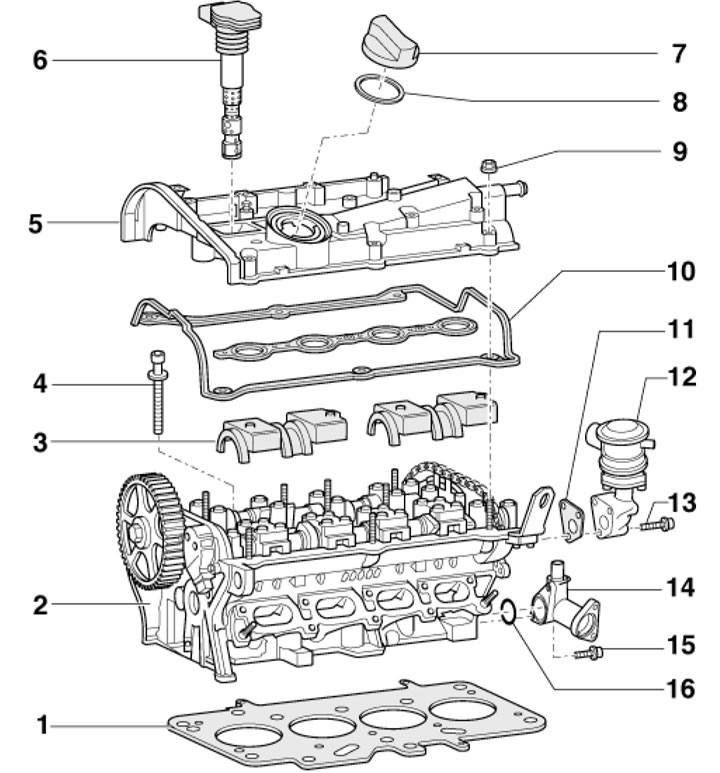
34.1. Cylinder head and cover installation details 1. Cylinder head gasket; 2. Cylinder head; 3.…

34.1. Cylinder head and cover installation details 1. Cylinder head gasket; 2. Cylinder head; 3. Camshaft bearing caps; 4. Engine oil distributors; 5. Cylinder head cover; 6. Ignition coil; 7. Oil filler cap; 8. Cover gasket 7; 9. Cylinder head cover fastening nuts, 9 Nm; 10. Cover gasket 5; 11. Valve gasket 12, subject to replacement; 12. SAI combination valve; 13. Valve mounting bolts 12, 10 Nm; 14. Coolant flange with ECT sensor; 15. Flange mounting bolts 14, 10 Nm; 16. Flange sealing ring 14, subject to replacement


Cylinder head cover


2. Release the fasteners (arrows in illustration 29.9) and remove the top engine cover.

3. If there is a casing (1 in illustration 5.11) on the right side of the engine compartment, remove this cover.

4. Disconnect the EVAP valve solenoid connector (1 in illustration 5.12) and remove the solenoid valve. Unscrew the screws (arrows) and remove the air duct (2).

5. Remove the PCV tube (2 in the illustration) and the PCV hose from the cylinder head cover. Disconnect the SAI combination valve tube (1) from the cylinder head cover and heat shield (3). Bend the SAI tube slightly to the side.
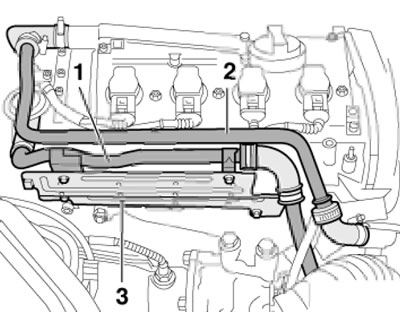


34.5. Tubes and hoses on the cylinder head cover

34.5. Tubes and hoses on the cylinder head cover


6. Disconnect the ground wire (2 in the illustration), disconnect the connectors (3) and set the wiring aside. Pull out the ignition coils (1).
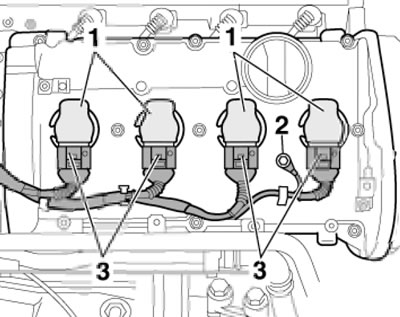
34.6. Removing the ignition coils

34.6. Removing the ignition coils


7. Release the two clamps of the upper timing belt cover, loosen the nuts (see illustration) and remove the cylinder head cover.
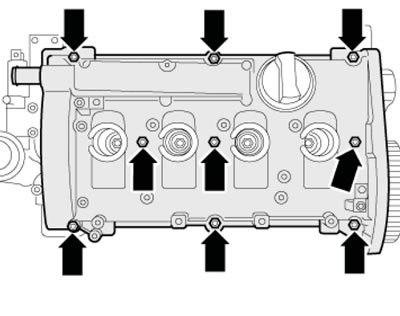
34.7. Cylinder head cover fasteners

34.7. Cylinder head cover fasteners


8. Prepare new sealing elements. Replace the cylinder head cover gasket if the old gasket is damaged.

9. Apply a small amount of sealant to the indicated points on the cylinder head at the front and also at the rear (by analogy).
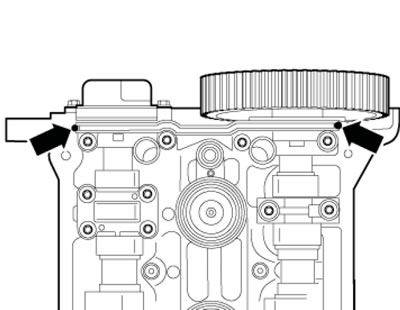
34.9. Places of sealant application

34.9. Places of sealant application


10. Install the cylinder head cover and tighten its inner nuts, then tighten the outer nuts in a diagonal sequence.

11. Further installation is carried out in the reverse order of dismantling the components.

Cylinder head


12. Disconnect the negative cable from the battery.

13. Drain the coolant from the cooling system.

14. Install the radiator frame in the service position (see Section 30).

15. Remove the upper coolant pipe (see Chapter 3) and the intake manifold (see Chapter 4).

16. Remove the timing belt from the camshaft sprocket (see Section 32).

17. Disconnect the connector (3 in illustration 29.21) EVAP valve solenoid and air flow meter connector (5), disconnect the hoses (1, 4, 6 and 7), remove the retainer (2) and detach the air cleaner housing.

18. Remove the PCV tube (2 in illustration 34.5) and the PCV hose from the cylinder head cover. Disconnect the SAI combination valve tube (1) from the cylinder head cover and heat shield (3). Tilt the SAI tube slightly to the side and remove the heat shield.


19. Remove the bolts (1 and 2 in the illustration) supply oil line, as well as the bolts (3) of the turbocharger.
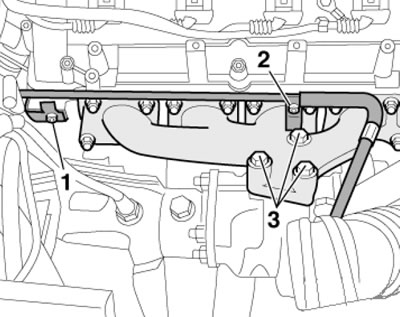
34.19. Fastening the turbocharger and its supply oil line

34.19. Fastening the turbocharger and its supply oil line


20. Disconnect the intake camshaft adjustment valve connector (see illustration).
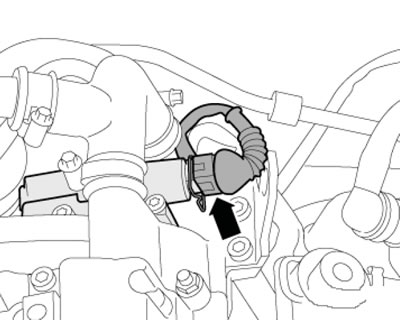
34.20. Camshaft control valve connector

34.20. Camshaft control valve connector


21. Disconnect the ECT sensor connector (see illustration).
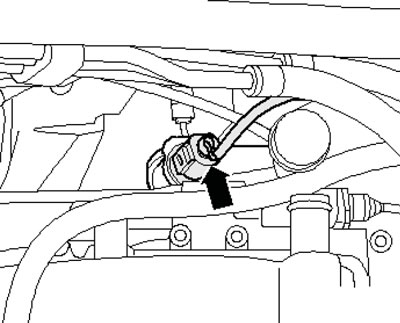
34.21. ECT sensor connector

34.21. ECT sensor connector


22. Disconnect the vacuum hose (arrow on the illustration) from the SAI combination valve, remove the coolant flange (bolts 2 and 3) and unscrew the bolt (1) securing the bracket for the oil supply line. Separate all electrical wiring from the cylinder head and set it aside. Disconnect the air conditioning radiator hose at the rear of the cylinder head (is fixed with a clamp on the flange).
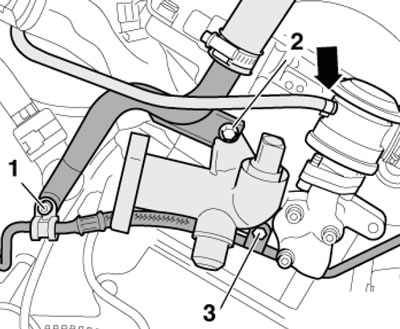
34.22. Cylinder head end connections

34.22. Cylinder head end connections


23. Disconnect the ground wire (2 in illustration 34.6), disconnect the connectors (3) and set the wiring aside. Pull out the ignition coils (1).

24. Release the two fasteners of the upper timing belt cover, loosen the nuts (see illustration 34.7) and remove the cylinder head cover.

25. Remove both oil distributors (4 in illustration 34.1).

26. Remove the cylinder head mounting bolts in the following sequence: (1-10 in the illustration) and remove it with the help of an assistant. The installation procedure is described below.
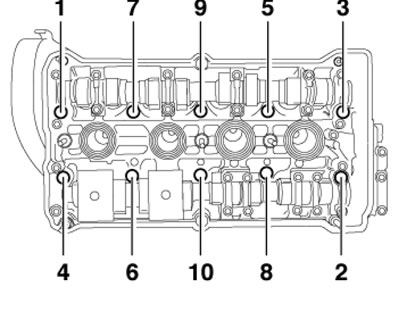
34.26. Sequence of unscrewing the cylinder head mounting bolts

34.26. Sequence of unscrewing the cylinder head mounting bolts


27. Inspect the cylinder head. If there are small cracks on it, (width up to 0.3 mm) between the valve seats or between the valve seat ring and the spark plug socket thread (no further than the first four thread turns), then the cylinder head can be used without reducing its service life.

28. Prepare new cylinder head mounting bolts, new self-locking nuts and bolts, new bolts tightened to a certain angle, as well as new sealing rings, cuffs and gaskets.

29. Carefully remove any remaining sealant from the cylinder head and cylinder block, avoiding the formation of long scratches or burrs. Carefully remove any remaining sandpaper or grinding material. There should be no oil or coolant in the blind threaded holes of the cylinder head.

30. When installing a new cylinder head with the camshafts installed, the mating surfaces between the hydraulic compensators and the camshaft cover should be lubricated with engine oil after installing the head. The plastic linings included in the repair kit for protecting open valves may be removed immediately before installing the cylinder head.

31. The new cylinder head gasket should be removed from the packaging immediately before installation. The gasket should be handled with extreme care. Damage to the silicone layer and corrugated connections will result in loss of sealing.

32. When replacing the cylinder head or its gasket, drain the old coolant and fill it with new coolant.

33. Set the camshaft to the TDC position and make sure that the mark on the crankshaft pulley also matches the TDC mark (see illustration 10.15). If necessary, turn the crankshaft.


34. Remove the bolts (1 and 2 in the illustration) turbocharger bracket by two turns to prevent stress from occurring when installing the cylinder head.
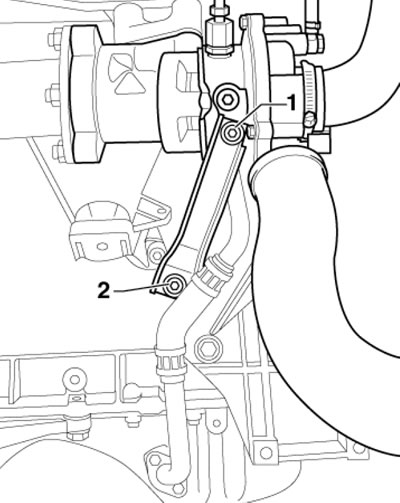
34.34. Turbocharger bracket fasteners

34.34. Turbocharger bracket fasteners


35. Place the cylinder head gasket on the centering pins in the cylinder block (the gasket number must be read from the inlet side). Place the cylinder head on the cylinder block and screw in all the new bolts by hand. Then tighten the cylinder head bolts in three steps in the sequence (1-10 in the illustration), at the first stage - with a force of 40 Nm, and at the second and third stages - tighten the bolts each time at an angle of 90°.
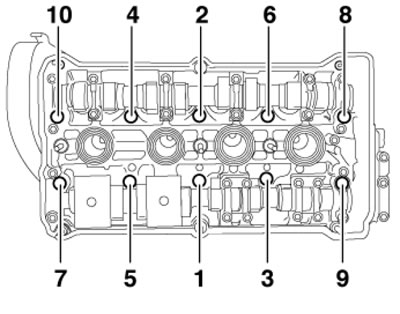
34.35. Cylinder head bolt tightening sequence

34.35. Cylinder head bolt tightening sequence


36. Further installation is carried out in the reverse order of dismantling the components. Use new bolts to secure the turbocharger to the exhaust manifold, tighten them with a force of 35 Nm. Tighten the turbocharger bracket fasteners to the compressor // cylinder block with a force of 30 // 25 Nm.

[This article was copied from the website: AUDImanual.ru]
The article was checked by auto expert Timur Bazhenov
This article is available at russian, bulgarian, belarusian, ukrainian, serbian, croatian, romanian, polish, slovak, hungarian

Share information:
Previous articles
Audi A4 B7: Petrol engines 1.8 (MPI)
Next articles

Replacing crankshaft seals and their holders, removing and…
Removal and installation the timing belt and its tensioner
Removal and installation the alternator drive belt, crankshaft…
Bringing the radiator frame into service position
Removal and installation of camshafts, replacement of their…
Removal and installation of parts and units of the lubrication…
1.6L MPI petrol engine
3.0L MPI petrol engine


Similar articles on other Audi car models:
Cylinder Head Cover — Removal and Installation Audi 80 B4 (1991-1996)
Cylinder head — removal, inspection and installation Audi 100 C3 (1982-1990, diesel)
Removal and installation the cylinder head (petrol) Audi A3 Type 8L (1996-2003)
Removal and installation the cylinder head (diesel engine… Audi A6 C5 (1997-2004)
Left cylinder head cover Audi A8 D2 (1994-2002)
Removal the cylinder head cover Audi Q5 Type 8R (2008-2017)
Removal and installation the cylinder head cover Audi A2 (1999-2005)
Link to this page in different formats


Visitor comments

No comments yet


How much will 22 + 23 =


A4(B8, 2007-2015) 
  • General information
  • Operating instructions
  • Power unit
  • Petrol engines 1.8 l
  • Petrol engines 1.8/2.0 l
  • Petrol engines 3.0 l
  • Petrol engines 3.2 l
  • Fuel system (petrol)
  • Diesel engines 2.0 l (CA*)
  • Diesel engines 2.0 l (CJCB)
  • Diesel engines 2.7/3.0 l
  • Diesel engines 3.0 l
  • Fuel system (diesel)
  • Transmission
  • Manual gearbox 0B1
  • Manual gearbox 0B2
  • Manual gearbox 0B3
  • Manual gearbox 0B4
  • Automatic transmission 0B5
  • Automatic transmission 0B6
  • Automatic transmission 0AW
  • All-wheel drive system
  • Chassis
  • Front suspension
  • Rear suspension
  • Brake system
  • Steering system
  • Body
  • Exterior
  • Interior
  • Seats
  • Doors, locks and windows
  • Security system
  • Heating and air conditioning
  • Electrical equipment
  • Audio system
  • Power devices
  • Equipment and devices
  • Lighting and lamps
  • Electrical circuits
 
A4(B7, 2004-2008) 
  • General information
  • Introduction to manual
  • Troubleshooting
  • Operating instructions
  • Maintenance
  • Power unit
  • Petrol engines 2.0 (ALT)
  • Petrol engines 2.0 (TFSI)
  • Petrol engines 1.8 (MPI)
  • Diesel engines
  • Cooling system
  • Air conditioner
  • Fuel and exhaust system
  • Ignition system
  • Starting and charging
  • Transmission
  • Clutch
  • Manual gearbox
  • Automatic gearbox
  • Drive shafts
  • Chassis
  • Brake system
  • Front suspension
  • Rear suspension
  • Steering
  • Body
  • Exterior
  • Interior
  • Electrical equipment
  • Equipment and devices
  • Lighting and signaling
  • Windscreen wipers and washers
  • Electrical diagrams
  • Electrical diagrams (since 2007)
 
A4(B6, 2000-2006) 
  • General information
  • Vehicle Description
  • User manual
  • Maintenance
  • Power unit
  • Gasoline engine
  • Diesel engine
  • Lubrication system
  • Cooling system
  • Supply system
  • Injection system
  • Exhaust system
  • Ignition and control
  • Transmission
  • Gear box
  • Clutch and drive shafts
  • Chassis
  • Brake system
  • Car suspension
  • Steering
  • Body
  • Heating and ventilation
  • Exterior (external elements)
  • Interior (internal elements)
  • Electrical equipment
  • Power devices
  • Lighting and appliances
  • Electrical circuits
 
A4(B6, 2000-2006, petrol) 
  • General information
  • Introduction to the guide
  • Car care
  • Power unit
  • Engine repair
  • Lubrication system
  • Cooling system
  • Injection and control system
  • Ignition system
  • Power and exhaust system
  • Transmission
  • Clutch and drive shafts
  • Car gearbox
  • Chassis
  • Suspension and wheels
  • Steering
  • Brake system
  • Body
  • Interior
  • Exterior
  • Electrical equipment
  • Equipment and devices
  • Lighting and signaling
  • Power devices
  • Electrical circuits
 
A4(B5, 1994-2001) 
  • General information
  • Introduction to the guide
  • Car care
  • Maintenance (gasoline)
  • Maintenance (diesel)
  • Power unit
  • Gasoline engines
  • Diesel engines
  • Engine overhaul
  • Cooling system
  • Fuel injection (gasoline)
  • Fuel system (diesel)
  • Exhaust system
  • Ignition system
  • Transmission
  • Clutch
  • Mechanical gearbox
  • Automatic gearbox
  • Drive shafts
  • Chassis
  • Brake system
  • Car suspension
  • Steering
  • Body
  • Exterior
  • Interior
  • Doors, locks and windows
  • Heating and ventilation
  • Electrical equipment
  • Power devices
  • Equipment and devices
  • Electrical circuits
 
A4(B5, 1994-2001, petrol) 
  • General information
  • Vehicle description
  • Maintenance
  • Power unit
  • Engine repair
  • Turbocharging
  • Exhaust system
  • Cooling system
  • Ignition system
  • Fuel system
  • Motronic injection system
  • MPI and MPFI injection system
  • Transmission
  • Clutch
  • Gearbox and shafts
  • Chassis
  • Steering
  • Car suspension
  • Brake system
  • Wheels and tires
  • Body
  • Heating and ventilation
  • Body parts
  • Electrical equipment
  • Fuses and relays
  • Power devices
  • Lighting and lamps
  • Tools and devices
  • Electrical circuits
 
AudiManual.ru © 2017-2026 · Mobile version · Feedback · Sitemap: EN BG BY UA RS HR RO PL SK HU · Site search · News and articles
80 B2 · 80 B3 petrol · 80 B3 · 80 B4 · 100 C3 diesel · 100 C3 petrol · 100 C3 · 100 C4 petrol · 100 C4 · A3 Type 8L · A4 B5 petrol · A4 B5 · A4 B6 petrol · A4 B6 · A4 B7 · A4 B8 · A6 C4 · A6 C5 · A6 C5 Allroad · A8 D2 · Q5 Type 8R · Q7 Typ 4L · Audi A2 ·
This site uses cookies 🍪. Click the button to accept this fact.