



Note: This operation must be carried out very carefully, since the thickness of the adjusting washer and sealing gasket affects the position of the main gear pinion. Measurements must be made with the outer bearing rings pressed in as far as they will go.
To select the thickness of the bearing adjusting rings, it is necessary to determine the following dimensions:
- a - protrusion of the primary shaft ball bearing from the gearbox housing;
- b — protrusion of the secondary shaft tapered roller bearing from the gearbox housing;
- c — sinking of the supporting surface of the secondary shaft rear bearing in the rear cover of the gearbox;
- d — recession of the supporting surface of the rear bearing of the primary shaft in the rear cover of the gearbox;
- s — thickness of the adjusting ring of the secondary shaft rear bearing;
- v — thickness of the adjusting ring of the rear bearing of the primary shaft;
- e — thickness of the sealing gasket.
Use a depth gauge to determine the dimensions of "a", "b", "c" and "d".
The rear bearings of the primary and secondary shafts are installed with a preload of 0.10 mm.
The thickness "e" of the sealing gasket is constant and is 0.40 mm. The thickness of the adjusting washers is calculated using the following formulas:
s = c - b + 0.30 mm
v = d - a + 0.30 mm
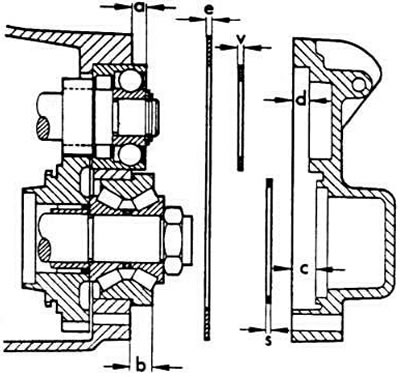
Scheme for selecting adjusting rings when installing the rear bearings of the primary and secondary shafts in the rear cover of the gearbox: a - protrusion of the rear bearing of the primary shaft; b — protrusion of the secondary shaft rear bearing; c — recession of the supporting surface of the secondary shaft rear bearing; d — recession of the supporting surface of the rear bearing of the primary shaft; e — thickness of the sealing gasket; v — thickness of the adjusting ring of the rear bearing of the primary shaft; s — thickness of the adjusting ring of the secondary shaft rear bearing
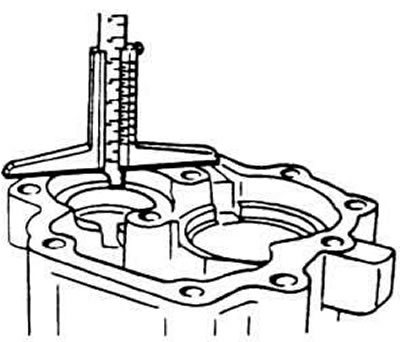
Measuring the recession of the bearing support surface in the gearbox rear cover socket
[The original source of the article can be found on the website: AUDImanual]