Table of contents: Advantages of all-wheel drive ↓ Advantages of All Wheel Drive ↓
Introduction
The Audi 100 Quattro/100 Avant Quattro is an efficient, versatile vehicle with extremely good driving characteristics. The all-wheel drive chassis has been specially developed for this model, which is particularly effective when driving on wet, smooth roads and ensures maximum driving safety.
The Audi 100 Quattro and Audi 100 Avant Quattro operate equally effectively on dry highways and on snowy and icy roads.
Advantages of all-wheel drive
1. Stability on the road.
2. Acceleration.
3. Traction force.
4. Reduced tire wear.
Dispenser mechanism
There are two modes of switching on the dispensing mechanism, which are selected by a rotary switch (see photo):
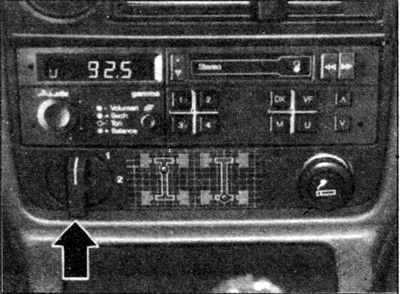
1 - Engagement of front-wheel drive only.
2 - Engaging front and rear drives.
Operating procedure
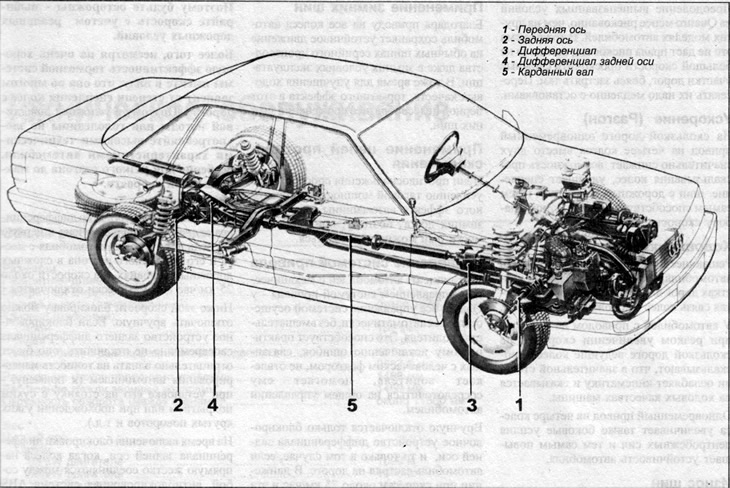
Engine power is transmitted via the gearbox and intermediate differential directly to the front axle differential, and from there via the propeller shaft to the rear axle differential.
The intermediate differential, thanks to a complex worm gear mechanism, automatically locks the drive on a slippery section of the road without driver intervention.
In normal driving conditions, on dry roads, it distributes engine power evenly to all wheels of the front and rear axles. If the wheels of one of the axles, for example in icy conditions, lose stable traction and are on the verge of slipping, the intermediate differential, without interrupting the traction force, begins to automatically lock these wheels, redistributing engine power to the wheels of the other axle, where traction is more stable.
As you can see, the distribution of drive power to the wheels is not always uniform, it depends on road conditions, primarily on the degree of adhesion of the front or rear wheels to the road surface.
The rear axle differential lock can be switched on and off manually. This lock is primarily intended for smooth starting and acceleration of the vehicle in difficult road conditions and is automatically switched off when the speed reaches approximately 25 km/h. The ABS anti-lock braking system is switched off for this time.
Advantages of All Wheel Drive
The advantages of Quattro all-wheel drive over conventionally driven vehicles are as follows:
Traction power
Permanent all-wheel drive significantly increases the traction power of the vehicle, especially in snowdrifts, icy conditions, when accelerating and driving uphill.
Overcoming the above conditions on the Quattro is less risky than on other models of cars. At the same time, this does not give the right to take risks, try to rush through difficult sections of the road at high speed, fearing to get stuck there. They must be crossed slowly with stops.
Acceleration (Acceleration)
On slippery roads, the simultaneous drive on four wheels instead of two significantly reduces the possibility of wheel slippage, improves the grip of the tires on the road surface and thus helps the car to accelerate faster.
Driving performance
Of decisive importance for the driving characteristics of a car, especially on slippery road sections, is a rigid kinematic connection of the wheels with the road surface. In cars with a single-axle drive, with a sharp increase in speed on a slippery road, the drive wheels slip, which significantly weakens the kinematics and affects the driving characteristics of the car.
The simultaneous four-wheel drive also increases the lateral forces of the centrifugal forces and thus improves the stability of the vehicle.
Tire wear
Quattro has a probability of wheel slippage several times lower than similar models with a single-axle drive. This in turn affects the wear time of the tires.
The wear life of the tires of the Quattro under the same operating conditions is significantly higher than that of cars of the same class with two-wheel drive.
Application of winter tires
Thanks to the all-wheel drive, the car maintains stable movement on regular serial production tires even in winter operating conditions. At the same time, to improve driving performance and braking effect during this period, it is more appropriate to use winter tires.
Application of anti-skid chains
Anti-skid chains help to increase the traction power and braking effect of a car in winter road conditions, so they can be used if necessary.
Drive system control
Unlike cars with mechanical drive system control, Quattro has all system control performed automatically, without driver intervention. This helps to practically eliminate errors related to the human factor, does not distract the driver, and helps him to concentrate on the overall control of the car.
Only the rear axle differential lock is manually disengaged, and only if the car is stuck on the road. When driving at a speed of about 25 km/h, this lock is also disengaged automatically. When driving at high speed in wet weather, the front wheels of even the Audi Quattro can unnoticeably come off the road (aquaplaning effect).
So be careful - choose your speed based on real road conditions.
Moreover, despite the very good efficiency of the braking system, keep in mind that it largely depends on the degree of adhesion of the wheels to the road. Therefore, in rainy weather or icy conditions, do not abuse the high technical characteristics of the car, especially for sharp acceleration to maximum speed.
Note
The rear axle differential lock is primarily designed to start the vehicle and accelerate it initially in difficult road conditions. It automatically switches off at a speed of about 25 km/h.
Below this speed, the lock can be manually disengaged. If the rear differential lock is not disengaged in time, it will negatively affect the precision of the vehicle's maneuvering (for example, when installing it on a dry parking lot or when driving through narrow sharp turns, etc.).
During the activation of the rear axle differential lock, when the wheels are directly and rigidly connected to each other, the ABS anti-lock braking system is automatically switched off, since autonomous regulation of the braking force separately for each wheel becomes impossible.