



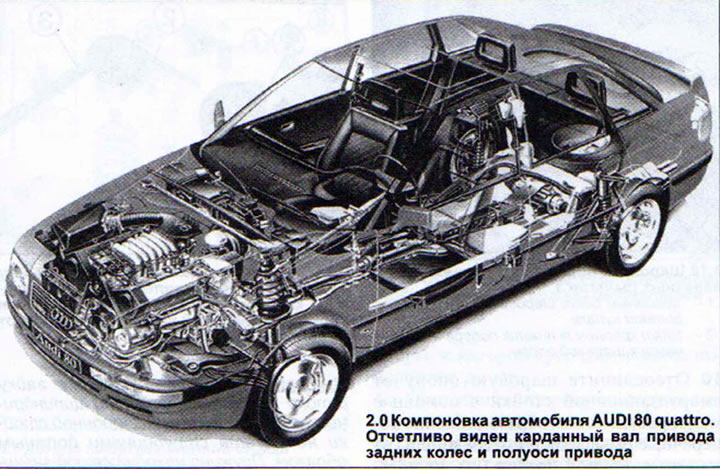
A well-known disadvantage of SUVs is the need to engage the rear-wheel drive only when driving on rough terrain. When driving on a flat road surface, this drive must be disengaged, because when turning, the radius of the front wheels is greater than the rear ones, and the car becomes difficult to control.
In AUDI 80 quattro cars, this problem is solved by means of the so-called distribution (interaxle) differential (torsen distribution differential), developed by Gleason, which provided permanent all-wheel drive. The operation of this differential is based on the principle of a worm drive (see illustration 2.0a).
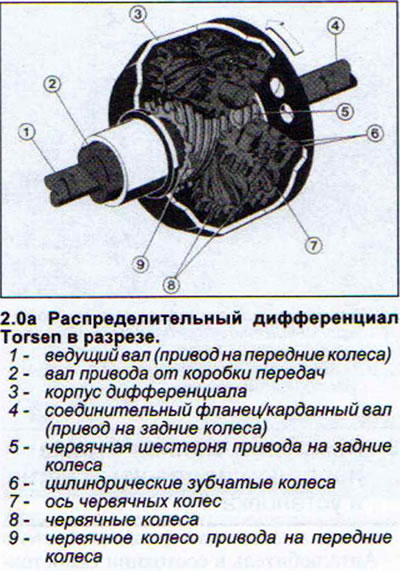
The Torsen designation is not given to the differential by chance, but is derived from two words that can be translated from English as "torque-sensitive". This is true, because when driving on a poor-quality road, the Torsen differential automatically directs the main traction force to those wheels that have the best grip on the road surface. When driving on a road with a smooth hard surface, on which the wheels of both the rear and front suspensions have the same degree of grip, there is an even distribution of the driving force and there is no need to turn off the differential, as is done in SUVs.
The specified differential made it possible to solve the problem of controllability on turns. Due to the fact that the radius of movement of the rear wheels when turning is smaller than that of the front wheels, and accordingly the number of their revolutions is also smaller, the distribution differential transfers more traction force to them, keeping the car on the desired trajectory. If, when turning at high speed, one of the rear wheels turns faster, the differential immediately redistributes the traction force and directs it to the front wheels, which are rotating more slowly at the moment. Such a quick reaction of the differential leads to the fact that at such a moment the front wheels begin to pull stronger and this stabilizes the position of the car.
Quattro cars - operating recommendations
The drive does not work on a raised front or rear axle. The same applies to a raised rear wheel if the differential is not engaged. When the cardan shaft is disconnected from the gearbox, the drive does not work.
The rear and front brakes can be tested alternately on a standard test stand, the speed of which is approximately 6 km/h. The drive to the wheels must be performed by the test stand. The differential lock or gear must not be engaged when testing the brakes.
The power test should only be performed on a stand that allows the vehicle to be positioned on all four wheels.
The car must be equipped with wheels of the same size and it is desirable that all tires have the same profile depth. Dynamic wheel balancing is only possible with all wheels raised. The wheels must be driven by the engine, not by the machine. Attention! Do not tighten the parking brake. It is also recommended to install winter tires on the quattro model. Anti-skid chains should also be installed if necessary.
Transportation of the damaged AUDI quattro is carried out in the usual manner, if it is working and stands on all four wheels. If at least one wheel does not turn or is raised, then it is recommended to transport the car by loading. Transportation by tow with the raised faulty wheel is allowed, if it is carried out over a distance of no more than 50 km and at a speed of no more than 50 km/h. The differential does not need to be engaged. If the above restrictions are exceeded, the gearbox may be damaged due to a lack of lubrication.
The rear-wheel drive differential in quattro vehicles has a wheel speed lock. This lock allows both rear wheels to rotate at the same speed, thus preventing one wheel from spinning. The lock is primarily intended to assist with starting off, especially on snowy, icy roads or when driving in mud. When the vehicle reaches a speed of over 25 km/h, the lock is automatically released.
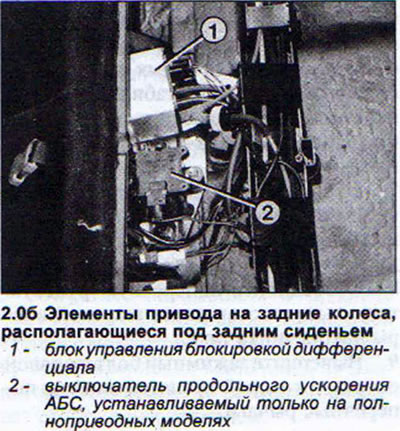
The lock must be turned on when the car is parked using the switch located on the central console. This command is executed by the electronic control unit. Located under the rear seat, it opens the supply of low-pressure air or, when the car reaches a speed of over 25 km/h, closes the supply of this air, thereby disabling the lock. Low-pressure air is taken from the intake manifold (see illustration 2.0b).
The original article is available on the website: AUDImanual.ru