Repair Chevrolet Repair Toyota Repair Honda Repair AvtoVAZ Repair Mercedes-Benz Repair BMW Repair Opel
Home  |  Contacts  |  Sitemap  |    
English Русский
Български
Беларускі
Український
Српски
Hrvatski
Română
Polski
Slovenský
Magyar
AudiManual.ru


  • AUDI 80
  • AUDI 100
  • AUDI A3
  • AUDI A4
  • AUDI A6
  • AUDI A8
  • AUDI Q
  • OTHER
  • ARTICLES
B8 (2007-2015) B7 (2004-2008) B6 (2000-2006) B6 (2000-2006, petrol) B5 (1994-2001) B5 (1994-2001, petrol)

High pressure fuel pump (HPFP) — removal, installation and adjustment (Audi A4 B5)

  • Home
  • Audi A4
  • B5 (1994-2001)
  • Power unit
  • Fuel system (diesel)
  • High pressure fuel pump (HPFP) — removal, installation and adjustment
            0
Table of contents: Removal ↓ Installation and adjustment ↓
Application: Before starting work, read the warnings in paragraph 1. Before initial setting of the injection timing, a dial indicator head and a suitable adapter are required.


Removal


1. Disconnect the negative battery cable as described in chapter 5A, move it away from the output.

2. Unscrew the nuts and remove the plastic cover from the top of the engine.

3. Remove the upper timing belt cover.

4. Remove the valve cover - see chapter 2B.

5. Set the piston of the first cylinder to TDC of the compression stroke, as described in chapter 2B. To perform this procedure you will need a camshaft locking bar.

6. Unscrew the connection bolts and remove the fuel lines from the high-pressure fuel pump. Note that the return line connection bolt has a built-in non-return valve (Fig. 6.6). Remove the sealing washers.

6. Unscrew the connection bolts and remove the fuel lines from the high-pressure fuel pump. Note…


7. Hang tags on the wiring connectors and disconnect it from the fuel injection pump.

8. Unscrew the connecting nuts of the fuel pipes to the injectors and the high-pressure fuel pump and remove them as a set (Fig. 6.8). When unscrewing the high-pressure fuel pump fittings, hold them with an open-end wrench. Try not to bend the pipes.
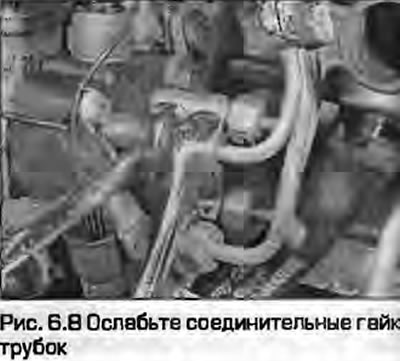


8. Unscrew the connecting nuts of the fuel pipes to the injectors and the high-pressure fuel pump…


9. Plug the holes in the tubes, nozzles and fuel injection pump fittings to prevent dirt from getting in.

10. Remove the timing belt tensioner as described in chapter 2B.

11. Attach a suitable tool to the fuel injection pump sprocket to hold it (Fig. 6.11).
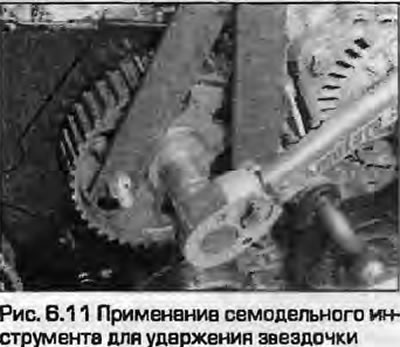
11. Attach a suitable tool to the fuel injection pump sprocket to hold it (Fig. 6.11).


12. Loosen the fuel injection pump sprocket mounting nut by one turn.

13. Using a suitable puller, remove the sprocket from the injection pump shaft (Fig. 6.13). When using the puller, do not apply great force or knock on the shaft to avoid damaging the pump.
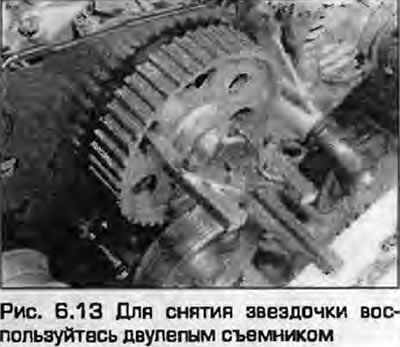
13. Using a suitable puller, remove the sprocket from the injection pump shaft (Fig. 6.13). When…


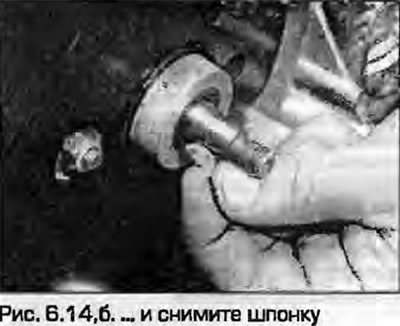
14. Unscrew the nut completely and remove the sprocket. Remove the key from the slot on the shaft (Fig. 6.14).
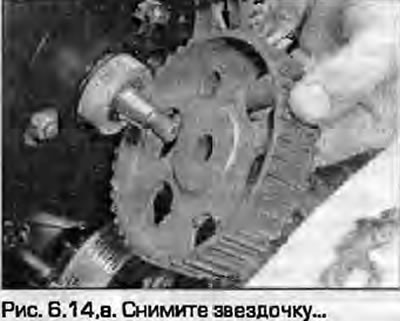


14. Unscrew the nut completely and remove the sprocket. Remove the key from the slot on the shaft…

15. To facilitate installation, mark the position of the pump on the bracket. Unscrew the front bolts securing the pump to the bracket. Access to the two inner bolts is possible from the front of the rear cover of the injection pump. Access to another bolt is possible from the injection pump side of the bracket.

16. Unscrew the rear mounting bolt and remove the pump from the mounting bracket (Fig. 6.16).
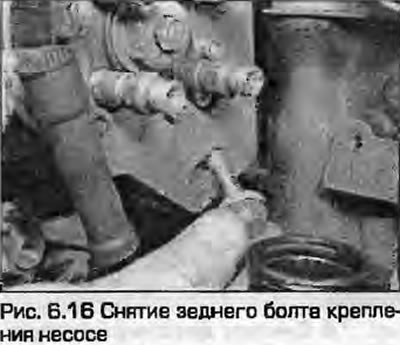
16. Unscrew the rear mounting bolt and remove the pump from the mounting bracket (Fig. 6.16).


Installation and adjustment


17. Mount the pump to the bracket and tighten the rear mounting bolt. Tighten the bolt and cone nut to the specified torque to center the pump.

18. Turn the pump to center it in the oblong holes in the front of the bracket, install the front mounting bolts and tighten them "finger tight" at this stage. If installing the previous pump, align the pre-marked marks and tighten the mounting bolts.

19. Insert the key into the slot on the pump shaft, put on the sprocket and tighten the nut. Holding the sprocket still with the tool used when unscrewing, tighten the nut to the specified torque.

20. Align the holes intended for installing the pump in the position corresponding to the TDC of the compression stroke of the first cylinder and insert the locking pin into them.

21. Install the timing belt and tensioner as described in chapter 2B.

22. Before connecting the wiring and fuel lines, perform the following adjustment.

23. Make sure that all TDC marks are aligned, remove the camshaft retaining plate and the pin from the fuel injection pump sprocket.

24. Unscrew the plug in the rear of the fuel pump, remove the sealing washer and screw in the adapter (adapter) with the indicator head (Fig. 6.24).
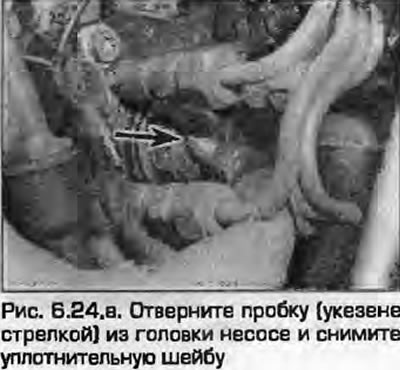
24. Unscrew the plug in the rear of the fuel pump, remove the sealing washer and screw in the…

25. Wind the indicator by 2 mm and smoothly turn the crankshaft counterclockwise until the indicator arrow stops. Wind the indicator by 1 mm. Zero the scale.


26. Slowly turn the engine clockwise until the mark on the flywheel/faceplate aligns with the indicator on the bell cutout. Do not turn the crankshaft further - the indication may be lost and the procedure will have to be repeated.

27. Indicator reading (plunger lift) in this position (initial injection advance) should be 0.7±0.2 mm.

28. If adjustment is required, loosen the pump mounting bolts by one turn and turn the pump until the required reading is achieved.

29. Tighten the pump mounting bolts to the specified torque, repeat the procedure and check the accuracy of the indicator readings.

30. Remove the indicator, screw in and tighten the plug with a new seal.

31. Install the fuel pipes between the injectors and the pump and tighten their nuts to the specified torque.

32. Connect the electrical wiring connectors to the pump.

33. Install the fuel lines by tightening the connection bolts with new sealing washers and tightening them to the specified torque. The bolt with the non-return valve is from the return line.

34. Install the valve cover as described in chapter 2B. Install the outer timing belt cover.

35. Connect the battery as described in chapter 5A.

36. Now the fuel injection pump must be bled with a hand pump. To drain fuel from the fuel injection pump, the Audi vacuum pump has a built-in container. Attach the pump to the return nipple of the fuel injection pump and pump until bubbles stop coming out of the pump. Do not allow fuel to enter the vacuum pump.

37. Connect the return line to the pump, start the engine and check for leaks.


38. Now it is necessary to check the dynamic injection advance. This requires specialized diagnostic equipment. Contact the dealer for assistance.

39. After completing the adjustment, always loosen the fuel line connection nuts and tighten them again to relieve stress that could cause them to break due to constant vibration.

40. Install the upper plastic engine cover.

(This article was previously published on the resource: AudiManual)
The article was checked by auto expert Timur Bazhenov
This article is available at russian, bulgarian, belarusian, ukrainian, serbian, croatian, romanian, polish, slovak, hungarian

Share information:
Previous articles
Audi A4 B5: Fuel system (diesel)
Next articles

Fuel tank — removal and installation
Fuel pump and fuel level indicator sensor unit
Accelerator Pedal Position Sensor — Removal, Installation and…
Air Cleaners and Air Intake Ducts — Removal and Installation
Injectors — general information, removal and installation
Diesel Engine Management System Components — Removal and…
Turbocharger — General information, removal and installation
Intercooler — removal and installation


Similar articles on other Audi car models:
Mechanical fuel pump — removal and installation Audi 80 B3 (1986-1991, petrol)
High pressure fuel pump — removal, installation and adjustment Audi 100 C3 (1982-1990, diesel)
Removal and installation the fuel pump / fuel level sensor Audi A3 Type 8L (1996-2003)
High pressure fuel pump (HPFP) — removal and installation Audi A6 C5 Allroad (1999-2005)
Removal and installation the engine Audi A8 D2 (1994-2002)
Removal the high pressure fuel pump Audi Q5 Type 8R (2008-2017)
Removal and installation the oil pressure sensor Audi A2 (1999-2005)
Link to this page in different formats


Visitor comments

No comments yet


How much will 49 + 37 =


A4(B8, 2007-2015) 
  • General information
  • Operating instructions
  • Power unit
  • Petrol engines 1.8 l
  • Petrol engines 1.8/2.0 l
  • Petrol engines 3.0 l
  • Petrol engines 3.2 l
  • Fuel system (petrol)
  • Diesel engines 2.0 l (CA*)
  • Diesel engines 2.0 l (CJCB)
  • Diesel engines 2.7/3.0 l
  • Diesel engines 3.0 l
  • Fuel system (diesel)
  • Transmission
  • Manual gearbox 0B1
  • Manual gearbox 0B2
  • Manual gearbox 0B3
  • Manual gearbox 0B4
  • Automatic transmission 0B5
  • Automatic transmission 0B6
  • Automatic transmission 0AW
  • All-wheel drive system
  • Chassis
  • Front suspension
  • Rear suspension
  • Brake system
  • Steering system
  • Body
  • Exterior
  • Interior
  • Seats
  • Doors, locks and windows
  • Security system
  • Heating and air conditioning
  • Electrical equipment
  • Audio system
  • Power devices
  • Equipment and devices
  • Lighting and lamps
  • Electrical circuits
 
A4(B7, 2004-2008) 
  • General information
  • Introduction to manual
  • Troubleshooting
  • Operating instructions
  • Maintenance
  • Power unit
  • Petrol engines 2.0 (ALT)
  • Petrol engines 2.0 (TFSI)
  • Petrol engines 1.8 (MPI)
  • Diesel engines
  • Cooling system
  • Air conditioner
  • Fuel and exhaust system
  • Ignition system
  • Starting and charging
  • Transmission
  • Clutch
  • Manual gearbox
  • Automatic gearbox
  • Drive shafts
  • Chassis
  • Brake system
  • Front suspension
  • Rear suspension
  • Steering
  • Body
  • Exterior
  • Interior
  • Electrical equipment
  • Equipment and devices
  • Lighting and signaling
  • Windscreen wipers and washers
  • Electrical diagrams
  • Electrical diagrams (since 2007)
 
A4(B6, 2000-2006) 
  • General information
  • Vehicle Description
  • User manual
  • Maintenance
  • Power unit
  • Gasoline engine
  • Diesel engine
  • Lubrication system
  • Cooling system
  • Supply system
  • Injection system
  • Exhaust system
  • Ignition and control
  • Transmission
  • Gear box
  • Clutch and drive shafts
  • Chassis
  • Brake system
  • Car suspension
  • Steering
  • Body
  • Heating and ventilation
  • Exterior (external elements)
  • Interior (internal elements)
  • Electrical equipment
  • Power devices
  • Lighting and appliances
  • Electrical circuits
 
A4(B6, 2000-2006, petrol) 
  • General information
  • Introduction to the guide
  • Car care
  • Power unit
  • Engine repair
  • Lubrication system
  • Cooling system
  • Injection and control system
  • Ignition system
  • Power and exhaust system
  • Transmission
  • Clutch and drive shafts
  • Car gearbox
  • Chassis
  • Suspension and wheels
  • Steering
  • Brake system
  • Body
  • Interior
  • Exterior
  • Electrical equipment
  • Equipment and devices
  • Lighting and signaling
  • Power devices
  • Electrical circuits
 
A4(B5, 1994-2001) 
  • General information
  • Introduction to the guide
  • Car care
  • Maintenance (gasoline)
  • Maintenance (diesel)
  • Power unit
  • Gasoline engines
  • Diesel engines
  • Engine overhaul
  • Cooling system
  • Fuel injection (gasoline)
  • Fuel system (diesel)
  • Exhaust system
  • Ignition system
  • Transmission
  • Clutch
  • Mechanical gearbox
  • Automatic gearbox
  • Drive shafts
  • Chassis
  • Brake system
  • Car suspension
  • Steering
  • Body
  • Exterior
  • Interior
  • Doors, locks and windows
  • Heating and ventilation
  • Electrical equipment
  • Power devices
  • Equipment and devices
  • Electrical circuits
 
A4(B5, 1994-2001, petrol) 
  • General information
  • Vehicle description
  • Maintenance
  • Power unit
  • Engine repair
  • Turbocharging
  • Exhaust system
  • Cooling system
  • Ignition system
  • Fuel system
  • Motronic injection system
  • MPI and MPFI injection system
  • Transmission
  • Clutch
  • Gearbox and shafts
  • Chassis
  • Steering
  • Car suspension
  • Brake system
  • Wheels and tires
  • Body
  • Heating and ventilation
  • Body parts
  • Electrical equipment
  • Fuses and relays
  • Power devices
  • Lighting and lamps
  • Tools and devices
  • Electrical circuits
 
AudiManual.ru © 2017-2026 · Mobile version · Feedback · Sitemap: EN BG BY UA RS HR RO PL SK HU · Site search · News and articles
80 B2 · 80 B3 petrol · 80 B3 · 80 B4 · 100 C3 diesel · 100 C3 petrol · 100 C3 · 100 C4 petrol · 100 C4 · A3 Type 8L · A4 B5 petrol · A4 B5 · A4 B6 petrol · A4 B6 · A4 B7 · A4 B8 · A6 C4 · A6 C5 · A6 C5 Allroad · A8 D2 · Q5 Type 8R · Q7 Typ 4L · Audi A2 ·
This site uses cookies 🍪. Click the button to accept this fact.