



Application: Before starting work, read the warnings contained in paragraph 1.
Attention! Under no circumstances should diesel fuel come into contact with the cooling system hoses - wipe up any accidental leaks immediately. If a hose has been in contact with fuel for a long time, it must be replaced. The diesel fuel system is particularly sensitive to dirt, air and water. When working with the fuel system, pay special attention to cleanliness. Before disconnecting the fuel system components, wipe the area around it clean. Store the removed components in a tightly closed container so that even condensation from the atmosphere does not accumulate in it. Use only lint-free rags for wiping.
General information
1. Injectors under normal operating conditions should not require repair or replacement for about 100,000 km. Proper inspection, maintenance and adjustment of injectors should be performed by a specialist. Defective injectors causing knocking or smoky exhaust can be found without removal as follows.
2. Start the engine and let it idle. Place a rag around the fuel line connections to the injectors to collect the fuel. Disconnect the injectors one by one by carefully unscrewing the connecting nuts. When you loosen the nut on the defective injector, the knocking and smoke will disappear.
Removal
Note: Do not allow dirt to enter the fuel system during the operation. Do not drop the injectors to avoid damaging the shut-off needles. The injectors are precision products that require delicate handling.
3. Cover the generator with a rag to avoid washing it down with fuel.
4. Thoroughly wipe the areas around the injectors and connecting pipes. Disconnect the return fuel hoses from the injectors.
5. Wipe clean the pipe connections and loosen the nuts securing them to the injectors and high-pressure fuel pump (the tubes are removed in one piece). When loosening the union nuts on the fuel injection pump nipples, hold the nipples with an open-end wrench to prevent them from being unscrewed from the pump. Remove the fuel pipes. Plug the pipes and nipples to prevent dirt from getting into the system.
6. Disconnect the wiring from the needle stroke sensor on injector #3.
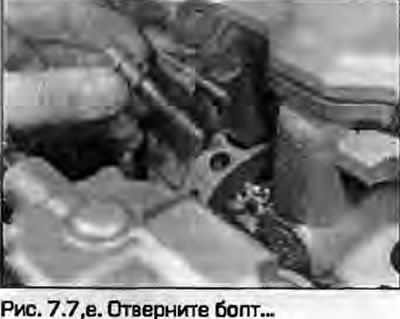
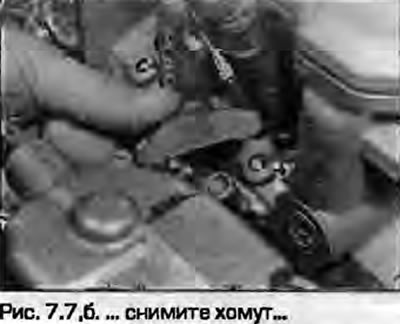
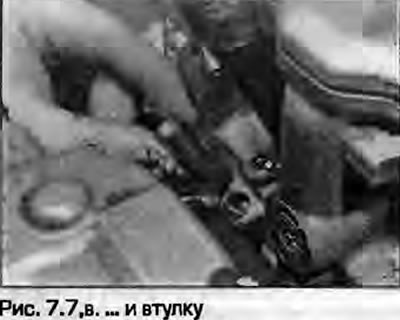
7. Unscrew the nuts (or bolts) securing the injector clamps. Remove the washers, cybvbnt clamps and bushings (fig. 7.7, a-c).
 |
 |
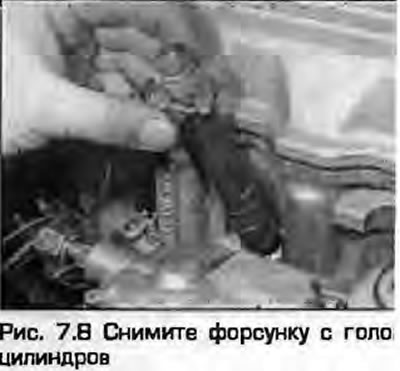
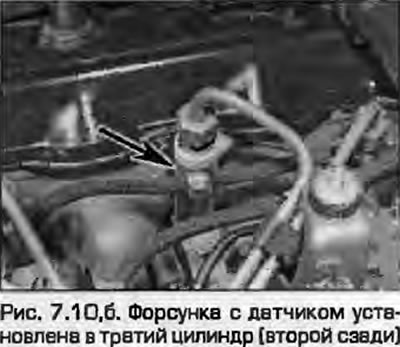
8. Remove the injectors from the cylinder head (Fig. 7.8). If the injectors are tightly seated, loosen them by rotating the flats with an open-end wrench. If this does not help, Audi specialists use a reverse hammer screwed to the thread of the injector connection with the tube. Note that the second injector from the back is higher than the others (third injector in 4-cylinder engines). It contains a needle lift sensor that transmits a signal to the engine control unit.
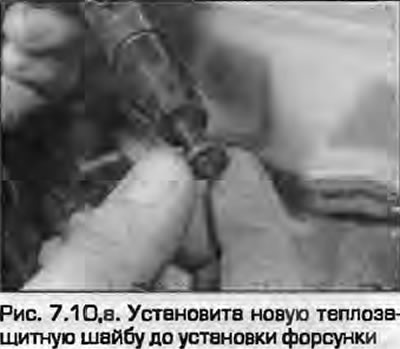
9. Using a screwdriver, remove the copper flame arrestor washers from their sockets in the cylinder head. New washers are required for installation.
Installation
10. Carefully insert the injectors into the sockets together with new sealing washers. The injector with the needle lift sensor is installed in the third cylinder (fig. 7.10, a, b).
 |
 |
11. Install the mounting bushings and clamps, secure them with bolts (or nuts) with washers, tightening to the specified torque.
12. Connect the wiring to the third injector needle lift sensor.
13. Install the stop beer tubes and tighten their connecting nuts to the specified torque.
14. Connect the return fuel hoses to the injectors.
15. Start the engine and make sure it operates normally.
(This publication is borrowed from the resource: AudiManual.ru)