



Table of contents: Removal ↓ Installation ↓
Fuel distribution line with injectors
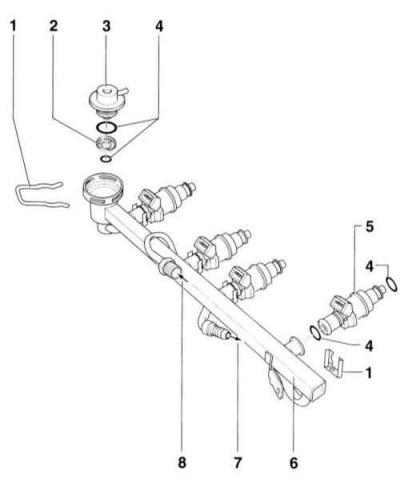
- 1 locking bracket. Ensure correct position on injector and line.
- 2 grid
- 3 fuel pressure regulator
- 4 sealing ring. Replace if damaged
- 5 injector
- 6 fuel distribution line
- 7 fuel return connection
- 8 fuel supply connection
Removal
1. Disconnect the vacuum hose and disconnect the switch valve connector at the intake manifold. Remove the spark plug connectors.
2. Remove the Allen screws (indicated by arrows) and tilt the top of the intake manifold.
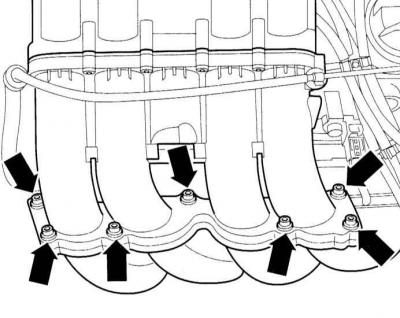
Disclaimer: Illustration shows 1.8L engine.
3. Disconnect the vacuum hose from the fuel pressure regulator.
Warning: The fuel system is under pressure! When opening the system, fuel may escape, collect it with a rag. Use protective glasses. Do not smoke, do not use open flames, fire hazard! Keep a fire extinguisher at hand.
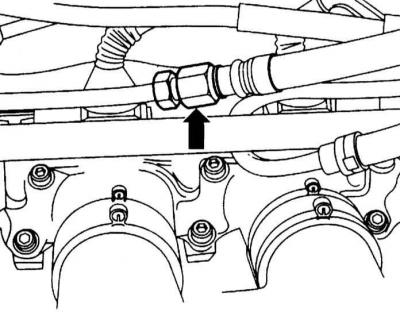
4. Disconnect the pressure line from the fuel distribution line and collect any leaking fuel with a rag.
5. Disconnect the connector to the injectors.
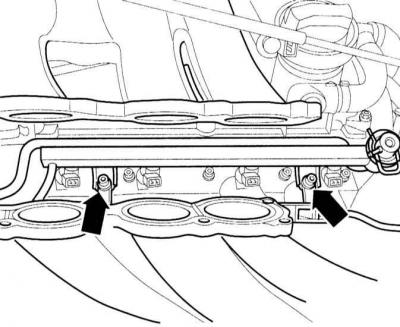
6. Unscrew the fuel distribution line mounting bolts and remove the injectors with the fuel distribution line from the exhaust manifold.
Warning: Illustration shows 150hp engine.
7. Remove the clamps connecting the injectors and the fuel rail. Remove the injectors from the fuel rail. The injectors are only inserted, not secured.
Warning: Do not swap injectors, install them in their original location.
Installation
Warning: When installing the injectors, be careful not to damage the sealing rings and the injectors in the cylinder head. Always replace the sealing rings with new ones. Do not remove the front plastic bushings from the injectors.
8. Lightly lubricate the O-rings with clean engine oil before installing them in place.
9. Insert the injectors vertically into the fuel rail until they stop and secure with clamps.
10. Carefully insert the line with injectors into the intake manifold and press it until it stops.
11. Install the mounting bolts, lightly press the fuel rail towards the intake manifold by hand and tighten the bolts to a torque of 10 Nm.
12. Connect the plug connections of the injectors.
13. Secure the feed line to the fuel rail.
14. Connect the vacuum line at the pressure regulator.
15. Secure the top of the intake manifold with a new gasket.
16. Connect the vacuum hose and the changeover valve connector at the intake manifold.
17. Connect the spark plug connectors.
Checking the injectors
Fuel injectors are electromagnetic valves opened and closed by the engine control unit, which determines the opening time and duration of fuel injection, depending on the engine crankshaft speed, throttle position, incoming air mass, incoming air temperature, coolant temperature and the presence of oxygen in the exhaust gases based on information received from sensors installed on and around the engine. The injectors spray fuel in a cone-shaped stream. After spraying the fuel, the injector valve does not close tightly, which may cause problems when starting a hot engine. If the injectors are faulty, the engine may continue to run after the ignition is turned off, in glow ignition mode.
18. Before checking the injectors, check the condition and functionality of the engine management system fuse, crankshaft speed sensor and fuel pump relay.
Checking the voltage supply to the injectors
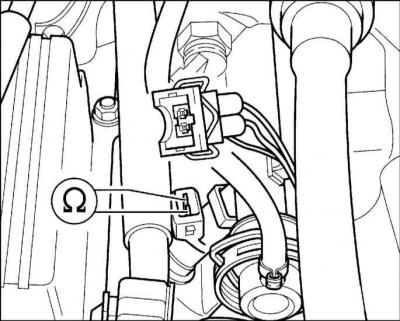
19. Disconnect the electrical connector from the injector of the first cylinder.
20. Connect the control LED to the connector contacts. When the engine crankshaft is turned by the starter, the LED should blink.
21. Similarly, check the voltage supply to the remaining fuel injectors.
The LED does not blink on any of the cylinders
22. Connect the test LED to terminal #1 of the electrical connector to supply voltage to the injector and to the vehicle ground. Connect terminal #2 of the electrical connector to the vehicle ground.
23. Turn the engine crankshaft with the starter. The LED should blink. Otherwise, check the entire electrical power supply circuit of the injectors.
The LED does not blink on only one or several cylinders
24. Check the condition of the injector power supply circuit, identify and eliminate the location of the electrical circuit break or short circuit to ground. Also check the operation of the engine control unit.
Resistance check
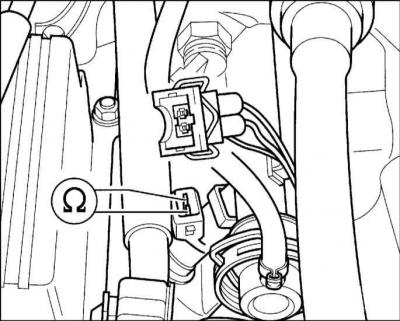
25. Disconnect the electrical connectors from the injectors one by one and, using an ohmmeter, check the resistance of the injectors, which should be between 12 and 17 ohms.
Warning: When the engine is warmed up to normal operating temperature, the resistance of the injectors increases by 4 – 6 Ohms.
26. If the injector resistance differs from the required value, replace it.
Checking the spray jet and the tightness of the injector valve
27. Disconnect the four-pin electrical connector from the coolant temperature sensor.
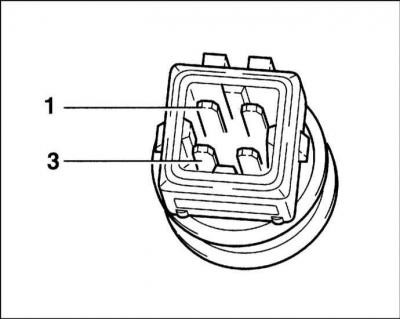
28. Short-circuit contacts 1 and 3 of the sensor with a 15 Ohm resistance.
29. Remove the fuel line together with the injectors without disconnecting the fuel hoses from it.
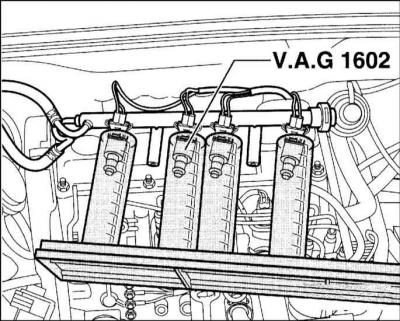
30. Insert the injectors into measuring vessels, such as VAG 1602.
31. Ask an assistant to turn on the starter for a few seconds. When the starter is running, the injectors should spray fuel. Check the fuel spray stream, which should be cone-shaped and the same for all injectors.
32. Turn off the ignition and check the injectors for leaks. No more than two drops of fuel should flow out of the injectors within 1 minute.
33. Install the fuel line together with the injectors on the engine. Before installation, check the condition and lubricate the injector sealing rings.
34. Connect the electrical connector to the coolant temperature sensor.
35. Connect the multi-pin electrical connector to the ignition coil control unit.
36. Install the upper engine cover.
Checking the pressure regulator
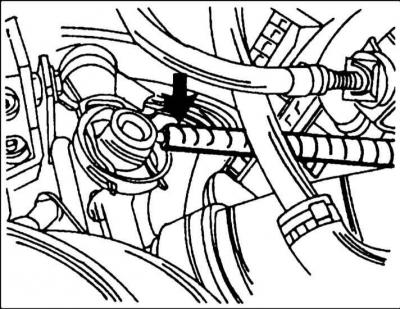
37. For precise measurement of fuel pressure, a special VAG1318 pressure gauge with additional parts is used, which allows measuring control values. The pressure at idle is 2.5 bar. When removing the vacuum hose in the place shown by the arrow, the pressure increases to 3.0 bar. After the engine stops, the pressure should be at least 2.3 bar. At the same time, the pressure after 10 minutes should drop to 2.0 bar.
Checking the coolant temperature sensor
38. The sensor has a dual purpose. First, it reports the engine coolant temperature and second, it connects to a remote thermometer on the instrument cluster. Sensor 2 is located on the back of the cylinder head. If air conditioning is installed, the second temperature sensor –1– is located in close proximity. To check, do the following:
39. Remove the sensor plug.
40. Connect an ohmmeter to the two contacts of the plug 1 and 3. On a cold engine and at room temperature, the ohmmeter reading should be between 1.5 and 3.0 kOhm. If this is not the case, install a new sensor.
Checking the intake air temperature sensor
The sensor is installed only on engines with a turbocharger. The sensor is installed next to the throttle control unit.
41. Remove the sensor plug.
42. Connect an ohmmeter to the sensor contacts. On a cold engine and at room temperature, the resistance should be 1.6 – 2.8 kOhm. Otherwise, replace the sensor.
Checking the air mass meter
If you do not have sufficient experience in electrical measurements, you can only check the voltage supply to the meter and the connection to the control unit. The air mass meters on the engine with and without a turbocharger are different. On the engine without a turbocharger, it is built into the air filter housing. A LED tester is required for checking.
43. Disconnect the plug from the air mass meter.
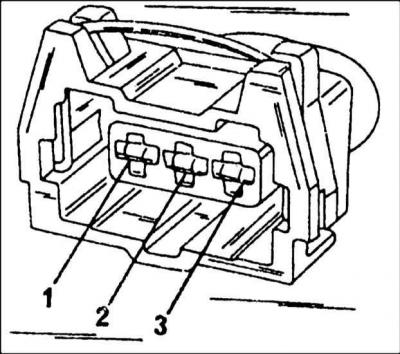
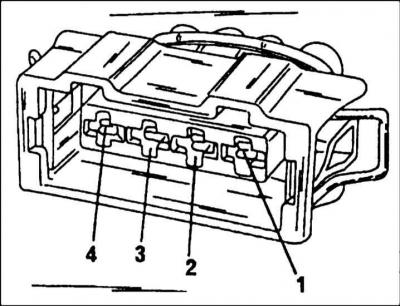
44. Connect the LED test leads between pin 3 of the plug and ground.
45. The assistant must turn on the starter (start the engine). If the LED lights up, then voltage is supplied to the meter.
46. To check the connections of the control unit, turn off the ignition and remove the plug from the unit. Now you need to check the flow of current.
47. On a non-turbocharged engine plug, connect an ohmmeter between terminal 1 on the control unit plug and terminal 2 of the air mass meter plug. Also measure the resistance between terminal 9 and terminal 2. In both cases, there should be continuity (0 ohms).