



Location of fuel system components in the TDI engine compartment
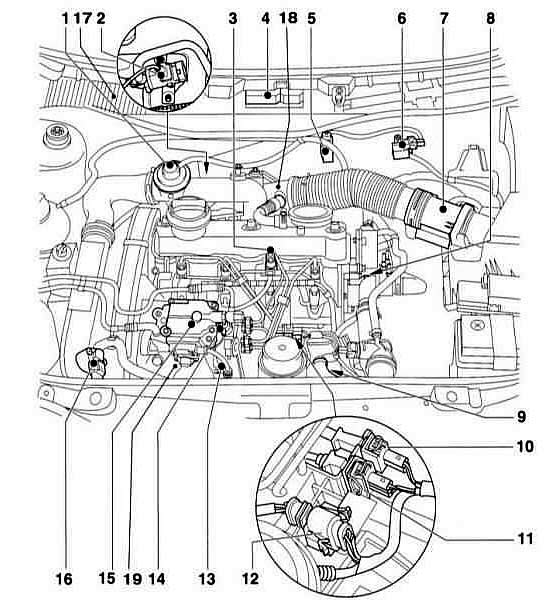
- 1 exhaust gas recirculation system valve
- 2 suction flap bypass valve
- 3 nozzle with needle movement sensor
- 4 control device
For direct fuel injection system. The height sensor is built into the control unit.
- 5 E/m EGR vacuum control valve
- 6 electromagnetic valve
To limit the pressure of the supplied air.
- 7 air mass meter
- 8 coolant temperature sensor
- 9 engine speed sensor
- 10 plug connection. Needle movement sensor.
- 11 plug connection of the engine speed sensor
- 12 plug connection of the high-pressure fuel pump
For coolant temperature sensor, quantity adjuster, throttle position sensor, fuel shut-off valve and injection start valve.
- 13 fuel injection start valve, oil pressure sensing valve
- 14 Fuel shut-off valve
- 15 executive body for regulating the amount of fuel injected by the high-pressure fuel pump
With fuel temperature sensor, quantity adjuster, and adjustment flap movement sensor.
- 16 Intake air pressure sensor with intake air temperature sensor. Other parts (not shown).
- 17 Transmission Control Unit
- 18 heating element of the PSV system
- 19 fuel temperature sensor, quality regulator, piston modulation displacement sensor
- And the brake pedal switch
- In the foot area, near the brake pedal.
- Into the brake light switch
- In the foot area, near the brake pedal.
- With gas pedal position sensor
- In the foot area, near the brake pedal.
- D clutch pedal switch
- In the foot area, near the clutch pedal.
Turbo Diesel Engine (TDI) Vacuum Pipes
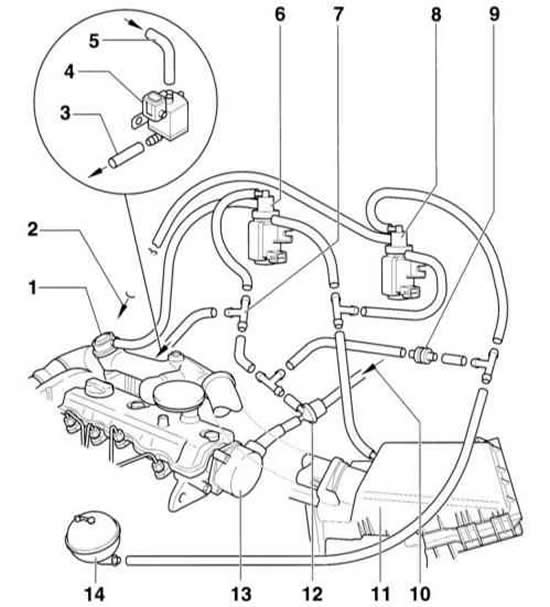
- 1 exhaust gas recirculation system valve
- 2 to the vacuum box for regulating the pressure of the supplied air. At the turbocharger.
- 3 to the vacuum box for the intake manifold flap
- 4 Switching valve for intake manifold flap
The intake manifold flap reduces jerks when the engine is stopped. The engine is not always equipped with AGR.
- 5 pipeline from tee –7–
- 6 exhaust gas recirculation adjustment valve
- 7 tee
- 8 electromagnetic valve for limiting the supply air pressure
- 9 check valve
- 10 from brake booster
- 11 air filter
- 12 check valve
- 13 vacuum pump
- 14 vacuum tank
Warning: The illustration shows ALH and AHF engines. AGR engines do not have a vacuum system to regulate the supply air pressure. Explanations of the operation of the exhaust gas recirculation system are given in the subsection Operation of the catalytic converter.
High pressure fuel pump
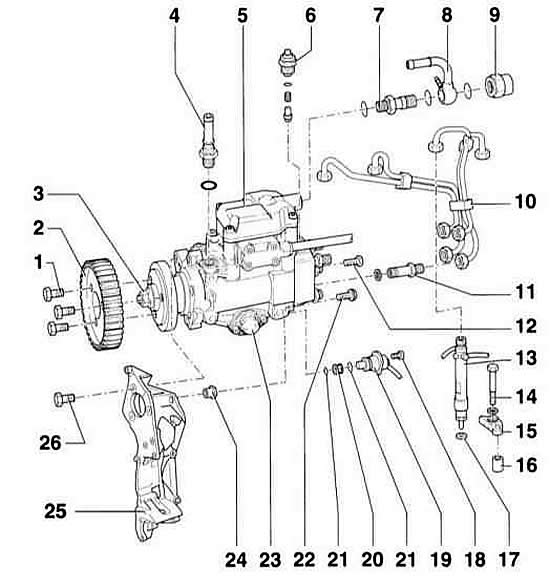
- 1 bolt, tightening torque: 20 Nm + 1/4 turn (90°). Be sure to replace.
- 2 toothed wheel of the fuel injection pump
- 3 nut. Do not unscrew.
- 4 connection nipple, 25 Nm. For the supply line, from the fuel filter.
- 5 high pressure fuel pumps
- 6 fuel shut-off valve, 40 Nm
- 7connecting nipple. For return pipeline.
- 8 return line. To the fuel filter.
- 9 nut, 25 Nm
- 10 high pressure pipes, 25 Nm
- 11 connecting nipple, 45 Nm
- 12 bolt, 25 Nm
- 13 injector. The injector of the third cylinder has a needle movement sensor.
- 14 bolt, 20 Nm
- 15 clamp
- 16 support
- 17 heat seal. Be sure to replace.
- 18 bolt, 10 Nm
- 19 fuel injection start valve
- 20 grid
- 21 O-ring. Be sure to replace.
- 22 bolt, 25 Nm
- 23 injection regulator cover
- 24 bushing with nut
- 25 console
- 26 bolt, 25 Nm
Here the injection pump directly injects fuel into the combustion chamber, namely, into the cavity in the piston. In this case, the injection pump creates a pressure of 900 bar and injects fuel in two stages.
Thanks to the multi-nozzle injectors and the two-spring injector holder, a small amount of fuel is first pre-injected, which, when burned, creates favorable conditions for the injection of the main amount of fuel. This injection process ensures soft and silent combustion, similar to swirl-chamber combustion. The amount of injected fuel is regulated by an electronic control device. The advantage of this injection is that fuel consumption is reduced by almost 20%. Signals from various sensors are used as control parameters for the injection process. These include:
- A pedal sensor that provides the control unit with information about the position of the gas pedal. There is no gas drive to the fuel injection pump.
- Speed sensor.
- Needle displacement sensor at the injector. Thanks to this sensor, the start of injection is determined and the injection process is regulated depending on the load and engine speed.
- Supply air pressure sensor.
- Supply air temperature sensor.
- Coolant temperature sensor.
- Fuel temperature sensor.
- Potentiometer for moving the regulating flap. The signals are used by the control unit as feedback for precise positioning of the regulating flap in the high-pressure fuel pump, which is an indicator of the actual amount of fuel injected.
To achieve high combustion quality, the intake duct is designed so that the air on its way to the combustion chamber receives a vortex trajectory. Due to the higher starting properties in the cold state of the direct injection engine, preheating is only required at temperatures below -10°C.
Before entering the injection pump, the fuel passes through the fuel filter. In the filter, the fuel is separated from water and contaminants. Therefore, it is important to remove water from the fuel and replace the filter element in a timely manner in accordance with the maintenance plan.
The high-pressure fuel pump does not require maintenance. The pump parts are lubricated with diesel fuel. The pump is driven by the crankshaft via a toothed belt.
Warning: When working on the fuel system of a diesel engine, safety and cleanliness measures must be observed.