
Repair Chevrolet Repair Toyota Repair Honda Repair AvtoVAZ Repair Mercedes-Benz Repair BMW Repair Opel
Home  |  Contacts  |  Sitemap  |    
English Русский
Български
Беларускі
Український
Српски
Hrvatski
Română
Polski
Slovenský
Magyar
AudiManual.ru


  • AUDI 80
  • AUDI 100
  • AUDI A3
  • AUDI A4
  • AUDI A6
  • AUDI A8
  • AUDI Q
  • OTHER
  • ARTICLES
Type 8L (1996-2003)

Operation of the catalytic converter (Audi A3 8L)

  • Home
  • Audi A3
  • Type 8L (1996-2003)
  • Power unit
  • Exhaust system
  • Operation of the catalytic converter
            0
Table of contents: Petrol engines ↓ Catalytic converter and exhaust gas… ↓
All engines are equipped with one or more catalytic converters to clean exhaust gases.

The catalytic converter has a central ceramic part of a honeycomb structure –3–, covered with a carrier layer. On the carrier layer are salts of noble metals, which act as converters. The catalytic converter is fixed in the housing –1– by means of an insulating support layer –2–, which simultaneously compensates for the thermal expansion of the catalytic converter.

Catalytic converter
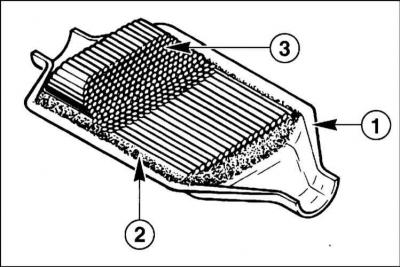


Catalytic converter

  • 1 building
  • 2 seal
  • 3 honeycomb catalytic converter

Petrol engines


In order to reduce harmful emissions with the help of a catalytic converter, the injection system must precisely dose the amount of injected fuel required for combustion. The oxygen sensor is located in the intake pipe before the catalytic converter and is washed by the flow of exhaust gases. The oxygen sensor is an electronic sensor that measures the oxygen content in the exhaust gases and represents it in the form of voltage fluctuations. Information from the oxygen sensor is transmitted to the injection system control unit. The obtained value allows you to adjust the composition of the air-gasoline mixture. On the one hand, this is necessary, since operating conditions are constantly changing (idle, full throttle), on the other hand, since optimal afterburning of fuel in the catalytic converter occurs only in this case if the exhaust gases contain a sufficient amount of fuel.


In order for the fuel to be burned in the catalyst, a temperature of 300–800°C is required. This requires a higher fuel content in the mixture than for clean combustion.

The catalytic converters used in gasoline engines are so-called three-functional devices. In the controlled conversion process, carbon monoxide (CO) and hydrocarbon (HC) are oxidized, and the concentration of nitrogen oxides (NOx) is reduced.

Gases at the inlet of the catalytic converter and products at its outlet
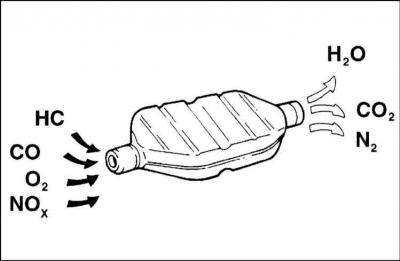


Gases at the inlet of the catalytic converter and products at its outlet


Catalytic converter and exhaust gas recirculation system of diesel engine


The exhaust gases of the diesel engine are also cleaned in a catalytic converter. This is an unregulated oxidation catalytic converter. This catalytic converter converts the carbon oxides and hydrocarbon compounds contained in the exhaust gases into CO₂ and H2O.

The reduction of nitrogen oxide (NOx) concentration in diesel engine exhaust gases is achieved by the presence of an additional exhaust gas regeneration system (eGR system).

The exhaust manifold of the engine contains a vacuum-controlled recirculation valve. Its task is to direct part of the exhaust gases into the combustion chambers of the engine, which helps to reduce the temperature of the exhaust gases and thereby reduce the concentration of harmful substances.

The original text is available on the website: AudiManual
The article was checked by auto expert Nikita Rudakov
This article is available at russian, bulgarian, belarusian, ukrainian, serbian, croatian, romanian, polish, slovak, hungarian

Share information:
Previous articles
Audi A3 Type 8L: Exhaust system
Next articles

Exhaust gas system
Safety precautions to avoid damage to the catalytic converter
Removal and installation of the exhaust system
Checking the exhaust system
Replacement of central/additional muffler


Similar articles on other Audi car models:
Vehicles equipped with a catalytic converter Audi 80 B3 (1986-1991)
Catalytic Converter — General Description and Precautions Audi 100 C3 (1982-1990, diesel)
Removal and installation of the catalytic converter and lambda… Audi A4 B6 (2000-2006)
Catalytic converter Audi A6 C5 (1997-2004)
Catalytic converter Audi A8 D2 (1994-2002)
Checking the operation of the master and slave clutch cylinders Audi Q5 Type 8R (2008-2017)
Removal and installation the inlet pipe with the catalytic… Audi A2 (1999-2005)
Link to this page in different formats


Visitor comments

No comments yet


How much will 18 + 44 =


A3(8L, 1996-2003) 
  • General information
  • User manual
  • Maintenance
  • Power unit
  • Engine repair
  • Lubrication system
  • Cooling system
  • Supply system
  • Fuel injection system
  • Exhaust system
  • Ignition system
  • Transmission
  • Manual transmission
  • Automatic transmission
  • Clutch and drive shafts
  • Chassis
  • Brake system
  • Front suspension
  • Rear suspension
  • Steering
  • Body
  • Ventilation and heating
  • Exterior (external elements)
  • Interior (internal elements)
  • Doors, covers and windows
  • Electrical equipment
  • Power devices
  • Lighting and appliances
  • Electrical circuits
 
AudiManual.ru © 2017-2026 · Mobile version · Feedback · Sitemap: EN BG BY UA RS HR RO PL SK HU · Site search · News and articles
80 B2 · 80 B3 petrol · 80 B3 · 80 B4 · 100 C3 diesel · 100 C3 petrol · 100 C3 · 100 C4 petrol · 100 C4 · A3 Type 8L · A4 B5 petrol · A4 B5 · A4 B6 petrol · A4 B6 · A4 B7 · A4 B8 · A6 C4 · A6 C5 · A6 C5 Allroad · A8 D2 · Q5 Type 8R · Q7 Typ 4L · Audi A2 ·
This site uses cookies 🍪. Click the button to accept this fact.