
Repair Chevrolet Repair Toyota Repair Honda Repair AvtoVAZ Repair Mercedes-Benz Repair BMW Repair Opel
Home  |  Contacts  |  Sitemap  |    
English Русский
Български
Беларускі
Український
Српски
Hrvatski
Română
Polski
Slovenský
Magyar
AudiManual.ru


  • AUDI 80
  • AUDI 100
  • AUDI A3
  • AUDI A4
  • AUDI A6
  • AUDI A8
  • AUDI Q
  • OTHER
  • ARTICLES
C5 Allroad (1999-2005) C5 (1997-2004) C4 (1994-1997)

Catalytic converter (Audi A6 C5)

  • Home
  • Audi A6
  • C5 (1997-2004)
  • Power unit
  • Exhaust system
  • Catalytic converter
            0
The catalytic converter is designed to reduce the amount of harmful substances emitted into the atmosphere with exhaust gases.

The catalytic converter of exhaust gases has a stainless steel housing, to which the inlet and outlet cones with pipes and fastening flanges, as well as heat reflectors holding the ceramic lining, are welded. The entire internal volume of the housing is filled with a ceramic porous monolith or a wire mesh made of heat-resistant stainless steel, which are fixed with rings. The structure of the monolith is a conventional filter, the internal and external surface of the pores of which, in contact with gases, are covered with a very thin molecular layer of an alloy of an active catalytic substance containing platinum, rhodium and palladium. The porosity of the monolith has a large surface area covered with this alloy of very expensive metals, which mainly determines the high price of the catalytic converter.

The catalytic converter causes a reaction that converts hazardous hydrocarbons and carbon monoxide in the exhaust gases into harmless gases and water vapor.

On vehicles with a catalytic converter, the fuel supply system is closed-loop, i.e. based on the signal from the lambda sensor installed in the exhaust system, the control unit constantly optimizes the composition of the fuel-air mixture. Depending on the oxygen content in the exhaust gases, the lambda sensor induces a voltage of 0.1 V (high oxygen, lean mixture) up to 0.9 V (low oxygen, rich mixture). Based on this data, the engine control unit changes the opening time of the fuel injectors and changes the fuel ratio in the fuel-air mixture. The stoichiometric ratio of the fuel mixture, at which its complete combustion occurs and there are no harmful substances in the exhaust gases, is 14.7 parts by weight of air to 1 part of fuel.


The catalytic converter operates effectively at temperatures of +300... +800°C.

Operation of vehicles with a catalytic converter


The catalytic converter is a reliable and simple device that does not require any maintenance, but there are some facts that the owner should know to ensure its maximum service life.

Do not use leaded gasoline in a vehicle equipped with a catalytic converter, as the lead will coat the precious metals in the converter grid, reducing the efficiency of their conversion and eventually causing damage to the converter.

Always keep the ignition and fuel system in good order.

If misfiring is observed while the engine is running, do not operate the vehicle until the problem is corrected.

If the engine control indicator lamp lights up while the engine is running, you should contact a service station as soon as possible. If there is damage to the engine control, then in addition to increased fuel consumption and reduced engine performance, the catalytic converter may fail.

Do not tow start the engine.

Do not turn off the ignition at high engine speeds.

Do not use fuel or motor oil additives as the additives may contain substances that can damage the catalytic converter.

Do not operate the vehicle if blue smoke is visible from the exhaust pipe.

After the engine has stopped, the exhaust system continues to emit a significant amount of heat for a long time, so you should avoid parking your car on grass and dry leaves.

Remember that the catalytic converter is fragile, so avoid impacts when removing the catalytic converter or exhaust system.


A catalytic converter used on a well-adjusted vehicle should last more than 100,000 km.
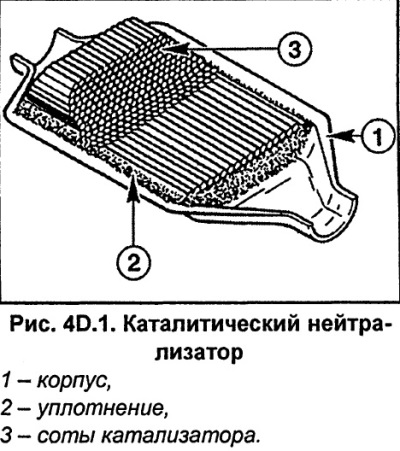
A catalytic converter used on a well-adjusted vehicle should last more than 100,000 km.
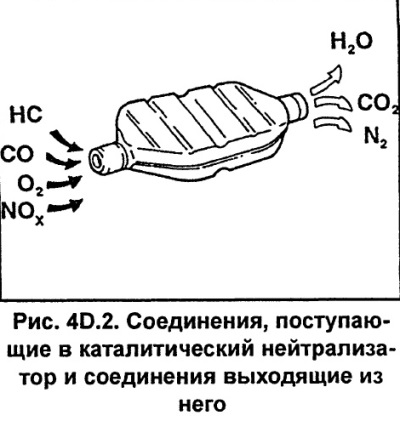

A catalytic converter used on a well-adjusted vehicle should last more than 100,000 km.
The article was checked by auto expert Alexey Ivanov
This article is available at russian, bulgarian, belarusian, ukrainian, serbian, croatian, romanian, polish, slovak, hungarian

Share information:
Previous articles
Audi A6 C5: Exhaust system
Next articles

General information
Exhaust gas system
Replacement of middle/rear mufflers
Checking the exhaust system
Lambda sensor


Similar articles on other Audi car models:
Vehicles equipped with a catalytic converter Audi 80 B3 (1986-1991)
Catalytic Converter — General Description and Precautions Audi 100 C3 (1982-1990, diesel)
Operation of the catalytic converter Audi A3 Type 8L (1996-2003)
Catalytic converter Audi A4 B6 (2000-2006)
Catalytic converter Audi A8 D2 (1994-2002)
Torque converter — removal and installation Audi Q5 Type 8R (2008-2017)
Removal and installation the inlet pipe with the catalytic… Audi A2 (1999-2005)
Link to this page in different formats


Visitor comments

No comments yet


How much will 36 + 17 =


A6(C5 AR, 1999-2005) 
  • General information
  • User manual
  • Maintenance
  • Troubleshooting
  • Power unit
  • V6 petrol engines
  • V8 petrol engines
  • Diesel engines
  • Cooling and heating system
  • Injection system (gasoline)
  • Fuel system (diesel)
  • Supply system
  • Exhaust system
  • Ignition system
  • Transmission
  • Clutch
  • Mechanical gearbox
  • Automatic gearbox
  • Chassis
  • Brake system
  • Car suspension
  • Steering
  • Body
  • Body elements
  • Doors, locks and windows
  • Electrical equipment
  • Equipment and devices
  • Power devices
  • Electrical circuits
  • Schemes (petrol engine 2.7 l)
  • Schemes (petrol engine 4.2 l)
  • Schemes (diesel engine 2.5 l)
 
A6(C5, 1997-2004) 
  • General information
  • User manual
  • Maintenance
  • Power unit
  • Engine repair
  • Cooling system
  • Fuel system
  • Engine management
  • Fuel system (diesel)
  • Exhaust system
  • Transmission
  • Clutch
  • Car gearbox
  • Chassis
  • Front suspension
  • Rear suspension
  • Steering
  • Wheels and tires
  • Brake system
  • Body
  • Exterior
  • Interior
  • Electrical equipment
  • Air conditioner
  • Equipment and devices
  • Electrical circuits
 
A6(C4, 1994-1997) 
  • General information
  • User manual
  • Maintenance (gasoline)
  • Maintenance (Diesel)
  • Gasoline engines
  • 4 cylinder engines
  • 5 cylinder engines
  • 6 cylinder engines
  • Diesel engines
  • 4 cylinder engines
  • 5 cylinder engines
  • Engine repair
  • Removal and reassembly
  • Cooling system
  • Single point injection system
  • Multipoint injection system
  • MPI/MPFI injection system
  • Fuel system (diesel)
  • Exhaust system
  • Ignition system
  • Transmission
  • Clutch
  • Manual transmission
  • Automatic transmission
  • Drive shafts
  • Chassis
  • Brake system
  • Front suspension
  • Rear suspension
  • Steering
  • Body
  • Exterior (external elements)
  • Interior (internal elements)
  • Electrical equipment
  • Power devices
  • Lighting and appliances
  • Electrical circuits
 
AudiManual.ru © 2017-2026 · Mobile version · Feedback · Sitemap: EN BG BY UA RS HR RO PL SK HU · Site search · News and articles
80 B2 · 80 B3 petrol · 80 B3 · 80 B4 · 100 C3 diesel · 100 C3 petrol · 100 C3 · 100 C4 petrol · 100 C4 · A3 Type 8L · A4 B5 petrol · A4 B5 · A4 B6 petrol · A4 B6 · A4 B7 · A4 B8 · A6 C4 · A6 C5 · A6 C5 Allroad · A8 D2 · Q5 Type 8R · Q7 Typ 4L · Audi A2 ·
This site uses cookies 🍪. Click the button to accept this fact.