



Table of contents: Safety instructions ↓ Checking the density of the coolant ↓ Topping up the coolant ↓
A low coolant level is indicated by a warning light in the instrument cluster.
Before every long-distance trip, the coolant level should be checked.
For topping up, it is necessary to use low-temperature concentrate G12 A8D or concentrate with the specification TL-VW 774 D (pay attention to the inscription on the container) and clean water with low lime content.
Safety instructions
When opening the expansion tank cap on a hot engine, be careful, as the escaping steam can cause severe burns. To do this, cover the expansion tank cap with a thick layer of cloth and slowly unscrew the cap until a hissing sound is heard. After the hissing stops, slowly unscrew and remove the cap from the expansion tank. Remove the cap from the expansion tank only at temperatures below +90°C.
The coolant level on a cold engine (coolant temperature about 20°C) should be between the MIN and MAX marks on the expansion tank (see fig. 1.10). When the engine is hot, the coolant level should be near the MAX mark.
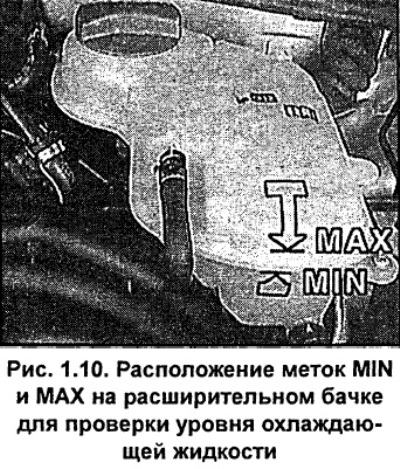
Large quantities of cold coolant can only be added to a cold engine to avoid engine damage.
Unscrew the expansion tank cap, first relieve the residual pressure in the cooling system, then completely unscrew the cap.
If the coolant level drops significantly in a short period of time, determine and correct the cause of the fluid leak.
Checking the density of the coolant
Before the winter season, check the density of the low-temperature concentrate, especially if distilled water was added to the cooling system during the warm season.
To check the density, you need to use a HAZET 4810 hydrometer or similar.
Warm up the engine briefly until the upper radiator hose is slightly warm. When measuring the density, the coolant temperature should be 20°C.
Unscrew the expansion tank cap, first relieve the residual pressure in the cooling system, then completely unscrew the cap.
Fill the hydrometer with coolant and use the scale on the float to determine its density (see fig. 1.11).
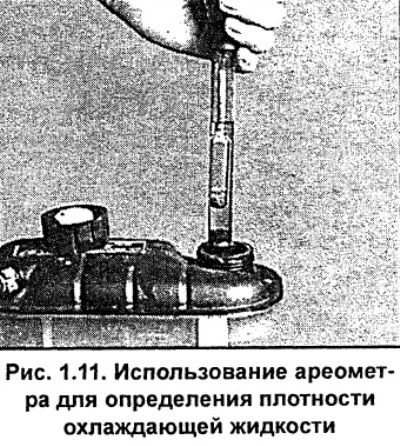
Use the table to determine the freezing point of the coolant depending on its density. The freezing point should be between -25°C and -35°C.
Topping up the coolant
In the temporary absence of low-temperature concentrate G12 A8D, do not add any other concentrate to the system. In this case, only distilled water can be added, at the first convenient opportunity, it is necessary to restore the required composition of the cooling liquid by adding the recommended low-temperature concentrate.
For protection against frost down to -25°C, the proportion of concentrate in the coolant should be 40%. For protection against frost down to -35°C, water and concentrate should be mixed in a 1:1 ratio.
Attention. The proportion of antifreeze should not exceed 60% (which corresponds to protection up to -40°C), since otherwise the protective and cooling properties of the coolant will decrease.
It is not recommended to use the previously used mixture of antifreeze and anti-corrosion agent G11, which is green. It is prohibited to mix anti-corrosion agents G11 and G12 A8D (red color), as this may cause serious damage to the engine.
Note: If the cooling system was filled with a coolant not recommended by the manufacturer, drain it from the cooling system. Fill the cooling system with clean water and run the engine at idle speed for 2 minutes. Drain the water from the cooling system and blow compressed air through the expansion tank into the engine cooling system. Fill with fresh coolant recommended by the manufacturer.
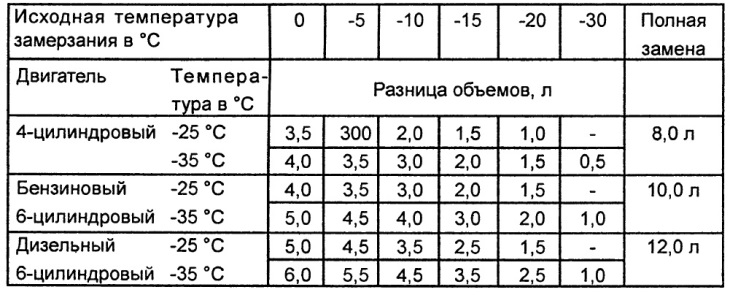
The table shows how much low-temperature concentrate G12 A8D must be added to obtain the required concentration (density) of the coolant. The table only provides reference figures, since the volumes of coolant differ for each specific engine.
Example. Density measurement showed that the freezing point of the coolant is -10°C for a 4-cylinder petrol engine. In this case, 2 litres of coolant must be removed from the cooling system and 2 litres of pure concentrate G12 A8D must be added instead. In this case, the freezing point of the coolant will be -25°C.
Install the cap on the expansion tank. Test drive and re-measure the coolant density.
(This article was copied from the website: «audimanual»)