
Repair Chevrolet Repair Toyota Repair Honda Repair AvtoVAZ Repair Mercedes-Benz Repair BMW Repair Opel
Home  |  Contacts  |  Sitemap  |    
English Русский
Български
Беларускі
Український
Српски
Hrvatski
Română
Polski
Slovenský
Magyar
AudiManual.ru


  • AUDI 80
  • AUDI 100
  • AUDI A3
  • AUDI A4
  • AUDI A6
  • AUDI A8
  • AUDI Q
  • OTHER
  • ARTICLES
B8 (2007-2015) B7 (2004-2008) B6 (2000-2006) B6 (2000-2006, petrol) B5 (1994-2001) B5 (1994-2001, petrol)

Checking the coolant level (Audi A4 B5)

  • Home
  • Audi A4
  • B5 (1994-2001, petrol)
  • Power unit
  • Cooling system
  • Checking the coolant level
            0
Table of contents: Constant control ↓ Adding coolant ↓ Antifreeze ↓

Constant control


Despite the equipment for monitoring the temperature and coolant level, you should not rely only on the indicator, but also periodically check the coolant level in the expansion tank in the engine compartment.
  • The coolant level can only be accurately checked when the engine is not running.
  • The fluid level is clearly visible in the transparent expansion tank even with the cap closed. When the engine is cold, it should be between the markings.
  • When the engine is hot, the level is naturally higher.

Adding coolant


A noticeable loss of coolant is a sign of some malfunction or defect. Coolant is not consumed and cannot evaporate from a closed cooling system. Sometimes, when the engine overheats, a small amount of coolant may be squeezed out to the sealing cap. If there is a constant loss of coolant, the cooling system should be checked for leaks as described later in the chapter.

1. If the expansion tank cap is opened when the engine is hot, there is a risk of scalding – so exercise extreme caution.

2. Slowly open the locking cap with a gloved hand or a rag, first by one turn and release excess pressure from the cooling system. Only then unscrew the cap completely.

3. If water is added, the antifreeze is gradually diluted, so add a little antifreeze at once.

4. Do not fill the coolant above the "MAX" mark; the coolant expands when heated and the excess flows out of the system.

5. You can add small amounts of coolant to the top-up tank both when the engine is warm and when it is cold.


6. If there is a significant loss of coolant and the engine is hot, do not pour cold liquid into the expansion tank. Due to "cold shock", the cylinder head may be deformed or the engine block may crack.

Antifreeze


Antifreeze


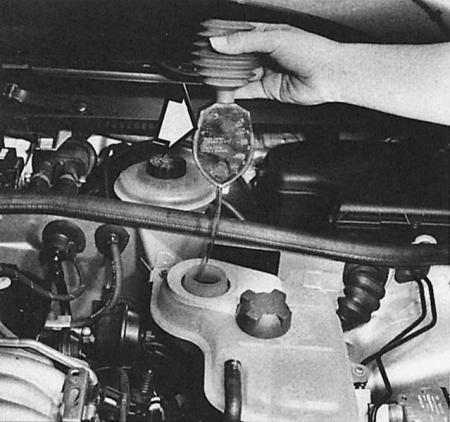
Here the concentration of antifreeze is checked by the analyzer (arrow).

In the cooling system, it is not distilled water alone that provides the necessary engine cooling, but a mixture of water, antifreeze and anticorrosive agent. Therefore, it is more accurate to talk about a cooling liquid or a cooling agent. The ratio of elements in the mixture for European conditions is 2:3, in northern countries 1:1.

Engine
Freeze protection up to
Water
Antifreeze
Four-cylinder engine
–25°C
–35°C
4.0 l
3.5 l
3.0 l
3.5 l
Six-cylinder engine
–25°C
–35°C
3.5 l
3.0 l
2.5 l
3.0 l


Ethylene glycol, an alcohol-based liquid that does not evaporate or evaporate, serves as an antifreeze. Just as protection against freezing is important, protection against corrosion is also important. The anticorrosive agent prevents the formation of scale, rust and other corrosion products in the cooling system. Therefore, the coolant filled at the factory cannot be drained in the spring; it remains in the cooling system throughout the year.


Audi workshops use their own antifreeze "G 011 A8 C". In the factory configuration, it is also allowed to use other products that have the mark "in accordance with TL VW 774 C". It is possible that due to a different concentration, other proportions are formed in the mixture, which differ from the information given in the table. Therefore, for the sake of safety, pay attention to the data on the packaging. However, antifreeze from different manufacturers can be mixed without fear.

[The original text of the material can be found on the website AUDIMANUAL.RU]
The article was checked by auto expert Georgy Rodionov
This article is available at russian, bulgarian, belarusian, ukrainian, serbian, croatian, romanian, polish, slovak, hungarian

Share information:
Previous articles
Audi A4 B5: Cooling system
Next articles

This is how cooling occurs
Antifreeze check
Checking the cooling system for leaks
Radiator — removal and installation
Cooling system locking cap


Similar articles on other Audi car models:
Coolant — Checking the Level Audi 80 B4 (1991-1996)
Checking the coolant level Audi 100 C4 (1990-1994, petrol)
Checking the transmission oil level of the manual transmission Audi A3 Type 8L (1996-2003)
Coolant — Checking the Level Audi A6 C5 Allroad (1999-2005)
Checking the oil level in a manual transmission Audi A8 D2 (1994-2002)
Replacing the coolant, checking and adjusting its level,… Audi Q7 Typ 4L (2005-2015, diesel)
Engine — Checking Oil Level Audi A2 (1999-2005)
Link to this page in different formats


Visitor comments

No comments yet


How much will 12 + 20 =


A4(B8, 2007-2015) 
  • General information
  • Operating instructions
  • Power unit
  • Petrol engines 1.8 l
  • Petrol engines 1.8/2.0 l
  • Petrol engines 3.0 l
  • Petrol engines 3.2 l
  • Fuel system (petrol)
  • Diesel engines 2.0 l (CA*)
  • Diesel engines 2.0 l (CJCB)
  • Diesel engines 2.7/3.0 l
  • Diesel engines 3.0 l
  • Fuel system (diesel)
  • Transmission
  • Manual gearbox 0B1
  • Manual gearbox 0B2
  • Manual gearbox 0B3
  • Manual gearbox 0B4
  • Automatic transmission 0B5
  • Automatic transmission 0B6
  • Automatic transmission 0AW
  • All-wheel drive system
  • Chassis
  • Front suspension
  • Rear suspension
  • Brake system
  • Steering system
  • Body
  • Exterior
  • Interior
  • Seats
  • Doors, locks and windows
  • Security system
  • Heating and air conditioning
  • Electrical equipment
  • Audio system
  • Power devices
  • Equipment and devices
  • Lighting and lamps
  • Electrical circuits
 
A4(B7, 2004-2008) 
  • General information
  • Introduction to manual
  • Troubleshooting
  • Operating instructions
  • Maintenance
  • Power unit
  • Petrol engines 2.0 (ALT)
  • Petrol engines 2.0 (TFSI)
  • Petrol engines 1.8 (MPI)
  • Diesel engines
  • Cooling system
  • Air conditioner
  • Fuel and exhaust system
  • Ignition system
  • Starting and charging
  • Transmission
  • Clutch
  • Manual gearbox
  • Automatic gearbox
  • Drive shafts
  • Chassis
  • Brake system
  • Front suspension
  • Rear suspension
  • Steering
  • Body
  • Exterior
  • Interior
  • Electrical equipment
  • Equipment and devices
  • Lighting and signaling
  • Windscreen wipers and washers
  • Electrical diagrams
  • Electrical diagrams (since 2007)
 
A4(B6, 2000-2006) 
  • General information
  • Vehicle Description
  • User manual
  • Maintenance
  • Power unit
  • Gasoline engine
  • Diesel engine
  • Lubrication system
  • Cooling system
  • Supply system
  • Injection system
  • Exhaust system
  • Ignition and control
  • Transmission
  • Gear box
  • Clutch and drive shafts
  • Chassis
  • Brake system
  • Car suspension
  • Steering
  • Body
  • Heating and ventilation
  • Exterior (external elements)
  • Interior (internal elements)
  • Electrical equipment
  • Power devices
  • Lighting and appliances
  • Electrical circuits
 
A4(B6, 2000-2006, petrol) 
  • General information
  • Introduction to the guide
  • Car care
  • Power unit
  • Engine repair
  • Lubrication system
  • Cooling system
  • Injection and control system
  • Ignition system
  • Power and exhaust system
  • Transmission
  • Clutch and drive shafts
  • Car gearbox
  • Chassis
  • Suspension and wheels
  • Steering
  • Brake system
  • Body
  • Interior
  • Exterior
  • Electrical equipment
  • Equipment and devices
  • Lighting and signaling
  • Power devices
  • Electrical circuits
 
A4(B5, 1994-2001) 
  • General information
  • Introduction to the guide
  • Car care
  • Maintenance (gasoline)
  • Maintenance (diesel)
  • Power unit
  • Gasoline engines
  • Diesel engines
  • Engine overhaul
  • Cooling system
  • Fuel injection (gasoline)
  • Fuel system (diesel)
  • Exhaust system
  • Ignition system
  • Transmission
  • Clutch
  • Mechanical gearbox
  • Automatic gearbox
  • Drive shafts
  • Chassis
  • Brake system
  • Car suspension
  • Steering
  • Body
  • Exterior
  • Interior
  • Doors, locks and windows
  • Heating and ventilation
  • Electrical equipment
  • Power devices
  • Equipment and devices
  • Electrical circuits
 
A4(B5, 1994-2001, petrol) 
  • General information
  • Vehicle description
  • Maintenance
  • Power unit
  • Engine repair
  • Turbocharging
  • Exhaust system
  • Cooling system
  • Ignition system
  • Fuel system
  • Motronic injection system
  • MPI and MPFI injection system
  • Transmission
  • Clutch
  • Gearbox and shafts
  • Chassis
  • Steering
  • Car suspension
  • Brake system
  • Wheels and tires
  • Body
  • Heating and ventilation
  • Body parts
  • Electrical equipment
  • Fuses and relays
  • Power devices
  • Lighting and lamps
  • Tools and devices
  • Electrical circuits
 
AudiManual.ru © 2017-2026 · Mobile version · Feedback · Sitemap: EN BG BY UA RS HR RO PL SK HU · Site search · News and articles
80 B2 · 80 B3 petrol · 80 B3 · 80 B4 · 100 C3 diesel · 100 C3 petrol · 100 C3 · 100 C4 petrol · 100 C4 · A3 Type 8L · A4 B5 petrol · A4 B5 · A4 B6 petrol · A4 B6 · A4 B7 · A4 B8 · A6 C4 · A6 C5 · A6 C5 Allroad · A8 D2 · Q5 Type 8R · Q7 Typ 4L · Audi A2 ·
This site uses cookies 🍪. Click the button to accept this fact.