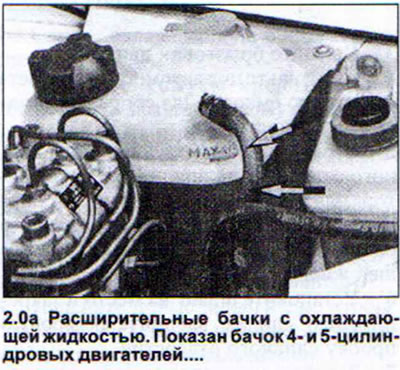
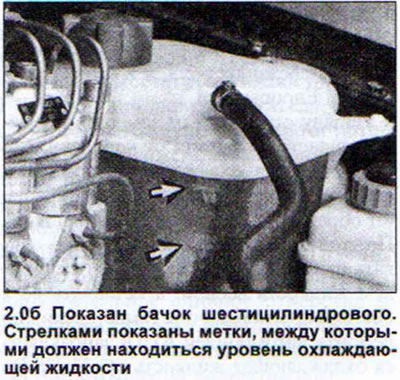
A noticeable drop in the coolant level in the expansion tank is a sign of a malfunction or defect in the cooling system. The coolant circulates in a closed space and does not evaporate. A leak in the form of steam is possible only when the engine overheats.
The coolant in the system is replenished through the expansion tank.
Caution! When the engine is hot, before removing the cap from the filler neck of the tank, place a rag on it or use work gloves to avoid burns.
1. Unscrew the cap one turn and thus release the pressure in the system. Only then completely unscrew and remove the cap.
2. Fill with coolant until its level in the expansion tank reaches the "MAX" mark. Do not fill the liquid above this mark. When heated, the liquid will expand and excess liquid will be squeezed out of the tank.
A small amount of coolant can be poured into the expansion tank both when the engine is cold and when it is hot. However, if there is a significant loss of coolant, do not pour coolant into the expansion tank when the engine is still hot. This may cause deformation of the cylinder head or rupture of the cylinder block.
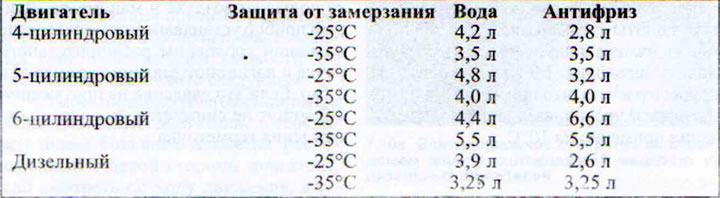
Coolant is not only water. The liquid is a mixture of antifreeze, water and anti-corrosion additives. The ratio of water to antifreeze in coolant for cars used in Western and Eastern Europe is 2:3, and in Northern Europe - 1:1.
In addition to protection against freezing, protection against corrosion is also important. Anti-corrosion additives contained in the coolant prevent the formation of scale, rust, etc. For this reason, it is recommended not to drain the liquid filled by the manufacturer in the spring, but to leave it in the system all year round. In AUDI car repair shops, the coolant "G 11 V8 B" of AUDI's own development is filled. It is permissible to fill with coolant from other manufacturers, on the packaging of which it is indicated that the liquid is manufactured in accordance with the standard "TL VW 774 B".