



The water pump is driven by a V-belt in a four-cylinder engine, and a toothed belt in a six-cylinder engine. The path the coolant takes through the countless hoses and channels depends on its temperature at the given moment.
- If the engine is not yet warmed up, the coolant moves along the "small circuit" that goes through the engine and the heating heat exchanger. Depending on the engine model, an oil radiator is additionally connected to the small coolant circulation circuit.
- At temperatures above 87°C, the thermostat opens the "large circuit" in which the radiator is connected.
- If the temperature continues to rise further, so that even in the radiator environment it reaches 82°C, the viscous clutch of the radiator fan switches to a rigid direct drive - the fan also rotates.
- In vehicles with an electric radiator fan drive (air conditioning system) the fan is switched on when the temperature in the radiator reaches approximately 92°C.
High pressure cooling system
At operating temperature, the cooling system experiences increased pressure of 1.2–1.5 bar, which significantly increases the boiling point of water – above 100°C under normal conditions. This creates a reserve, the engine can reach operating temperatures above 100°C, and there is no "danger of liquid boiling" in the cooling system.
The correct pressure in the cooling system is ensured by the expansion tank shut-off cap, which contains a high-pressure safety valve (approx. 1.2–1.5 bar) and a low-pressure safety valve (0.06–0.1 bar).
The low pressure valve allows air flow when the coolant temperature drops and therefore occupies less volume.
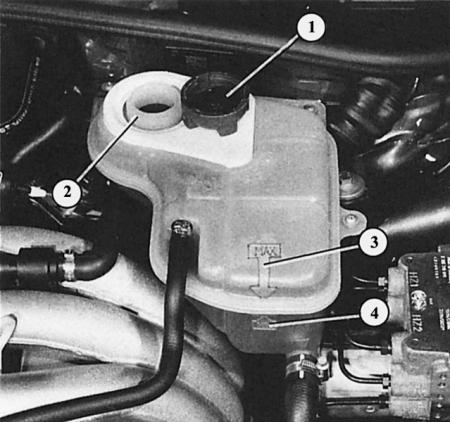
In the shut-off cap (1) of the cooling system, on the filler pipe (2) of the expansion tank, there are high-pressure and low-pressure valves. On the side of the transparent tank there is a liquid level marking (3 and 4).
The text is based on materials from the website: AUDIMANUAL