
Repair Chevrolet Repair Toyota Repair Honda Repair AvtoVAZ Repair Mercedes-Benz Repair BMW Repair Opel
Home  |  Contacts  |  Sitemap  |    
English Русский
Български
Беларускі
Український
Српски
Hrvatski
Română
Polski
Slovenský
Magyar
AudiManual.ru


  • AUDI 80
  • AUDI 100
  • AUDI A3
  • AUDI A4
  • AUDI A6
  • AUDI A8
  • AUDI Q
  • OTHER
  • ARTICLES
B8 (2007-2015) B7 (2004-2008) B6 (2000-2006) B6 (2000-2006, petrol) B5 (1994-2001) B5 (1994-2001, petrol)

Removal and installation of pump-injectors (Audi A4 B7)

  • Home
  • Audi A4
  • B7 (2004-2008)
  • Power unit
  • Fuel and exhaust system
  • Removal and installation of pump-injectors
            0
Table of contents: Diesel engines 1.9 and 2.0 SOHC ↓ Diesel engines 2.0 DOHC ↓

Diesel engines 1.9 and 2.0 SOHC


1. Remove the cylinder head cover (see Chapter 2).

2. Turn the crankshaft so that both cams of the corresponding unit injector are facing upward.

3. Loosen the locknuts of the adjusting bolts (1 in the illustration) on all unit injectors and unscrew the adjusting bolts so that each rocker arm contacts the push spring of the corresponding unit injector. Remove the rocker arm shaft by unscrewing the bolts (2), starting with the outer ones. Unscrew the bolt (3) and remove the retaining block.
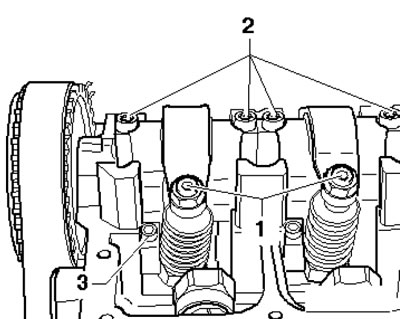
9.3. Removing the retaining block

9.3. Removing the retaining block


4. Using a screwdriver, press the connector away from the pump-injector (see illustration). Gently press the opposite side of the connector with your finger to prevent it from becoming crooked.
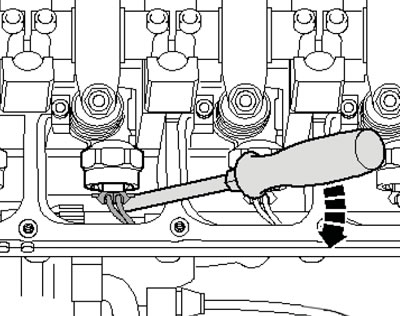
9.4. Electrical wiring connector

9.4. Electrical wiring connector


5. Insert the T10055 puller into the groove on the side of the unit injector in place of the retaining block and pull the unit injectors out of the cylinder head by pulling and slightly rocking the device (see illustration).
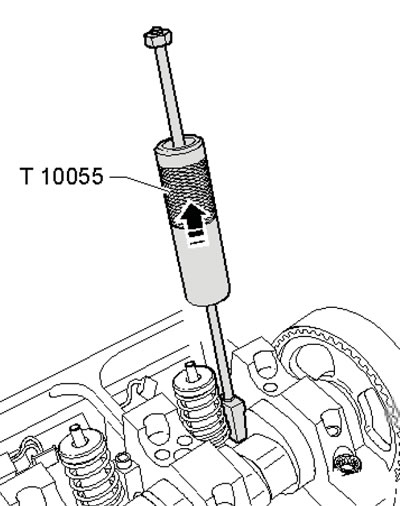
9.5. Removing the pump-injector

9.5. Removing the pump-injector


6. New unit injector bolts will be required for installation. When replacing a unit injector, the corresponding adjusting bolt on the rocker arm must also be replaced. When installing old unit injectors, the sealing rings and insulating gasket must be replaced.

7. Make sure that the sealing rings are not twisted, lubricate them and the guide of the unit injector in the cylinder head. Very carefully insert the unit injector into the seat of the cylinder head and press it until it stops. Insert the retaining block.

8. If the unit injector is not installed at a right angle to the retaining block, the mounting bolt may come loose, which will result in damage to the unit injector or cylinder head. To align the unit injector, screw a new mounting bolt into the retaining block so that the unit injector can be slightly rotated, then align the unit injector at an angle to the camshaft bearing elevations and check the distance (and in the illustration) from the outer edge of the cylinder head to the rounded edge of the pump-injector. For pump-injectors with a nut with a cylindrical sleeve, this dimension should be 332.2, 244.2, 152.8 and 64.8 for cylinders No.1-4, respectively, with a tolerance of ±0.8 mm. For pump-injectors with a nut with a beveled sleeve, this dimension should exceed the specified ones by 0.8 mm with the same tolerance.
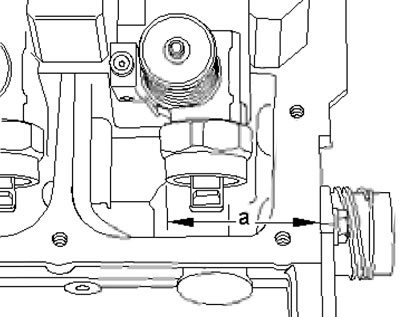


9.8. Checking the position of the pump-injector (using the example of a pump-injector with a nut…

9.8. Checking the position of the pump-injector (using the example of a pump-injector with a nut with a cylindrical sleeve)


9. If necessary, adjust the position of the pump-injector, tighten the mounting bolt with a force of 12 Nm, and tighten it by 3/4 of a turn. Tighten the inner (2 in illustration 44.9 Chapter 2), and then the outer (1) bolts with a torque of 20 Nm, and then tighten them by 1/4 turn.

10. Fit a plunger type dial gauge to the adjusting bolt as shown in the illustration and rotate the crankshaft until the rocker roller is at the end of the cam. In the illustration, the roller side (A) is shown at the highest point and the dial gauge (B) is shown at the lowest point. Remove the gauge, screw the adjusting bolt into the rocker arm until significant resistance is felt and back it out half a turn. While holding the adjusting bolt in this position, tighten the lock nut to 30 Nm.
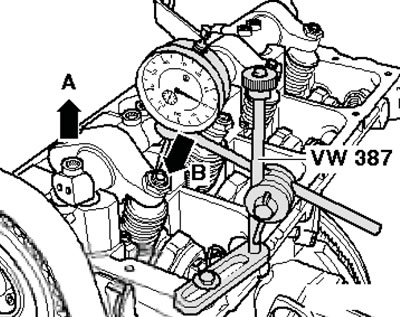
9.10. Checking the stroke of the pump-injector

9.10. Checking the stroke of the pump-injector


11. Further installation is carried out in the reverse order of dismantling the components.

Diesel engines 2.0 DOHC


12. The details of the pump-injector installation are shown in the illustration.
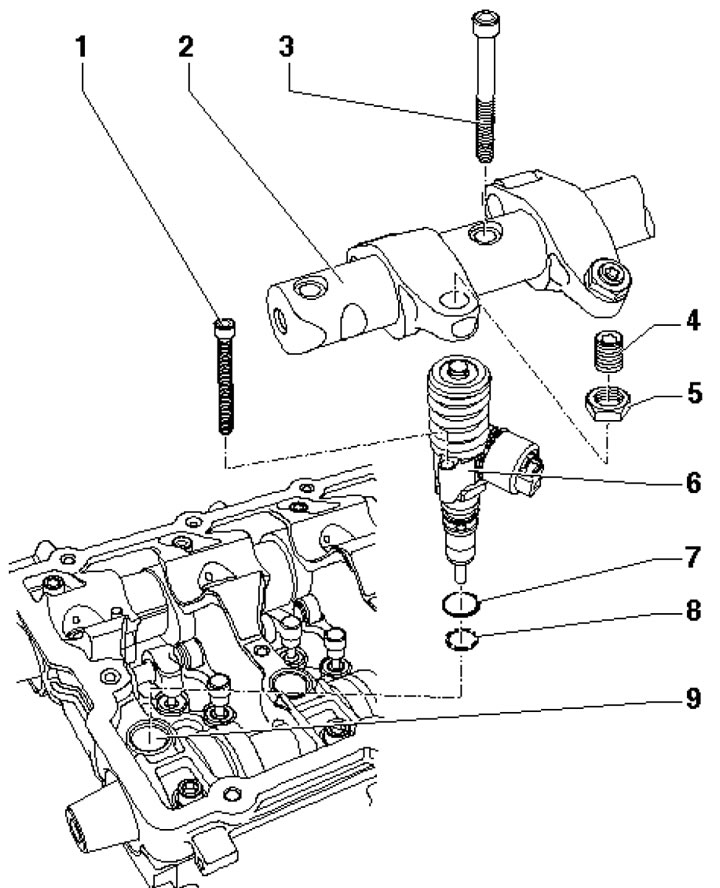
9.12. Unit-injector installation details 1. Bolt, 3 Nm, then tighten to an angle of 90°, then…

9.12. Unit-injector installation details 1. Bolt, 3 Nm, then tighten to an angle of 90°, then tighten to an angle of 180°, subject to replacement; 2. Rocker arm axle with rocker arms; 3. Bolt, 20 Nm, then tighten to an angle of 90°, subject to replacement; 4. Adjusting bolt, subject to replacement; 5. Lock nut; 6. Pump injector; 7, 8. Sealing ring, subject to replacement; 9. Cylinder head


13. Remove the cylinder head cover (see Chapter 2).

14. Turn the crankshaft so that both cams of the corresponding unit injector are facing upwards.

15. Loosen the lock nuts (2 in illustration 47.13 Chapter 2) adjusting bolts (1) on all unit injectors and unscrew the adjusting bolts so that each rocker arm touches the push spring of the corresponding unit injector.

16. Remove the bolts (1, 3 and 5 in Illustration 47.14 Chapter 2), and then the bolts (2 and 4). Remove the rocker arm shaft without removing the bolts from it, so as not to mix them up later.


17. Disconnect the glow plug and pump injector wiring connectors, unscrew the bolts on the retaining clips and remove the wiring harness to the side.

18. Unscrew the bolts using a suitable wrench (see illustration).
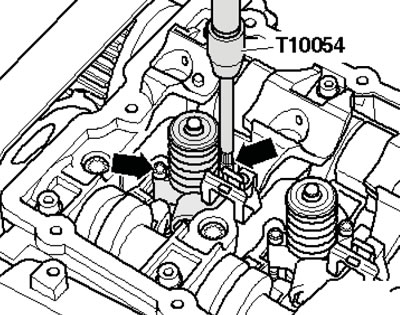
9.18. Pump-injector mounting bolts

9.18. Pump-injector mounting bolts


19. Pull out the ball studs (1 in the illustration) from the removable pump-injector
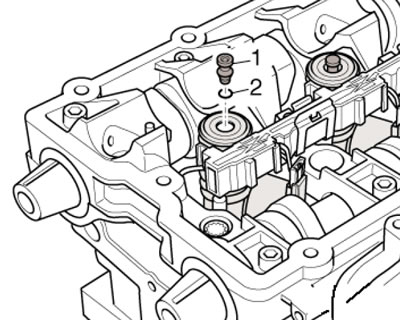
9.19. Pump injector stud

9.19. Pump injector stud


20. Insert the T10163 puller into the holes of the pump-injector bolts (see illustration), lightly screw the spindle (A) onto the pump-injector and tighten the lock nut (B) by hand. Using a T10133/3 sliding hammer, knock the pump-injector out of its seat.

Note: Do not confuse the pump injectors.
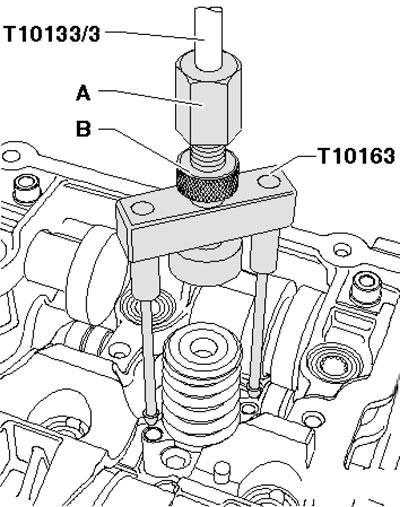

9.20. Removing the pump-injector

9.20. Removing the pump-injector


21. New unit injector bolts will be required for installation. When replacing a unit injector, the corresponding adjusting bolt on the rocker arm must also be replaced. When installing old unit injectors, the sealing rings and insulating gasket must be replaced. The sealing rings with white markings are installed in the lower groove of the unit injector.

22. Very carefully insert the unit injector into the cylinder head seat. Mount the 2036 tool and the 2036/1 mounting plates on the cylinder head retaining frame (see illustration).
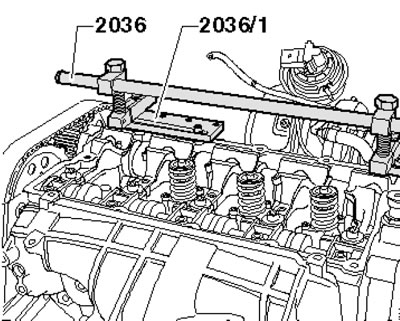
9.22. Device 2036

9.22. Device 2036


23. Screw in the new mounting bolts by hand until they are snug (see illustration).
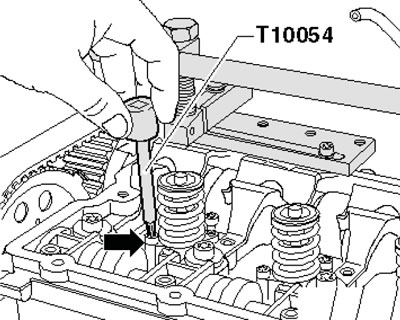
9.23. Bolt T10054

9.23. Bolt T10054


24. Install the VW541/1A lever using the VW541/5 compression tool and carefully press the unit injector into the cylinder head (see illustration). Screw in the pump-injector mounting bolts by hand until they fit, and then with the required force.
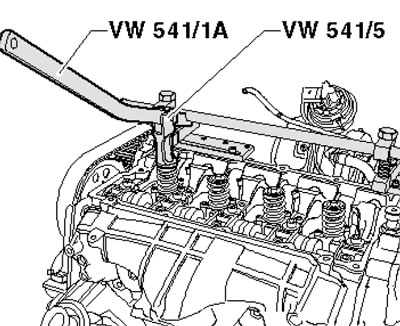


9.24. Installing the pump-injector

9.24. Installing the pump-injector


25. Further installation is carried out in the reverse order. After tightening the rocker shaft mounting bolts, install a plunger-type dial gauge on the adjusting bolt and turn the crankshaft so that the rocker roller is at the end of the camshaft cam. Roller side (And in the illustration) is at the highest point, and the side of the meter (B) is at the lowest point.
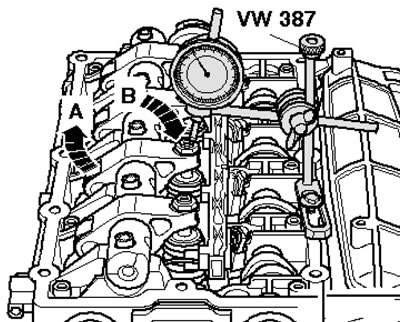
9.25. Adjusting the pump-injector

9.25. Adjusting the pump-injector


26. Remove the gauge, screw the adjusting bolt into the rocker arm until you feel significant resistance, and unscrew it half a turn. Holding the adjusting bolt in this position, tighten the lock nut with a force of 30 Nm.

This article was copied from the website: AUDImanual.ru
The article was checked by auto expert Timur Bazhenov
This article is available at russian, bulgarian, belarusian, ukrainian, serbian, croatian, romanian, polish, slovak, hungarian

Share information:
Previous articles
Audi A4 B7: Fuel and exhaust system
Next articles

Removal and installation of fuel injection pump
Removal and installation a turbocharger
Removal and installation the intercooler
Removal and installation of fuel distribution line and injectors
Removal and installation the gas pedal
Removal and installation the fuel tank
Removal and installation the fuel supply module
Removal and installation the EVAP canister (petrol models)


Similar articles on other Audi car models:
Vacuum Pump (with Automatic Transmission) — Removal and… Audi 80 B3 (1986-1991, petrol)
Fuel Pump Drive Belt — Removal, Inspection and Installation Audi 100 C3 (1982-1990, diesel)
Removal and installation of fuel lines and injectors (petrol) Audi A3 Type 8L (1996-2003)
Removal and installation valve injectors Audi A6 C4 (1994-1997)
Removal and installation the engine Audi A8 D2 (1994-2002)
Removal and installation of injectors and fuel lines Audi Q7 Typ 4L (2005-2015, diesel)
Removal and installation of wiring harness for pump-injectors… Audi A2 (1999-2005)
Link to this page in different formats


Visitor comments

No comments yet


How much will 24 + 41 =


A4(B8, 2007-2015) 
  • General information
  • Operating instructions
  • Power unit
  • Petrol engines 1.8 l
  • Petrol engines 1.8/2.0 l
  • Petrol engines 3.0 l
  • Petrol engines 3.2 l
  • Fuel system (petrol)
  • Diesel engines 2.0 l (CA*)
  • Diesel engines 2.0 l (CJCB)
  • Diesel engines 2.7/3.0 l
  • Diesel engines 3.0 l
  • Fuel system (diesel)
  • Transmission
  • Manual gearbox 0B1
  • Manual gearbox 0B2
  • Manual gearbox 0B3
  • Manual gearbox 0B4
  • Automatic transmission 0B5
  • Automatic transmission 0B6
  • Automatic transmission 0AW
  • All-wheel drive system
  • Chassis
  • Front suspension
  • Rear suspension
  • Brake system
  • Steering system
  • Body
  • Exterior
  • Interior
  • Seats
  • Doors, locks and windows
  • Security system
  • Heating and air conditioning
  • Electrical equipment
  • Audio system
  • Power devices
  • Equipment and devices
  • Lighting and lamps
  • Electrical circuits
 
A4(B7, 2004-2008) 
  • General information
  • Introduction to manual
  • Troubleshooting
  • Operating instructions
  • Maintenance
  • Power unit
  • Petrol engines 2.0 (ALT)
  • Petrol engines 2.0 (TFSI)
  • Petrol engines 1.8 (MPI)
  • Diesel engines
  • Cooling system
  • Air conditioner
  • Fuel and exhaust system
  • Ignition system
  • Starting and charging
  • Transmission
  • Clutch
  • Manual gearbox
  • Automatic gearbox
  • Drive shafts
  • Chassis
  • Brake system
  • Front suspension
  • Rear suspension
  • Steering
  • Body
  • Exterior
  • Interior
  • Electrical equipment
  • Equipment and devices
  • Lighting and signaling
  • Windscreen wipers and washers
  • Electrical diagrams
  • Electrical diagrams (since 2007)
 
A4(B6, 2000-2006) 
  • General information
  • Vehicle Description
  • User manual
  • Maintenance
  • Power unit
  • Gasoline engine
  • Diesel engine
  • Lubrication system
  • Cooling system
  • Supply system
  • Injection system
  • Exhaust system
  • Ignition and control
  • Transmission
  • Gear box
  • Clutch and drive shafts
  • Chassis
  • Brake system
  • Car suspension
  • Steering
  • Body
  • Heating and ventilation
  • Exterior (external elements)
  • Interior (internal elements)
  • Electrical equipment
  • Power devices
  • Lighting and appliances
  • Electrical circuits
 
A4(B6, 2000-2006, petrol) 
  • General information
  • Introduction to the guide
  • Car care
  • Power unit
  • Engine repair
  • Lubrication system
  • Cooling system
  • Injection and control system
  • Ignition system
  • Power and exhaust system
  • Transmission
  • Clutch and drive shafts
  • Car gearbox
  • Chassis
  • Suspension and wheels
  • Steering
  • Brake system
  • Body
  • Interior
  • Exterior
  • Electrical equipment
  • Equipment and devices
  • Lighting and signaling
  • Power devices
  • Electrical circuits
 
A4(B5, 1994-2001) 
  • General information
  • Introduction to the guide
  • Car care
  • Maintenance (gasoline)
  • Maintenance (diesel)
  • Power unit
  • Gasoline engines
  • Diesel engines
  • Engine overhaul
  • Cooling system
  • Fuel injection (gasoline)
  • Fuel system (diesel)
  • Exhaust system
  • Ignition system
  • Transmission
  • Clutch
  • Mechanical gearbox
  • Automatic gearbox
  • Drive shafts
  • Chassis
  • Brake system
  • Car suspension
  • Steering
  • Body
  • Exterior
  • Interior
  • Doors, locks and windows
  • Heating and ventilation
  • Electrical equipment
  • Power devices
  • Equipment and devices
  • Electrical circuits
 
A4(B5, 1994-2001, petrol) 
  • General information
  • Vehicle description
  • Maintenance
  • Power unit
  • Engine repair
  • Turbocharging
  • Exhaust system
  • Cooling system
  • Ignition system
  • Fuel system
  • Motronic injection system
  • MPI and MPFI injection system
  • Transmission
  • Clutch
  • Gearbox and shafts
  • Chassis
  • Steering
  • Car suspension
  • Brake system
  • Wheels and tires
  • Body
  • Heating and ventilation
  • Body parts
  • Electrical equipment
  • Fuses and relays
  • Power devices
  • Lighting and lamps
  • Tools and devices
  • Electrical circuits
 
AudiManual.ru © 2017-2026 · Mobile version · Feedback · Sitemap: EN BG BY UA RS HR RO PL SK HU · Site search · News and articles
80 B2 · 80 B3 petrol · 80 B3 · 80 B4 · 100 C3 diesel · 100 C3 petrol · 100 C3 · 100 C4 petrol · 100 C4 · A3 Type 8L · A4 B5 petrol · A4 B5 · A4 B6 petrol · A4 B6 · A4 B7 · A4 B8 · A6 C4 · A6 C5 · A6 C5 Allroad · A8 D2 · Q5 Type 8R · Q7 Typ 4L · Audi A2 ·
This site uses cookies 🍪. Click the button to accept this fact.