
Repair Chevrolet Repair Toyota Repair Honda Repair AvtoVAZ Repair Mercedes-Benz Repair BMW Repair Opel
Home  |  Contacts  |  Sitemap  |    
English Русский
Български
Беларускі
Український
Српски
Hrvatski
Română
Polski
Slovenský
Magyar
AudiManual.ru


  • AUDI 80
  • AUDI 100
  • AUDI A3
  • AUDI A4
  • AUDI A6
  • AUDI A8
  • AUDI Q
  • OTHER
  • ARTICLES
B8 (2007-2015) B7 (2004-2008) B6 (2000-2006) B6 (2000-2006, petrol) B5 (1994-2001) B5 (1994-2001, petrol)

Removal and installation the fuel tank (Audi A4 B7)

  • Home
  • Audi A4
  • B7 (2004-2008)
  • Power unit
  • Fuel and exhaust system
  • Removal and installation the fuel tank
            0
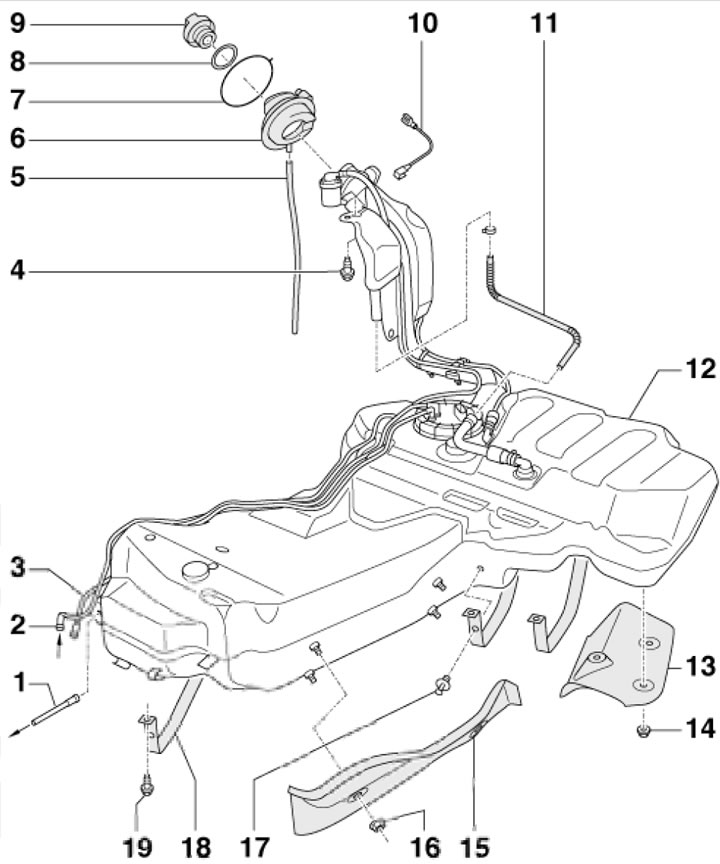
1. The fuel tank installation details for gasoline models are shown in the illustrations. For diesel models, the difference is the absence of EVAP lines. The description of fuel tank removal is given using the example of gasoline AWD models.

11.1a. Fuel tank installation details for MPI and 2.0 FSI petrol engines of FWD models 1. Fuel…

11.1a. Fuel tank installation details for MPI and 2.0 FSI petrol engines of FWD models 1. Fuel supply pipe from the fuel filter to the engine; 2. Return fuel pipe from the engine; 3. EVAP tube to carbon canister; 4. Bolt, 23 Nm; 5. Overflow hose; 6. Rubber hatch; 7. Retaining ring; 8. Compaction; 9. Fuel tank cap; 10. Connection to ground; 11. Ventilation tube; 12. Fuel tank; 13, 15. Heat shield; 14, 16. Nut, 2 Nm; 17. Retainer; 18. Tank mounting clamp 19 Bolt, 23 Nm
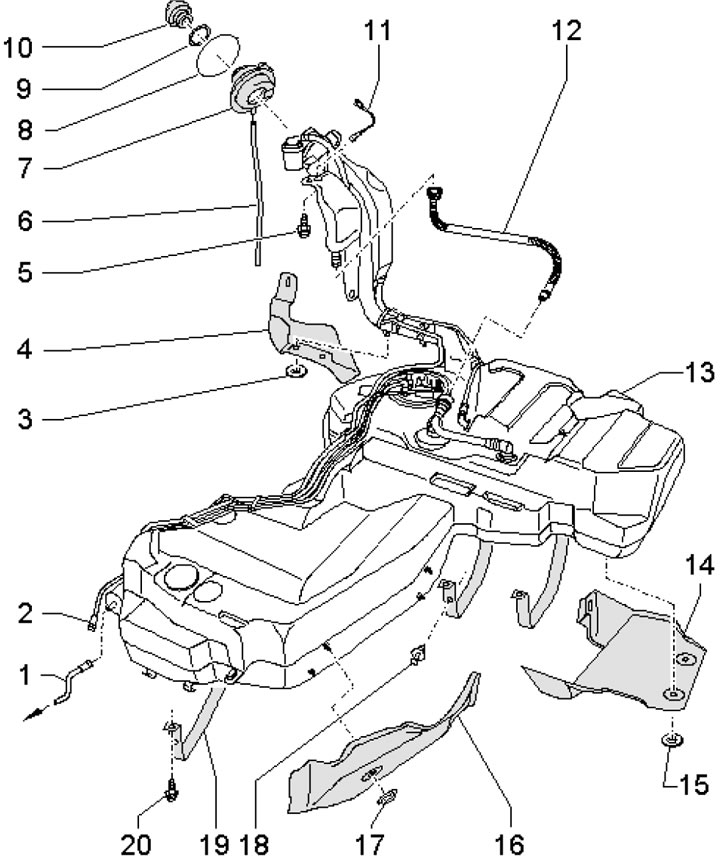

11.1b. Fuel tank installation details for 4-cylinder TFSI petrol engines and 6-cylinder FSI petrol…

11.1b. Fuel tank installation details for 4-cylinder TFSI petrol engines and 6-cylinder FSI petrol engines (fWD models) 1. Fuel supply pipe from the fuel filter to the engine; 2. EVAP tube to carbon canister; 3. Nut, 2 Nm; 4. Thermal protection screen of the filler neck; 5. Bolt, 23 Nm; 6. Overflow hose; 7. Rubber hatch; 8. Retaining ring; 9. Compaction; 10. Fuel tank cap; 11. Connection to ground; 12. Ventilation tube; 13. Fuel tank; 14, 16. Heat shield; 15, 17. Nut, 2 Nm; 18. Retainer; 19. Tank mounting clamp; 20. Bolt, 23 Nm
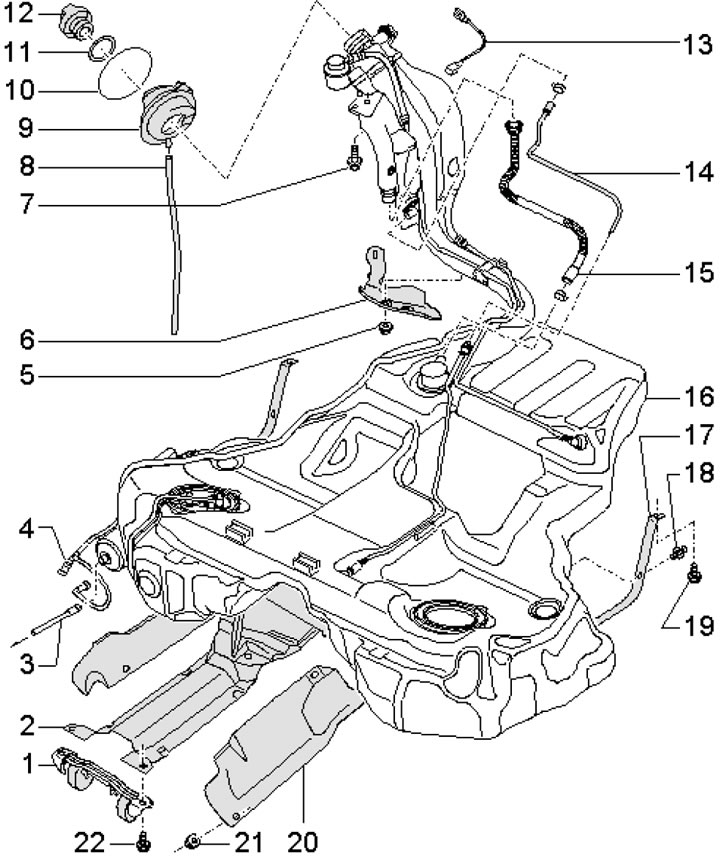


11.1c. Fuel tank installation details for petrol AWD models 1. Exhaust pipe bracket; 2. Support…

11.1c. Fuel tank installation details for petrol AWD models 1. Exhaust pipe bracket; 2. Support bracket; 3. Fuel supply pipe from the fuel filter to the engine; 4. EVAP tube to carbon canister; 5. Nut, 2 Nm; 6. Thermal protection screen of the filler neck; 7. Bolt, 23 Nm; 8. Overflow hose; 9. Rubber hatch; 10. Retaining ring; 11. Compaction; 12. Fuel tank cap; 13. Connection to ground; 14, 15. Ventilation tube; 16. Fuel tank; 17. Tank mounting clamp; 18. Retainer; 19, 22. Bolt, 23 Nm; 20. Heat shield; 21. Nut, 2 Nm


2. Disconnect the negative cable from the battery (see Chapter 5).

3. Open the fuel tank cap and close it again to equalize the pressure in the tank with the atmospheric pressure.

4. On Sedan models, remove the trim panel in the luggage compartment and, if necessary, fold the right seatback forward.

5. On Station Wagon models, remove the left rear seatback, left cargo area trim panel and mudguard.

6. Remove the bolts securing the service hole cover (see illustration) and take it off.
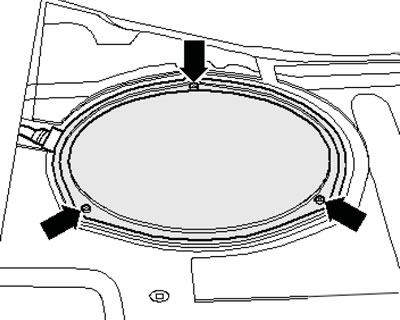
11.6. Fastening the service port cover

11.6. Fastening the service port cover


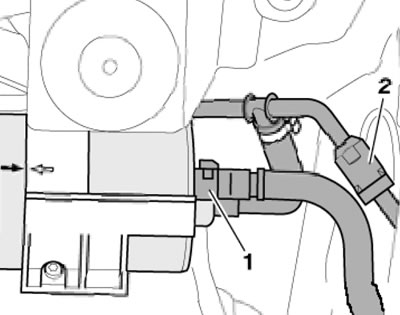
7. Disconnect the ventilation hoses (1 and 2 in the illustration).
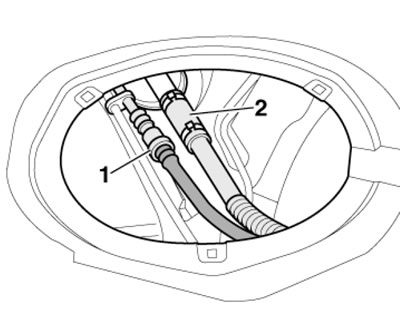
11.7. Pipe connections under the service port

11.7. Pipe connections under the service port


8. Remove the rear seat (see Chapter 11) and remove the covers of both service holes (see illustration).
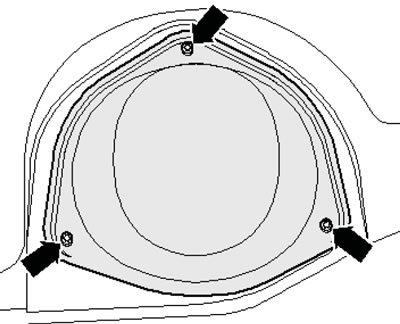
11.8. Fastening the service hole cover under the rear seat

11.8. Fastening the service hole cover under the rear seat


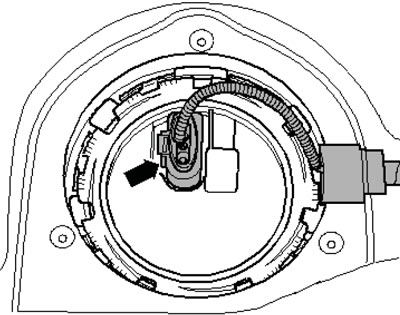
9. Disconnect the connectors on the right and left sides (see illustrations).
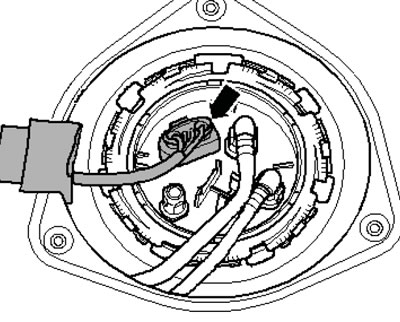
11.9a. Connector under the right service cover
11.9a. Connector under the right service cover


11.9b. Connector under the left service cover

11.9b. Connector under the left service cover


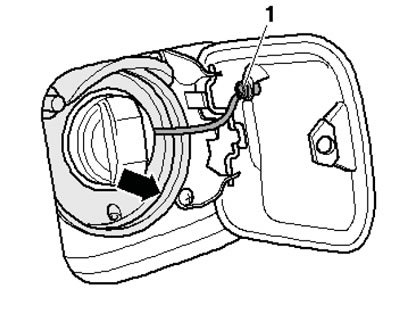
10. Detach the loop (1 in the illustration) from the filler cap, clean the area around the neck (without removing the lid), pry up the retaining ring (arrow) and press the rubber neck inward.
11.10. Removing the rubber neck

11.10. Removing the rubber neck


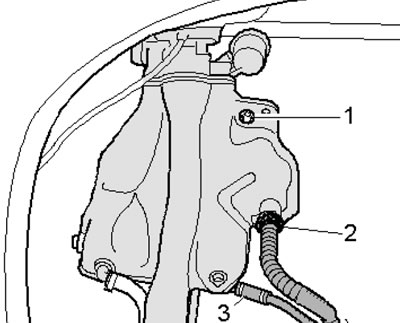
11. Remove the rear right wheel and the right rear wheel arch liner. Disconnect the ventilation pipes (2 and 3 in the illustration) from the filler neck and unscrew the bolt (1) securing the filler neck.
11.11. Removing the filler neck

11.11. Removing the filler neck


12. Remove the rear section of the exhaust pipe (see Part B), propeller shaft and rear drive shafts (see Chapter 8).

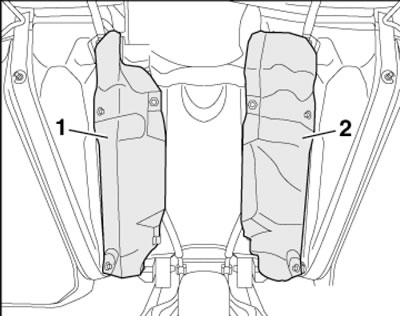
13. Remove the heat shields (1 and 2 in the illustration).
11.13. Thermal protection screens

11.13. Thermal protection screens


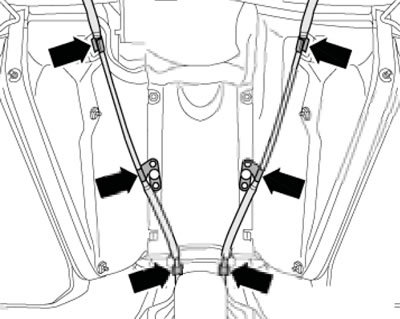
14. Remove the parking brake cables from the holders shown in the illustration.
11.14. Parking brake cable holders

11.14. Parking brake cable holders


15. Disconnect the fuel and vent lines (see illustrations) from the front right side of the fuel tank. On models with an independent heater, additionally disconnect its fuel line.
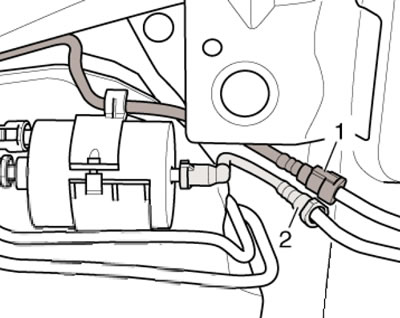
11.15a. Fuel and ventilation lines
11.15a. Fuel and ventilation lines


11.15b Fuel lines of the 1.8T engine

11.15b Fuel lines of the 1.8T engine


16. Support the fuel tank with a transmission jack and remove the bolts (1-10 in the illustration) and lower the tank on the jack, guiding it with your hand.
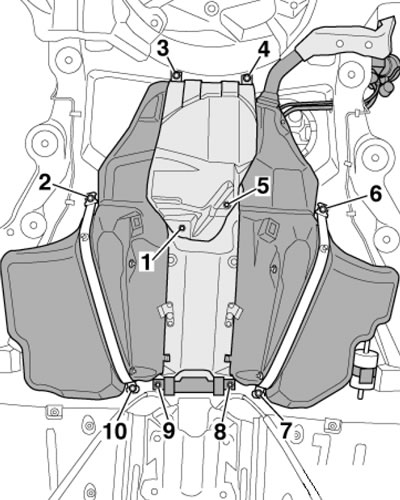
11.16. Removing the fuel tank

11.16. Removing the fuel tank


17. Installation is carried out in the reverse order of dismantling the components. Make sure that neither end of the ground connection is oxidized. Connector (4 in the illustration) must be located on the metal ring (3), and the contact bracket (2) must be connected to the tank (5) and secured with a spacer sleeve (1), if present.
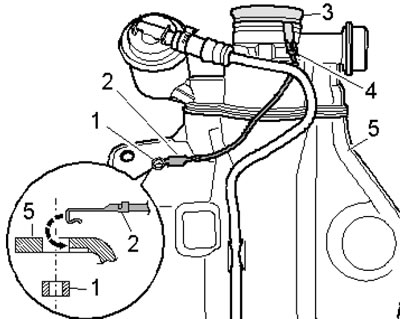
11.17. Wiring diagram

11.17. Wiring diagram


(The article was copied from the website: «Audimanual.ru»)
The article was checked by auto expert Timur Bazhenov
This article is available at russian, bulgarian, belarusian, ukrainian, serbian, croatian, romanian, polish, slovak, hungarian

Share information:
Previous articles
Audi A4 B7: Fuel and exhaust system
Next articles

Removal and installation the gas pedal
Removal and installation of pump-injectors
Removal and installation of fuel injection pump
Removal and installation a turbocharger
Removal and installation the fuel supply module
Removal and installation the EVAP canister (petrol models)
Replacing the fuel level sensor
Exhaust and Emission Control Systems — General Information


Similar articles on other Audi car models:
Fuel tank — removal and installation Audi 80 B3 (1986-1991, petrol)
Fuel tank — removal and installation Audi 100 C3 (1982-1990, diesel)
Removal and installation of fuel lines and injectors (petrol) Audi A3 Type 8L (1996-2003)
Fuel tank — removal and installation Audi A6 C5 Allroad (1999-2005)
Removal and installation the engine Audi A8 D2 (1994-2002)
Removal and installation the fuel tank Audi Q7 Typ 4L (2005-2015, diesel)
Removal and installation the fuel tank Audi A2 (1999-2005)
Link to this page in different formats


Visitor comments

No comments yet


How much will 38 + 45 =


A4(B8, 2007-2015) 
  • General information
  • Operating instructions
  • Power unit
  • Petrol engines 1.8 l
  • Petrol engines 1.8/2.0 l
  • Petrol engines 3.0 l
  • Petrol engines 3.2 l
  • Fuel system (petrol)
  • Diesel engines 2.0 l (CA*)
  • Diesel engines 2.0 l (CJCB)
  • Diesel engines 2.7/3.0 l
  • Diesel engines 3.0 l
  • Fuel system (diesel)
  • Transmission
  • Manual gearbox 0B1
  • Manual gearbox 0B2
  • Manual gearbox 0B3
  • Manual gearbox 0B4
  • Automatic transmission 0B5
  • Automatic transmission 0B6
  • Automatic transmission 0AW
  • All-wheel drive system
  • Chassis
  • Front suspension
  • Rear suspension
  • Brake system
  • Steering system
  • Body
  • Exterior
  • Interior
  • Seats
  • Doors, locks and windows
  • Security system
  • Heating and air conditioning
  • Electrical equipment
  • Audio system
  • Power devices
  • Equipment and devices
  • Lighting and lamps
  • Electrical circuits
 
A4(B7, 2004-2008) 
  • General information
  • Introduction to manual
  • Troubleshooting
  • Operating instructions
  • Maintenance
  • Power unit
  • Petrol engines 2.0 (ALT)
  • Petrol engines 2.0 (TFSI)
  • Petrol engines 1.8 (MPI)
  • Diesel engines
  • Cooling system
  • Air conditioner
  • Fuel and exhaust system
  • Ignition system
  • Starting and charging
  • Transmission
  • Clutch
  • Manual gearbox
  • Automatic gearbox
  • Drive shafts
  • Chassis
  • Brake system
  • Front suspension
  • Rear suspension
  • Steering
  • Body
  • Exterior
  • Interior
  • Electrical equipment
  • Equipment and devices
  • Lighting and signaling
  • Windscreen wipers and washers
  • Electrical diagrams
  • Electrical diagrams (since 2007)
 
A4(B6, 2000-2006) 
  • General information
  • Vehicle Description
  • User manual
  • Maintenance
  • Power unit
  • Gasoline engine
  • Diesel engine
  • Lubrication system
  • Cooling system
  • Supply system
  • Injection system
  • Exhaust system
  • Ignition and control
  • Transmission
  • Gear box
  • Clutch and drive shafts
  • Chassis
  • Brake system
  • Car suspension
  • Steering
  • Body
  • Heating and ventilation
  • Exterior (external elements)
  • Interior (internal elements)
  • Electrical equipment
  • Power devices
  • Lighting and appliances
  • Electrical circuits
 
A4(B6, 2000-2006, petrol) 
  • General information
  • Introduction to the guide
  • Car care
  • Power unit
  • Engine repair
  • Lubrication system
  • Cooling system
  • Injection and control system
  • Ignition system
  • Power and exhaust system
  • Transmission
  • Clutch and drive shafts
  • Car gearbox
  • Chassis
  • Suspension and wheels
  • Steering
  • Brake system
  • Body
  • Interior
  • Exterior
  • Electrical equipment
  • Equipment and devices
  • Lighting and signaling
  • Power devices
  • Electrical circuits
 
A4(B5, 1994-2001) 
  • General information
  • Introduction to the guide
  • Car care
  • Maintenance (gasoline)
  • Maintenance (diesel)
  • Power unit
  • Gasoline engines
  • Diesel engines
  • Engine overhaul
  • Cooling system
  • Fuel injection (gasoline)
  • Fuel system (diesel)
  • Exhaust system
  • Ignition system
  • Transmission
  • Clutch
  • Mechanical gearbox
  • Automatic gearbox
  • Drive shafts
  • Chassis
  • Brake system
  • Car suspension
  • Steering
  • Body
  • Exterior
  • Interior
  • Doors, locks and windows
  • Heating and ventilation
  • Electrical equipment
  • Power devices
  • Equipment and devices
  • Electrical circuits
 
A4(B5, 1994-2001, petrol) 
  • General information
  • Vehicle description
  • Maintenance
  • Power unit
  • Engine repair
  • Turbocharging
  • Exhaust system
  • Cooling system
  • Ignition system
  • Fuel system
  • Motronic injection system
  • MPI and MPFI injection system
  • Transmission
  • Clutch
  • Gearbox and shafts
  • Chassis
  • Steering
  • Car suspension
  • Brake system
  • Wheels and tires
  • Body
  • Heating and ventilation
  • Body parts
  • Electrical equipment
  • Fuses and relays
  • Power devices
  • Lighting and lamps
  • Tools and devices
  • Electrical circuits
 
AudiManual.ru © 2017-2026 · Mobile version · Feedback · Sitemap: EN BG BY UA RS HR RO PL SK HU · Site search · News and articles
80 B2 · 80 B3 petrol · 80 B3 · 80 B4 · 100 C3 diesel · 100 C3 petrol · 100 C3 · 100 C4 petrol · 100 C4 · A3 Type 8L · A4 B5 petrol · A4 B5 · A4 B6 petrol · A4 B6 · A4 B7 · A4 B8 · A6 C4 · A6 C5 · A6 C5 Allroad · A8 D2 · Q5 Type 8R · Q7 Typ 4L · Audi A2 ·
This site uses cookies 🍪. Click the button to accept this fact.