



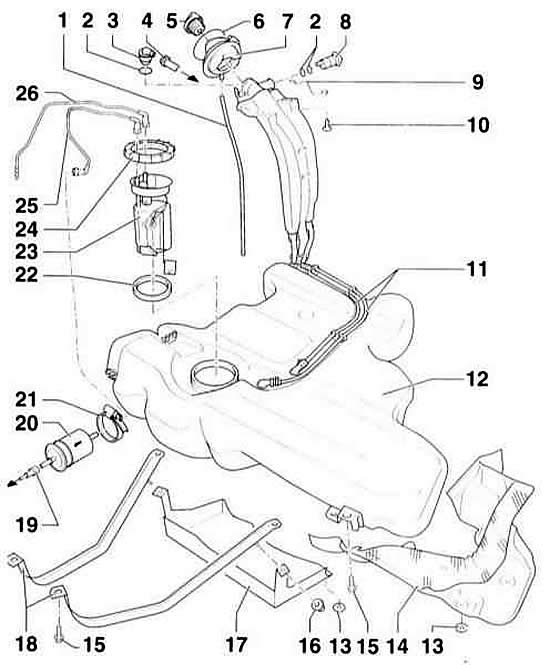
- 1 fuel overflow hose
- 2 sealing ring. Must be replaced.
- 3 gravity valve. To remove the valve
- 4 ventilation tube*. To the adsorber.
- 5 fuel tank cap. Replace damaged sealing ring.
- 6 sealing ring
- 7 rubber cup
- 8 ventilation valve
- 9 connection to ground
- 10 screw, 10 Nm
- 11 ventilation pipes
- 12 fuel tank
- 13 clamp, 2 Nm
- 14 heat shield
- 15 bolt, 25 Nm
- 16 clamping nut, 2 Nm
- 17 cover
- 18 Tank mounting clamp. Note the difference in length.
- 19 Fuel line, black. To the engine. When disconnecting, press the latches on the quick-release coupling.
- 20 Fuel filter*. The arrow on the filter housing points in the direction of flow. Note: The filter is not changed during maintenance.
- 21 clamps*. For fuel filter.
- 22 sealing ring. Replace if damaged. Moisten with fuel when installing.
- 23 Fuel level sensor/supply unit with fuel pump*
- 24 union nut, 60 Nm
- 25 Fuel line, black. To the engine. When disconnecting, press the locks on the quick-release coupling.
- 26 Fuel return line, blue. From the engine. Attaches with the "R" marking to the shut-off flange. When disconnecting, press the locks on the quick-release coupling.
* only for petrol engine.
The fuel system consists of a fuel tank, fuel lines, filter, fuel pump and fuel injection system (separate Section).
The fuel tank, made of plastic, is located at the bottom of the car in front of the rear suspension. The available fuel supply is shown to the driver on the instrument panel. The fuel tank is ventilated through a closed air removal system. In a gasoline engine, harmful gasoline vapors are collected in the adsorber and fed into the combustion chambers of the engine.
Driving style has a significant impact on fuel consumption. Below are some tips on how to use the gas pedal wisely.
Execution order
1. After starting the engine, move off immediately, even if it is in cold weather.
2. If the vehicle is stopped for more than 40 seconds, turn off the engine.
3. Always drive in the highest possible gear.
4. When driving long distances, maintain a steady speed whenever possible. Avoid driving at high speeds. Drive carefully. Do not brake unnecessarily.
5. Do not carry unnecessary loads on the vehicle. If the luggage rack is not in use, remove it from the roof.
6. Check the air pressure in your tires. Do not allow the pressure to drop too much.
Warning: When working on the fuel system, the following safety and cleanliness precautions must be observed:
Warning: Do not use open fire, do not smoke or hold any very hot objects near the work area. There is a risk of accident! Keep a fire extinguisher at hand.
Warning: Ensure adequate ventilation of the work area. Fuel vapors are toxic.
7. The fuel system is under pressure. When opening the system, fuel may escape under pressure. Collect the fuel with a rag. Use safety glasses.
8. Hose connections are secured with band or clamp clamps. Clamp clamps must be replaced with band clamps or clamps of the latest design. There is a special device for installing band clamps, such as HAZET 796-5 or AUDI-1921.
9. Clean connections and adjacent areas thoroughly before opening.
10. Place the removed parts on a clean lining and cover. Use polyethylene or paper for this. Do not use fibrous fabric!
11. Carefully cover open parts or install process plugs if the repair will take some time.
12. Install only clean parts. Remove spare parts from their packaging only immediately before installation. Do not use parts that have been stored unpackaged (for example, stored in a toolbox).
13. If possible, do not use compressed air when the fuel system is open. If possible, do not move the vehicle while doing this.
14. Do not use sealants containing silicone. Silicone elements that get into the engine do not burn out and damage the oxygen sensor.
Warning: Before removing the tank, drain the fuel or pump out the fuel using a specially designed pump.
Warning: The fuel tank is removed from the underside of the vehicle. Before disconnecting the tank clamps, place a jack and shims underneath the tank.
Warning: An empty tank is explosive and cannot be disposed of in this form. Before disposal, the tank must be cut into pieces. Make sure that no sparks are generated. To do this, hand the fuel tank over to a specialized company.
Warning: After installing the tank in place, start the engine and check all connections for leaks.