



Table of contents: V-belt/ribbed belt for alternator ↓ V-ribbed alternator belt ↓ V-belt of the generator ↓ V-ribbed alternator belt ↓ V-belt - replacement ↓ V-belt breakage ↓
The generator is driven by a V-belt or V-ribbed belt. V-belts are used in cars produced before 9/91. Starting from 10/91, AUDI 80s are equipped with V-ribbed belts.
An over-tensioned belt stretches and simultaneously breaks the base fibers. If the belt is under-tensioned, it slips on the pulley, which leads to its excessive heating.
The tension of the alternator belt can be checked by pressing the belt on the section between both belt pulleys with the index finger. A correctly tensioned V-belt should deflect as follows:
- a) vehicles with four-cylinder engines produced before 9/91 by approximately 10 mm;
- b) cars with a five-cylinder engine - about 5 mi;
- c) cars with diesel engines - approximately 5 mm.
After installing a new V-belt, it is recommended to check its tension and, if necessary, tighten it after a run of approximately 100 km, because new belts stretch more during the initial period of their use.
When checking the tension of the V-belt on vehicles with four-cylinder engines produced since 10/91, the belt must be loosened and re-tensioned.
The tension of the V-belt of the generator of cars with six-cylinder and diesel engines is performed automatically and therefore does not require adjustment.
V-belt/ribbed belt for alternator
Cars with four-cylinder engines produced before 9/91.
1. Loosen the clamping pin on the generator tension bar (see illustration).
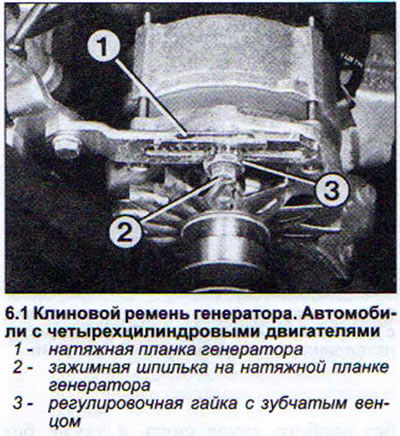
2. Turn the adjusting slotted nut in the desired direction until the V-belt is properly tensioned.
3. Tighten the clamping pin on the tension bar. If the generator does not move when the belt is tensioned, then it is necessary to loosen the generator mounting bolt on the bracket. Access to the mounting bolt is possible only after removing the generator belt protective cover.
4. Tighten the generator mounting bolt if it had to be loosened when tensioning the belt.
V-ribbed alternator belt
Cars with four-cylinder engines produced since 10/91.
5. Loosen the clamping pin on the generator tension bar.
6. Loosen the generator mounting bolt on the bracket and make sure the generator moves easily.
7. Tighten the belt tension slotted nut using a 22mm socket on a torque wrench to 6 Nm.
8. Tighten the clamping pin onto the tension bar.
9. Tighten the generator mounting bolt.
V-belt of the generator
Cars with five-cylinder engines
10. Loosen the clamping pin on the generator tension bar (see illustration).
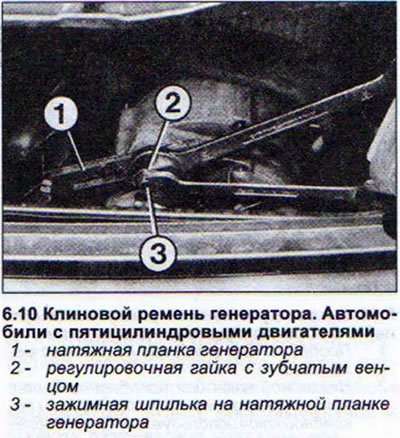
11. Turn the adjusting nut with toothed ring in the desired direction until the V-belt is properly tensioned.
12. Tighten the clamping pin on the tension bar. If the generator does not move when the belt is tensioned, then it is necessary to loosen the generator mounting bolt on the bracket. Access to the mounting bolt is possible only after removing the generator belt protective cover.
V-ribbed alternator belt
Diesel engines and six-cylinder petrol engines
The tension of the V-belt in cars with the specified engines is provided by an automatic tension roller. Belt adjustment is not required. If the tension roller spring breaks, the belt tension mechanism must be completely replaced.
V-belt - replacement
Cars with six-cylinder engines
13. Remove the V-belt protective cover.
14. Loosen the tensioner bolt with a 15 mm socket wrench and move the belt tensioner to the right. The tensioner on some models is tightened with a socket head bolt (see illustration).
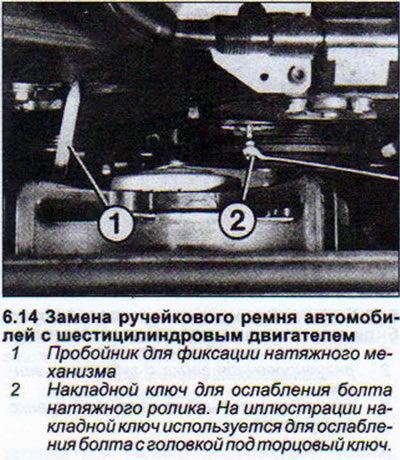
15. Secure the tensioner by inserting a suitable drill or punch into the corresponding hole in the tension roller.
16. Mark the direction of rotation of the belt with chalk or a felt-tip pen.
17. Remove the V-belt.
When installing a V-belt, place it on the drive pulleys and idler pulley first, and on the tension pulley last.
18. Remove the drill or punch that was used to lock the belt tension roller. To do this, lift the tension mechanism slightly.
19. Install the V-belt protective cover in place.
Replacing the V-belt on vehicles with diesel engines is performed identically (see illustration 6.0).
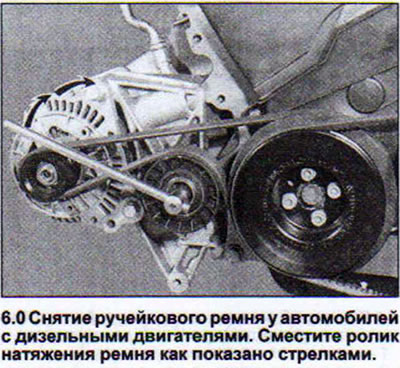
The V-belt can be accessed from both above and below. In some models, the belt tension roller may be covered with a cover. When replacing the V-belt, you must remove the engine splash guard from below the car. Access to the V-belt is equally difficult in both cases.
When replacing a V-belt, never try to force it onto the pulleys by prying it with a screwdriver. In this case, the rupture of the base fibers is guaranteed and you yourself "program" premature wear of the V-belt.
20. Loosen the tension of the belt to be replaced. Now the belt can be removed without much difficulty and a new one can be put on without any difficulty.
21. Tighten the new V-belt. Tighten it after about 100 km.
V-belt breakage
V-belts can be used without replacement for the entire service life of the car. As for V-belts, it is possible for one of the belts to break.
In this case, the following happens:
- suddenly, while driving, the red battery charging indicator light comes on;
- the power steering starts to work hard and jerkily;
- the air conditioner stops;
- the engine overheats because the coolant pump has stopped.
Engine overheating due to damage to the V-belt
If the power steering pump belt breaks on a 4-cylinder engine, the water pump will also be left without a drive and the engine will overheat. As a result, the cylinder head gasket or the cylinder head itself may be damaged, which will require very expensive repairs.
Therefore, if the steering suddenly becomes more difficult while driving, you should immediately stop the car and check the V-belt of the water pump and power steering pump. If it is torn, sinks, then the car should be towed.
The breakage of other V-belts does not lead to significant consequences. You can continue the trip to the nearest workshop without power steering (only on a car with a 5-cylinder engine), without generator (see movement with defective generator), and also without air conditioning.
In cars with a 5-cylinder engine, there is no danger of engine overheating, since the water pump is driven by a toothed belt. The same applies to a 6-cylinder engine.