
Repair Chevrolet Repair Toyota Repair Honda Repair AvtoVAZ Repair Mercedes-Benz Repair BMW Repair Opel
Home  |  Contacts  |  Sitemap  |    
English Русский
Български
Беларускі
Український
Српски
Hrvatski
Română
Polski
Slovenský
Magyar
AudiManual.ru


  • AUDI 80
  • AUDI 100
  • AUDI A3
  • AUDI A4
  • AUDI A6
  • AUDI A8
  • AUDI Q
  • OTHER
  • ARTICLES
B4 (1991-1996) B3 (1986-1991) B3 (1986-1991, petrol) B2 (1979-1986)

Alternator (Audi 80 B4)

  • Home
  • Audi 80
  • B4 (1991-1996)
  • Electrical equipment
  • Electrical system
  • Alternator
            0
General Provisions and Precautions

Until about the end of 1991, some AUDI 80 models were equipped with a 65-A alternator. They were replaced by 90-A alternators. With special equipment, 110 and 120-A alternators can be installed. The alternator produces a voltage of 14 V when the on-board network needs 12 V. Due to this difference, the battery is charged.

The generator drive by a V-belt or V-belt from the crankshaft belt pulley is designed so that even when the engine is idling, the generator can generate current at ⅔ of its maximum capacity (see illustrations 4.0a).
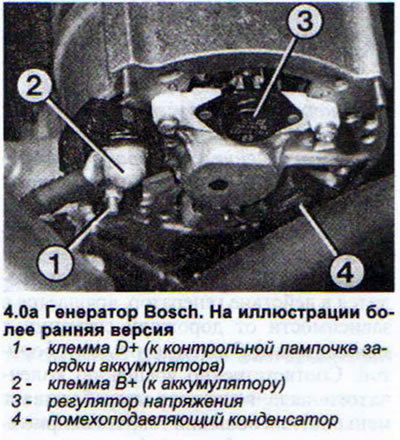
The generator drive by a V-belt or V-belt from the crankshaft belt pulley is designed so that even…


Illustration 4.0b shows a newer model Bosch generator, which differs from the previous ones by the cover 1.2-terminal B+ (to the battery).
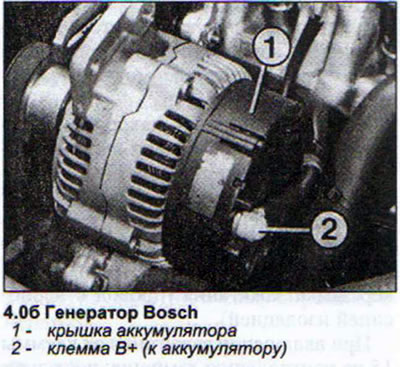
Illustration 4.0b shows a newer model Bosch generator, which differs from the previous ones by the…


Since the battery can only be charged with direct current, the alternating current generated by the generator is converted into direct current by a corresponding diode rectifier. The rectifier diodes are very sensitive to high voltages. For this reason, it is necessary to observe certain precautions:


  • do not disconnect or connect the wires between the battery and the generator while the generator is running. The resulting voltage peaks may damage the diodes.
  • the generator must not operate with the battery disconnected.
  • all connections from the generator, including the ground (-) wire, must have good contact.
  • disconnect the battery when performing welding work on the body.

The crankshaft, which drives the generator, rotates depending on the road situation with a lower or higher number of revolutions. Accordingly, the crankshaft rotation, the generator produces a lower or higher current, which is unacceptable for consumers of the on-board network. For this reason, the generator is equipped with a voltage regulator that maintains the voltage from the generator within 14 V regardless of the generator rotation frequency.

There is a battery charge indicator light on the instrument panel. It has two positive contacts (+). One of them receives power from the D+ terminal of the generator (blue insulated wire), and on the second one - from terminal 15 through the multi-pin plug of the ignition switch (wire with black and blue insulation).

When the ignition is switched on, power is supplied to the indicator lamp from terminal 15. However, the generator has not yet switched on, so terminal D+ acts as "ground" (-). The indicator lamp lights up. When the engine starts, power also starts to flow from terminal D+ on the generator, and the indicator lamp goes out. An extinguished battery charge indicator lamp does not prove that the battery is being recharged. It may happen that the on-board network consumers take more from the battery than is supplied to it by the generator. This is possible if the generator is weak and is not able to recharge the battery. In such cases, the battery charge indicator lamp will not light up.

The generator requires virtually no maintenance, except for the occasional replacement of carbon contact brushes. Repairing a damaged generator at home is impossible.
The article was checked by auto expert Timur Bazhenov
This article is available at russian, bulgarian, belarusian, ukrainian, serbian, croatian, romanian, polish, slovak, hungarian

Share information:
Previous articles
Audi 80 B4: Electrical system
Next articles

Fuses — replacement and purpose
Central distribution panel
General description
Generator — Checking, Removing and Installing
Alternator Belt — Tension
Rechargeable battery
Starter — Removing and Replacing Brushes


Similar articles on other Audi car models:
Driving with a faulty alternator Audi 100 C4 (1990-1994, petrol)
Battery, starter, alternator, main fuse box... Audi A3 Type 8L (1996-2003)
Battery, starter, alternator Audi A4 B5 (1994-2001, petrol)
V-ribbed alternator drive belt — removal and installation Audi A6 C5 Allroad (1999-2005)
Link to this page in different formats


Visitor comments

No comments yet


How much will 46 + 42 =


80(B4, 1991-1996) 
  • General information
  • User manual
  • Maintenance
  • Troubleshooting
  • Power unit
  • Engine
  • Cooling system
  • Heating and ventilation
  • Petrol injection
  • Diesel fuel system
  • Fuel system
  • Exhaust systems
  • Ignition system
  • Transmission
  • Clutch
  • Car gearbox
  • Chassis
  • Brake system
  • Suspension and steering wheel
  • Body
  • Body and trim
  • Electrical equipment
  • Electrical system
  • Electrical circuits
 
80(B3, 1986-1991) 
  • General information
  • Repair characteristics
  • Maintenance
  • Power unit
  • Gasoline engine
  • Diesel engine
  • Engine lubrication system
  • Fuel system (gasoline)
  • Injection system (gasoline)
  • Fuel system (diesel)
  • Ignition system
  • Cooling system
  • Heater
  • Exhaust system
  • Transmission
  • Clutch and gearbox
  • Chassis
  • Steering
  • Brake system
  • Car suspension
  • Body
  • Body elements
  • Electrical equipment
  • Power devices
  • Lighting and appliances
  • Electrical circuits
 
80(B3, 1986-1991, petrol) 
  • General information
  • User manual
  • Maintenance
  • Power unit
  • Engine 4-cylinder
  • Engine 5-cylinder
  • Cooling system
  • Fuel and exhaust systems
  • Ignition system
  • Transmission
  • Clutch
  • Mechanical transmission
  • Automatic transmission
  • Drive shafts
  • Chassis
  • Brake system
  • Suspension
  • Steering
  • Body
  • Exterior
  • Interior
  • Electrical equipment
  • Equipment and devices
  • Electrical circuits
 
80(B2, 1979-1986) 
  • General information
  • User manual
  • Power unit
  • Engine FZ
  • Engine EP, YP, YZ, DT, DS, DZ
  • Transmission
  • Clutch
  • 4 speed gearbox
  • 5 speed gearbox
  • Front wheel drive
  • Chassis
  • Front suspension
  • Rear suspension
  • Steering
  • Brake system
  • Electrical equipment
  • Equipment and devices
  • Electrical circuits
 
AudiManual.ru © 2017-2026 · Mobile version · Feedback · Sitemap: EN BG BY UA RS HR RO PL SK HU · Site search · News and articles
80 B2 · 80 B3 petrol · 80 B3 · 80 B4 · 100 C3 diesel · 100 C3 petrol · 100 C3 · 100 C4 petrol · 100 C4 · A3 Type 8L · A4 B5 petrol · A4 B5 · A4 B6 petrol · A4 B6 · A4 B7 · A4 B8 · A6 C4 · A6 C5 · A6 C5 Allroad · A8 D2 · Q5 Type 8R · Q7 Typ 4L · Audi A2 ·
This site uses cookies 🍪. Click the button to accept this fact.