



- Brake system (Bremsanlage). This means that when checking the condition of the brake system, it was found that the brake fluid level is low and the fluid needs to be topped up, and the tightness of the system needs to be checked.
- Engine oil pressure (Motoruldruck). Oil pressure at idle speed is below 0.3 bar or at speeds above 2100 rpm the engine oil pressure is 0.9 bar respectively (diesel engines), 1.8 bar (four- and five-cylinder engines) or 2.5 bar (six-cylinder engines) is not achieved.
- Coolant (Kbhlmittel). The coolant temperature is above 120°C, or the operating coolant temperature is not reached, or the coolant level is low.
In addition to the appearance of prohibitory inscriptions on the instrument panel, an audible signal is emitted. Prohibitory messages have priority. If a line with prohibitory content is displayed, the warning signal will not light up until the reason for the appearance of the prohibitory inscription is eliminated.
Warning signs are displayed in yellow and are accompanied by a single sound signal. Warning signals are:
- Stop signal (Bremslicht). This sign lights up immediately when the ignition is turned on and warns the driver about the need to check the brake lights. If the brake lights are OK, then when you press the brake pedal, it goes out.
- Lighting (Beleuchtung). The control unit is not able to perform a lighting check in automatic mode and therefore such a message reminds the driver to turn on the low beam. Only with the low beam on is the low beam headlights and rear lights checked. However, if the low beam and rear light bulbs have burned out, the control unit is not able to issue two messages at the same time for technical reasons. The lighting function is checked by the corresponding sensors for the condition of the vehicle's lighting bulbs.
- Battery (Batterie). The battery symbol lights up when the battery voltage does not reach the rated values of 10.6-15.6 V.
- Windscreen washer (Scheibenwaschanlage). This sign reminds the driver to top up the windshield washer fluid.
- Fuel tank (Tank). The fuel stand symbol lights up when the remaining fuel in the tank is 12 liters.
When a situation arises where the driver needs to be warned about the need to perform certain operations on several systems at once, the corresponding symbols are displayed in turn when the ignition is turned on.
The "OK" message appears after the ignition is turned on and after pressing the brake pedal, if the "Stop light" message goes out. The "OK" message indicates that the vehicle's systems have been checked and no defects have been detected. After a while, this message goes out.
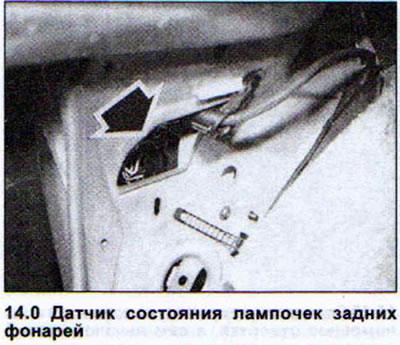
Attention! When installing the socket for the towing hitch on vehicles equipped with a diagnostic unit for the operation of the systems, it is necessary to take into account that the power supply wire for the rear light bulbs must be connected before the sensor that controls these bulbs. This device is located in the left rear part of the trunk. If the socket is powered from one of the rear lights, the diagnostic unit will report a defect in the rear light bulb.
A car enthusiast can only partially check the control unit for the functioning of the main systems of the car on his own. If the unit is faulty, all sensors are checked first. If they are normal, then the unit itself is faulty. The sensors are checked in the same way as on cars with conventional control lights. The sensor for monitoring the supply of washing fluid in the windshield washer reservoir, installed only when the car is equipped with a control unit, is checked as follows.
1. Disconnect the sensor plug if the corresponding message appears and there is enough washing liquid in the tank. If the warning message goes out, the sensor is faulty (see illustration).
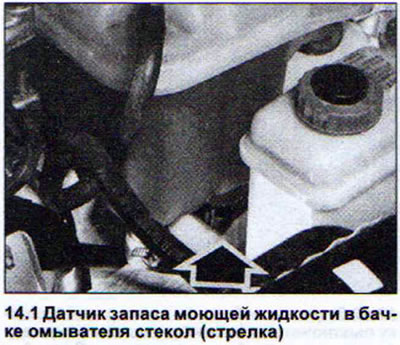
Checking the sensors of the car's light bulbs should be entrusted to a workshop. The sensor of the light bulbs of the front lights is located on the block of additional relays on the left under the instrument panel, and the rear lights - on the left side of the trunk (see illustration 14.0).
Checking the operation of the display of the diagnostic unit for the functioning of the main vehicle systems
2. Press the button on the lower left side of the instrument panel with the ignition on and the engine stopped (or in a moving vehicle at a speed of no more than 5 km/h). All symbols should appear on the display in turn if the display is OK.
Attention! If the display shows a prohibiting message, it is not possible to check the display operation.
Additional functions of the diagnostic unit
- Signal for exceeding the set speed. If the driver has entered into the unit's memory the speed at which he was moving at the moment of entering into the memory, then, until this data is deleted from the memory, the unit will remind you of this each time it is significantly exceeded with a corresponding message and an acoustic signal. Entering the required speed into the memory is done by pressing the left button on the instrument panel. This entry is saved until the ignition is turned off or can be replaced with another one. Deleting the entry is done with the same button. To do this, it must be held down for about one second.
- Display of the frequency of the received radio station. If the display is not occupied by messages from the diagnostic unit on the functioning of the main systems of the car, then, if the radio receiver is equipped accordingly, the frequency to which the radio receiver is currently tuned is displayed. Additionally, information about stereo reception or listening to recordings on a cassette may appear. When receiving RDS radio stations reporting on the situation on the highways, the corresponding designation appears on the display. The name of the radio station can be read on the display of the radio receiver.
(Content source: the specified website AUDIMANUAL)