
Repair Chevrolet Repair Toyota Repair Honda Repair AvtoVAZ Repair Mercedes-Benz Repair BMW Repair Opel
Home  |  Contacts  |  Sitemap  |    
English Русский
Български
Беларускі
Український
Српски
Hrvatski
Română
Polski
Slovenský
Magyar
AudiManual.ru


  • AUDI 80
  • AUDI 100
  • AUDI A3
  • AUDI A4
  • AUDI A6
  • AUDI A8
  • AUDI Q
  • OTHER
  • ARTICLES
B4 (1991-1996) B3 (1986-1991) B3 (1986-1991, petrol) B2 (1979-1986)

Radio receiver — removal and installation (Audi 80 B4)

  • Home
  • Audi 80
  • B4 (1991-1996)
  • Electrical equipment
  • Electrical system
  • Radio receiver — removal and installation
            0
Table of contents: Dashboard Speakers - Removal and… ↓ Radio antenna ↓
The following procedure applies to serially installed radio receivers.

1. Make sure that you know and write down the security code that your radio has.

2. Disconnect the battery.

3. Insert the supplied radio removal brackets into the holes on both sides of the panel and remove the radio (see illustration).
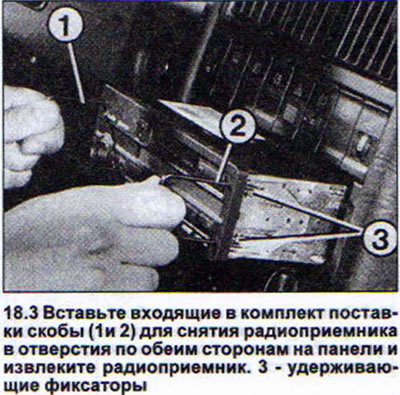
3. Insert the supplied radio removal brackets into the holes on both sides of the panel and remove…


If there are no brackets, you can use suitable pins, inserting them into the holes in the radio panel in order to press the latches that secure the radio in the console.

4. Disconnect the radio power plug and antenna plug.

When installing the radio in place, hold it horizontally so that the retaining pin on the back of the radio fits into the hole. Once installed, push the radio forward slightly until the catches click into place.

5. Enter the security code into the radio if it is equipped with such a code.

Attention! The security code must be entered into the radio every time after disconnecting the battery from the vehicle electrical system, after replacing the radio fuse, or after turning off the power to the radio.


Dashboard Speakers - Removal and Installation


Speakers are installed on the top, right and left sides of the instrument panel.

6. Carefully remove the speaker cover using a small screwdriver.

7. Remove the two Phillips-head screws that secure the speaker. When installing the speakers later, insert the tabs on them into the slots on the panel (see illustration).
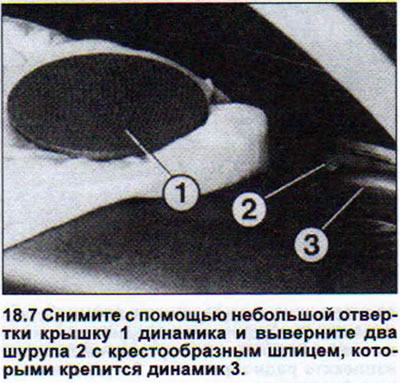
7. Remove the two Phillips-head screws that secure the speaker. When installing the speakers later,…


The rear speakers are mounted behind the rear side door trim.

8. Remove the door trim.

9. Remove the mounting screws and remove the speaker unit.

10. Remove the three screws securing the speaker to the unit and disconnect the speaker wire (see illustration).
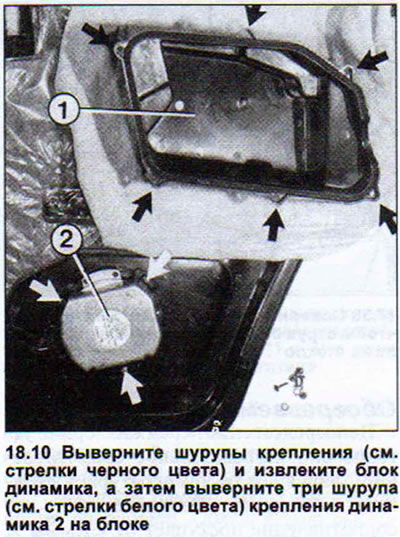
10. Remove the three screws securing the speaker to the unit and disconnect the speaker wire (see…


11. High-pitch speaker. Unscrew the threaded pin that holds the free-standing high-pitch speaker on the stylish side and disconnect its wire (see illustration).
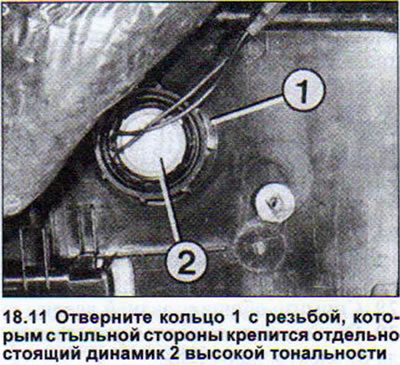


11. High-pitch speaker. Unscrew the threaded pin that holds the free-standing high-pitch speaker on…


Radio antenna


The rear window heater filaments serve as the radio antenna. The two upper filaments serve as the antenna for receiving medium wave transmissions, and the remaining filaments serve as the antenna for receiving VHF transmissions. A radio signal amplifier installed under the left rear roof pillar trim compensates for the insufficient height of such an antenna (see illustration 18.0).
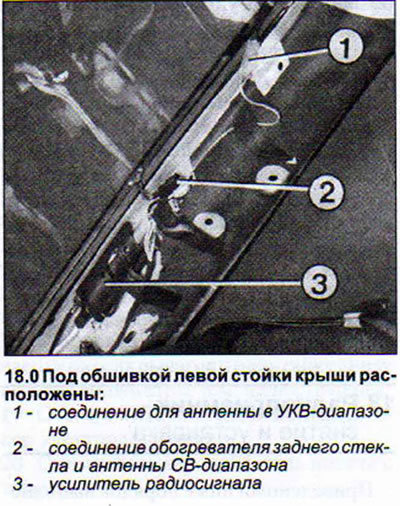
The rear window heater filaments serve as the radio antenna. The two upper filaments serve as the…


If the radio antenna is defective, you must do the following to detect it.

12. Remove the trim from both roof pillars.

13. Check the ground (-) connection of the rear window heater. The same applies to the ground (-) connection of the radio signal amplifier.

14. Make sure that the heater filaments are not damaged. If damage is found, apply conductive varnish to the break or replace the rear door glass.


15. Disconnect the amplifier plug. Make sure that there is power. To do this, turn on the radio. If there is no power, check the wire.

16. Check the resistance of the amplifier itself with an ammeter. The ammeter should show a resistance of 30-50 mA. Otherwise, the amplifier is faulty and must be replaced.

17. Disconnect the lower rear window defroster wire to perform further testing.

18. Turn on the ignition and rear window heater and measure the voltage on the wire. The voltmeter should show battery voltage. Otherwise, the wiring or amplifier is faulty. To determine where exactly the fault is, disconnect the lower wire from the amplifier and measure the voltage with the ignition and rear window heater on. If the voltmeter shows battery voltage, the wiring is normal and the amplifier is not working. Otherwise, the situation is different.

(The original article is located on the online resource «AudiManual.ru»)
The article was checked by auto expert Timur Bazhenov
This article is available at russian, bulgarian, belarusian, ukrainian, serbian, croatian, romanian, polish, slovak, hungarian

Share information:
Previous articles
Audi 80 B4: Electrical system
Next articles

Glass cleaners and washers
Ignition and steering lock switch — removal
Switches
Diagnostic unit for the functioning of the main vehicle systems…
Adjustable mirrors and electric windows
Central lock


Similar articles on other Audi car models:
Radio and loudspeakers — removal and installation Audi 100 C3 (1982-1990, diesel)
Removal, installation and coding of the radio receiver Audi A3 Type 8L (1996-2003)
Radio receiver — dismantling Audi A4 B5 (1994-2001, petrol)
Radio receiver Audi A6 C5 (1997-2004)
Radio receiver Audi A8 D2 (1994-2002)
Control unit in the instrument cluster, radio clock, its… Audi Q7 Typ 4L (2005-2015, diesel)
Radio or Navigation System Plus — Activating Security Coding Audi A2 (1999-2005)
Link to this page in different formats


Visitor comments

No comments yet


How much will 38 + 33 =


80(B4, 1991-1996) 
  • General information
  • User manual
  • Maintenance
  • Troubleshooting
  • Power unit
  • Engine
  • Cooling system
  • Heating and ventilation
  • Petrol injection
  • Diesel fuel system
  • Fuel system
  • Exhaust systems
  • Ignition system
  • Transmission
  • Clutch
  • Car gearbox
  • Chassis
  • Brake system
  • Suspension and steering wheel
  • Body
  • Body and trim
  • Electrical equipment
  • Electrical system
  • Electrical circuits
 
80(B3, 1986-1991) 
  • General information
  • Repair characteristics
  • Maintenance
  • Power unit
  • Gasoline engine
  • Diesel engine
  • Engine lubrication system
  • Fuel system (gasoline)
  • Injection system (gasoline)
  • Fuel system (diesel)
  • Ignition system
  • Cooling system
  • Heater
  • Exhaust system
  • Transmission
  • Clutch and gearbox
  • Chassis
  • Steering
  • Brake system
  • Car suspension
  • Body
  • Body elements
  • Electrical equipment
  • Power devices
  • Lighting and appliances
  • Electrical circuits
 
80(B3, 1986-1991, petrol) 
  • General information
  • User manual
  • Maintenance
  • Power unit
  • Engine 4-cylinder
  • Engine 5-cylinder
  • Cooling system
  • Fuel and exhaust systems
  • Ignition system
  • Transmission
  • Clutch
  • Mechanical transmission
  • Automatic transmission
  • Drive shafts
  • Chassis
  • Brake system
  • Suspension
  • Steering
  • Body
  • Exterior
  • Interior
  • Electrical equipment
  • Equipment and devices
  • Electrical circuits
 
80(B2, 1979-1986) 
  • General information
  • User manual
  • Power unit
  • Engine FZ
  • Engine EP, YP, YZ, DT, DS, DZ
  • Transmission
  • Clutch
  • 4 speed gearbox
  • 5 speed gearbox
  • Front wheel drive
  • Chassis
  • Front suspension
  • Rear suspension
  • Steering
  • Brake system
  • Electrical equipment
  • Equipment and devices
  • Electrical circuits
 
AudiManual.ru © 2017-2026 · Mobile version · Feedback · Sitemap: EN BG BY UA RS HR RO PL SK HU · Site search · News and articles
80 B2 · 80 B3 petrol · 80 B3 · 80 B4 · 100 C3 diesel · 100 C3 petrol · 100 C3 · 100 C4 petrol · 100 C4 · A3 Type 8L · A4 B5 petrol · A4 B5 · A4 B6 petrol · A4 B6 · A4 B7 · A4 B8 · A6 C4 · A6 C5 · A6 C5 Allroad · A8 D2 · Q5 Type 8R · Q7 Typ 4L · Audi A2 ·
This site uses cookies 🍪. Click the button to accept this fact.