
Repair Chevrolet Repair Toyota Repair Honda Repair AvtoVAZ Repair Mercedes-Benz Repair BMW Repair Opel
Home  |  Contacts  |  Sitemap  |    
English Русский
Български
Беларускі
Український
Српски
Hrvatski
Română
Polski
Slovenský
Magyar
AudiManual.ru


  • AUDI 80
  • AUDI 100
  • AUDI A3
  • AUDI A4
  • AUDI A6
  • AUDI A8
  • AUDI Q
  • OTHER
  • ARTICLES
B8 (2007-2015) B7 (2004-2008) B6 (2000-2006) B6 (2000-2006, petrol) B5 (1994-2001) B5 (1994-2001, petrol)

Replacing crankshaft seals and their holders (Audi A4 B7)

  • Home
  • Audi A4
  • B7 (2004-2008)
  • Power unit
  • Petrol engines 2.0 (ALT)
  • Replacing crankshaft seals and their holders
            0
Table of contents: Replacing the front oil seal ↓ Removal and installation the front… ↓ Replacing the rear oil seal and its… ↓
1 The crankshaft seal parts are shown in the illustration.
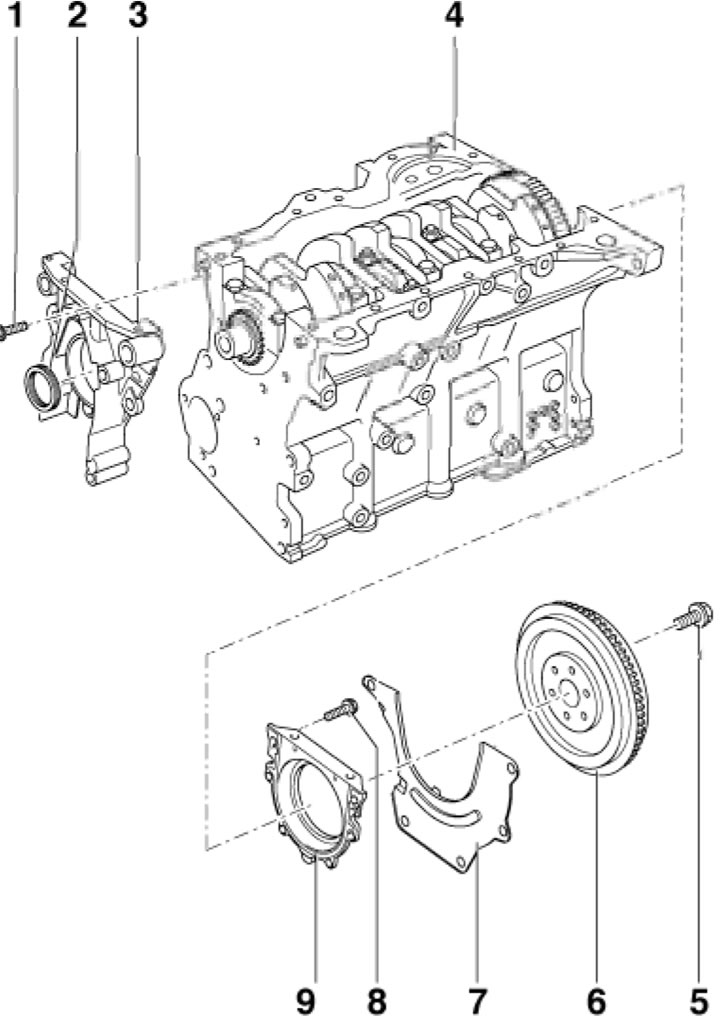
11.1 Crankshaft seal parts 1. Holder mounting bolts 3, 15 Nm; 2. Front oil seal; 3. Front oil seal…

11.1 Crankshaft seal parts 1. Holder mounting bolts 3, 15 Nm; 2. Front oil seal; 3. Front oil seal holder (oil pump sprocket cover); 4. Cylinder block; 5. Flywheel mounting bolts; 6. Flywheel; 7. Intermediate shield; 8. Holder mounting bolts 9, 15 Nm; 9. Rear oil seal holder with oil seal


Replacing the front oil seal


2. Set the radiator frame to the service position (see Section 6) and remove the alternator belt (see Section 8).

3. Remove the timing belt (see Section 10).

4. Fix the crankshaft gear using support No.3415, unscrew its mounting bolt and remove the gear (see illustration).
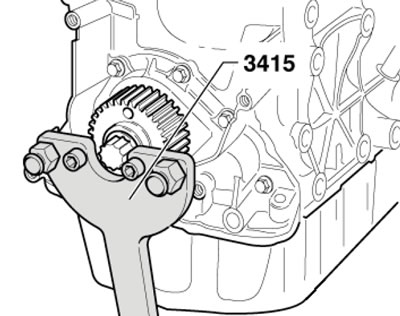
11.4. Keeping the gear from turning

11.4. Keeping the gear from turning


5. Screw the gear mounting bolt back into the crankshaft by hand. Unscrew the inner part of puller #3203 by 9 turns (approximately 20 mm) from the outer part and secure with a knurled screw. Lubricate the threaded head of the puller with engine oil, install and, pressing hard, screw it as deep as possible into the seal (see illustration). Loosen the knurled bolt and rotate the inside of the puller against the crankshaft until the seal is pulled out. Clamp the puller in a vice at the flat spots and remove the seal from it with pliers.
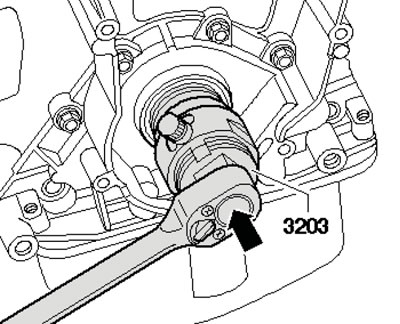
11.5. Removing the oil seal

11.5. Removing the oil seal


6. Clean the working and sealing surface. Remove any remaining oil from the crankshaft connecting rod journal with a clean rag, and fit guide bush No. T10053/1 onto the journal (see illustration) and slide the oil seal through the guide sleeve onto the crankshaft journal.
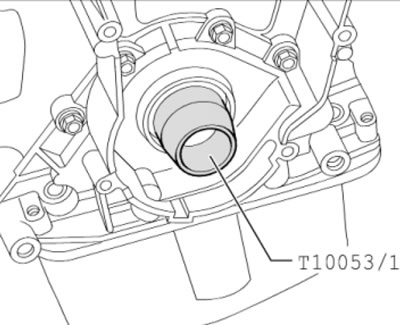
11.6. Mounting sleeve

11.6. Mounting sleeve


7. Press the oil seal flush with the central bolt of the gear wheel and the bushing from the mounting device No. T10053 (see illustration).
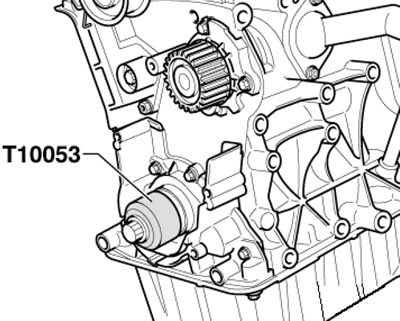
11.7. Installing the seal

11.7. Installing the seal


8. Fit the toothed wheel and hold it from turning with support No.3415 (see illustration 11.4), tighten the new mounting bolt.

Note: There must be no oil on the mating surfaces between the gear and the crankshaft; the bolt should also be screwed in without additional lubrication.


9. Further installation is carried out in the reverse order of dismantling the components.

Removal and installation the front oil seal holder


10. Set the radiator frame to the service position (see Section 6) and remove the top engine cover (see illustration 5.21).

11. Remove the alternator belt (see Section 8), unscrew the bolt (18 in illustration 7.1) and remove the intermediate roller (17).

12. Remove the timing belt (see Section 10) and the crankshaft gear (see paragraph 4).

13. Remove the bolts (1-10 in the illustration) and remove the front oil seal holder. Press the oil seal out of the removed holder. Seal the torn off part of the engine crankcase with a rag.
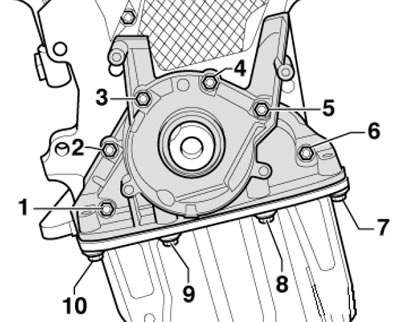


11.13. Front oil seal housing fastening bolts

11.13. Front oil seal housing fastening bolts


14. Carefully remove any remaining sealant from the cylinder block, oil pan and seal cover. Clean the seating surfaces from oil and grease.

15. Apply a 2 mm bead of sealant to the joints of the cylinder block and oil pan (see illustration).
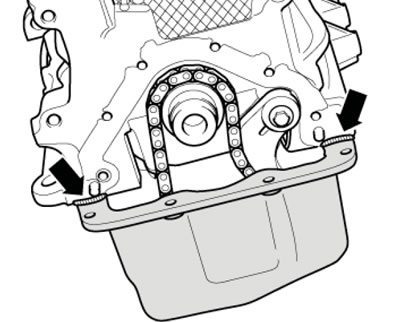
11.15. Places of sealant application (between the cylinder block and the oil pan)

11.15. Places of sealant application (between the cylinder block and the oil pan)


16. Apply a 2-3 mm diameter bead of sealant to the clean front seal retainer seating surface as shown in the accompanying illustration. Additionally, apply an even layer of sealant to the entire area of the lower seal retainer mating surface.
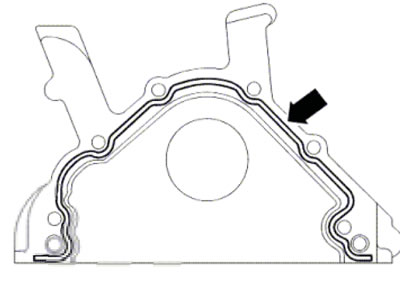
11.16. Applying sealant to the front oil seal holder

11.16. Applying sealant to the front oil seal holder


Note: The seal holder must be installed within 5 minutes after applying the sealant.


17. Carefully slide the oil seal holder onto the cylinder block and tighten the bolts (1-10 in illustration 11.13) its fasteners, install a new seal, gear wheel and other parts (see subsection above).

Replacing the rear oil seal and its holder


Note: The rear oil seal can only be replaced as a complete assembly with the holder.


18. Remove the manual transmission (see Chapter 6) or CVT/AT (see Chapter 7).

19. Remove the flywheel (see Section 12).

20. Remove the intermediate shield from the sealing flange and mounting bushings (see illustration).
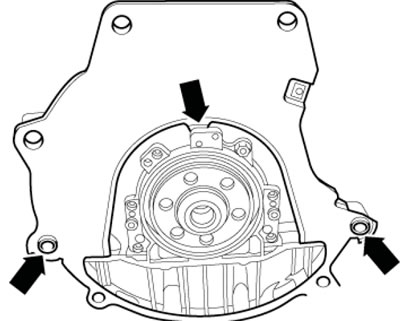
11.20. Intermediate shield

11.20. Intermediate shield


21. Remove the bolts (1-8 in the illustration) and remove the rear oil seal holder.
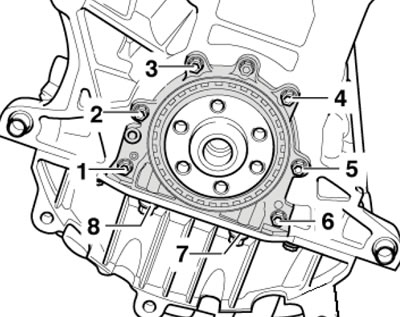
11.21. Rear oil seal holder mounting bolts

11.21. Rear oil seal holder mounting bolts


22. Carefully remove any remaining sealant from the cylinder block and oil pan. Clean the mounting surfaces from oil and grease.

23. Apply a 2 mm bead of sealant to the mating surfaces between the cylinder block and the oil pan (see illustration). Apply an even coat of sealant to the entire area of the lower seal retainer mating surface.
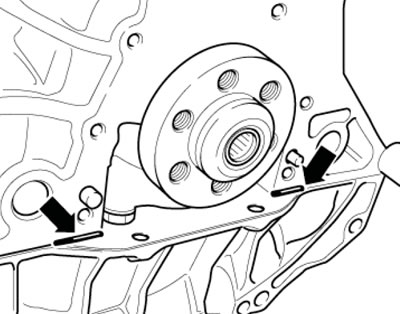
11.23. Places of application of sealant (between the cylinder block and the oil pan

11.23. Places of application of sealant (between the cylinder block and the oil pan


Note: The seal holder must be installed within 5 minutes after applying the sealant.


24. Attach the holder (2 in the illustration) rear oil seal together with the guide sleeve (1) inserted into the holder onto the crankshaft. Then carefully slide the oil seal holder onto the cylinder block pins.
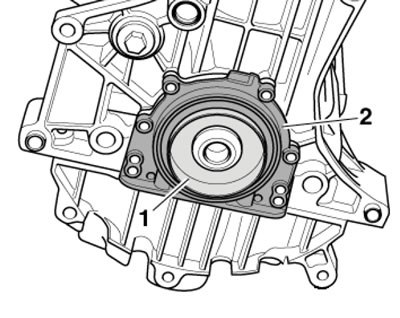
11.24. Installing the rear oil seal with holder

11.24. Installing the rear oil seal with holder


25. Tighten the bolts (1-8 in illustration 11.21) rear oil seal holder fastenings.

26. Hang the intermediate shield on the seal holder and place it on the mounting bushings.

27. Install the flywheel and transmission.

Text provided by the online resource AUDIMANUAL
The article was checked by auto expert Timur Bazhenov
This article is available at russian, bulgarian, belarusian, ukrainian, serbian, croatian, romanian, polish, slovak, hungarian

Share information:
Previous articles
Audi A4 B7: Petrol engines 2.0 (ALT)
Next articles

Removal and installation the timing belt and its tensioner
Removal and installation the auxiliary unit bracket
Removal and installation the crankshaft pulley
Removal and installation the alternator drive belt
Removal and installation the flywheel
Removal and installation the cylinder head and its cover
Removal and installation of camshafts and chain tensioner,…
Timing belt repair


Similar articles on other Audi car models:
Front and rear crankshaft seals — replacement Audi 80 B3 (1986-1991, petrol)
Replacing crankshaft seals Audi 100 C3 (1982-1990)
Checking the condition and replacing engine compartment hoses,… Audi A3 Type 8L (1996-2003)
Crankshaft seals Audi A6 C4 (1994-1997)
Replacing spark plugs Audi A8 D2 (1994-2002)
Replacing the rear hatch section seals Audi Q5 Type 8R (2008-2017)
Replacing the crankshaft seal Audi A2 (1999-2005)
Link to this page in different formats


Visitor comments

No comments yet


How much will 12 + 49 =


A4(B8, 2007-2015) 
  • General information
  • Operating instructions
  • Power unit
  • Petrol engines 1.8 l
  • Petrol engines 1.8/2.0 l
  • Petrol engines 3.0 l
  • Petrol engines 3.2 l
  • Fuel system (petrol)
  • Diesel engines 2.0 l (CA*)
  • Diesel engines 2.0 l (CJCB)
  • Diesel engines 2.7/3.0 l
  • Diesel engines 3.0 l
  • Fuel system (diesel)
  • Transmission
  • Manual gearbox 0B1
  • Manual gearbox 0B2
  • Manual gearbox 0B3
  • Manual gearbox 0B4
  • Automatic transmission 0B5
  • Automatic transmission 0B6
  • Automatic transmission 0AW
  • All-wheel drive system
  • Chassis
  • Front suspension
  • Rear suspension
  • Brake system
  • Steering system
  • Body
  • Exterior
  • Interior
  • Seats
  • Doors, locks and windows
  • Security system
  • Heating and air conditioning
  • Electrical equipment
  • Audio system
  • Power devices
  • Equipment and devices
  • Lighting and lamps
  • Electrical circuits
 
A4(B7, 2004-2008) 
  • General information
  • Introduction to manual
  • Troubleshooting
  • Operating instructions
  • Maintenance
  • Power unit
  • Petrol engines 2.0 (ALT)
  • Petrol engines 2.0 (TFSI)
  • Petrol engines 1.8 (MPI)
  • Diesel engines
  • Cooling system
  • Air conditioner
  • Fuel and exhaust system
  • Ignition system
  • Starting and charging
  • Transmission
  • Clutch
  • Manual gearbox
  • Automatic gearbox
  • Drive shafts
  • Chassis
  • Brake system
  • Front suspension
  • Rear suspension
  • Steering
  • Body
  • Exterior
  • Interior
  • Electrical equipment
  • Equipment and devices
  • Lighting and signaling
  • Windscreen wipers and washers
  • Electrical diagrams
  • Electrical diagrams (since 2007)
 
A4(B6, 2000-2006) 
  • General information
  • Vehicle Description
  • User manual
  • Maintenance
  • Power unit
  • Gasoline engine
  • Diesel engine
  • Lubrication system
  • Cooling system
  • Supply system
  • Injection system
  • Exhaust system
  • Ignition and control
  • Transmission
  • Gear box
  • Clutch and drive shafts
  • Chassis
  • Brake system
  • Car suspension
  • Steering
  • Body
  • Heating and ventilation
  • Exterior (external elements)
  • Interior (internal elements)
  • Electrical equipment
  • Power devices
  • Lighting and appliances
  • Electrical circuits
 
A4(B6, 2000-2006, petrol) 
  • General information
  • Introduction to the guide
  • Car care
  • Power unit
  • Engine repair
  • Lubrication system
  • Cooling system
  • Injection and control system
  • Ignition system
  • Power and exhaust system
  • Transmission
  • Clutch and drive shafts
  • Car gearbox
  • Chassis
  • Suspension and wheels
  • Steering
  • Brake system
  • Body
  • Interior
  • Exterior
  • Electrical equipment
  • Equipment and devices
  • Lighting and signaling
  • Power devices
  • Electrical circuits
 
A4(B5, 1994-2001) 
  • General information
  • Introduction to the guide
  • Car care
  • Maintenance (gasoline)
  • Maintenance (diesel)
  • Power unit
  • Gasoline engines
  • Diesel engines
  • Engine overhaul
  • Cooling system
  • Fuel injection (gasoline)
  • Fuel system (diesel)
  • Exhaust system
  • Ignition system
  • Transmission
  • Clutch
  • Mechanical gearbox
  • Automatic gearbox
  • Drive shafts
  • Chassis
  • Brake system
  • Car suspension
  • Steering
  • Body
  • Exterior
  • Interior
  • Doors, locks and windows
  • Heating and ventilation
  • Electrical equipment
  • Power devices
  • Equipment and devices
  • Electrical circuits
 
A4(B5, 1994-2001, petrol) 
  • General information
  • Vehicle description
  • Maintenance
  • Power unit
  • Engine repair
  • Turbocharging
  • Exhaust system
  • Cooling system
  • Ignition system
  • Fuel system
  • Motronic injection system
  • MPI and MPFI injection system
  • Transmission
  • Clutch
  • Gearbox and shafts
  • Chassis
  • Steering
  • Car suspension
  • Brake system
  • Wheels and tires
  • Body
  • Heating and ventilation
  • Body parts
  • Electrical equipment
  • Fuses and relays
  • Power devices
  • Lighting and lamps
  • Tools and devices
  • Electrical circuits
 
AudiManual.ru © 2017-2026 · Mobile version · Feedback · Sitemap: EN BG BY UA RS HR RO PL SK HU · Site search · News and articles
80 B2 · 80 B3 petrol · 80 B3 · 80 B4 · 100 C3 diesel · 100 C3 petrol · 100 C3 · 100 C4 petrol · 100 C4 · A3 Type 8L · A4 B5 petrol · A4 B5 · A4 B6 petrol · A4 B6 · A4 B7 · A4 B8 · A6 C4 · A6 C5 · A6 C5 Allroad · A8 D2 · Q5 Type 8R · Q7 Typ 4L · Audi A2 ·
This site uses cookies 🍪. Click the button to accept this fact.