



Table of contents: Valve caps ↓ What are the consequences of low… ↓
Air pressure should be measured when the tires are cold. As the tire heats up during driving, the pressure increases, so measuring the pressure immediately after driving will give incorrect results. Tire pressure should be checked regularly, every three to four weeks. In the case of a branded tire, a decrease in pressure of 1.5 percent per month is normal. If there is significant air loss, the tire should be inspected more closely.

The tire pressure label is located on the back of the fuel filler cap
Valve caps
Always close the tire valves with caps. If dirt gets into the valve, the valve needle may get stuck and the seal will be broken. The tire pressure should not fall below the values given on the table. On the contrary, an increase in pressure by 0.2-0.3 bar provides certain advantages: the steering works more precisely, the tires last longer, and even fuel consumption is slightly reduced. The disadvantage of increased pressure: in a car with highly inflated tires, passengers feel less comfortable.
What are the consequences of low tire pressure?
An ill-maintained tire can be a risk factor for both the driver and the car itself. For example, if you frequently drive with a poorly inflated tire and with a very heavy load, the tread may partially peel off. Such defects may remain unnoticed for a long time. If the damaged tire is subjected to heavy loads again, then due to the enormous centrifugal forces that occur when driving at high speed, entire pieces of the tire may even break off.
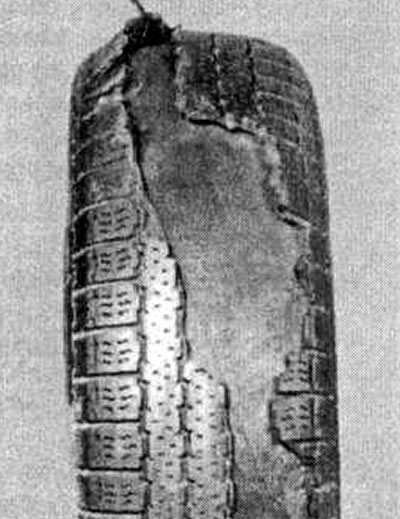
A poorly maintained tire can be a risk factor

Tire pressure determines the shape and size of the tire's support surface, and therefore its service life (tread wear), fuel consumption and driving performance of tires (the tires are crushed and respond to control with a delay and not accurately)
A - When the tire pressure is correct, the entire tread is in contact with the road.
B - If the pressure is too high, the tire contacts the road only in the middle part of the tread.
C - When the pressure is insufficient, the shoulder area of the tread comes into contact with the road.