
Repair Chevrolet Repair Toyota Repair Honda Repair AvtoVAZ Repair Mercedes-Benz Repair BMW Repair Opel
Home  |  Contacts  |  Sitemap  |    
English Русский
Български
Беларускі
Український
Српски
Hrvatski
Română
Polski
Slovenský
Magyar
AudiManual.ru


  • AUDI 80
  • AUDI 100
  • AUDI A3
  • AUDI A4
  • AUDI A6
  • AUDI A8
  • AUDI Q
  • OTHER
  • ARTICLES
B8 (2007-2015) B7 (2004-2008) B6 (2000-2006) B6 (2000-2006, petrol) B5 (1994-2001) B5 (1994-2001, petrol)

Checking the condition of the tires (Audi A4 B6)

  • Home
  • Audi A4
  • B6 (2000-2006, petrol)
  • Chassis
  • Suspension and wheels
  • Checking the condition of the tires
            0
The front wheels set the car in motion, and the steering is done through these wheels. In addition, the front wheels bear the main load during braking. For this reason, the tires of the front wheels wear out faster than the tires of the rear wheels. The condition of the tires is most conveniently checked by placing the car on jack stands.

1. Rotate each wheel completely. Use a small screwdriver to remove stones and other foreign bodies from the tread grooves. If there is a piece of glass or a nail in the tire, air may escape from this area.

2. Pay attention to such defects as punctures, cuts, cracks and torn pieces. If the rubber is damaged, moisture penetrates into the tire. However, from the outside, you may not notice that the stabilizing steel breaker is already being eaten away by rust. To be sure, ask a specialist to check the tire. The same should be done in case of severe wear of the tire.

3. The tread depth over its entire area must be at least 1.6 mm. The tire shown in the picture has wear indicators in several places on the tread. These places are marked on the sidewall with the letters "twi". As the tread wears, the driving performance of the tires deteriorates, especially on wet roads. To be on the safe side, summer tires should be replaced when the tread depth is two millimeters, and winter tires when the tread depth is four millimeters.

4. Check that all tires are worn evenly.
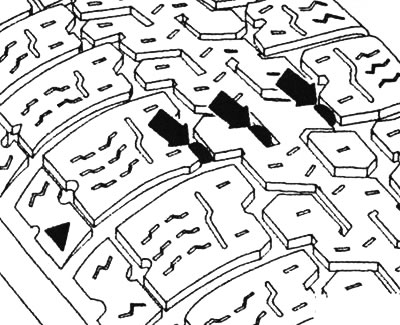
The minimum tread depth is reached when the 1.6 mm high wear indicators (arrows) located around the…

The minimum tread depth is reached when the 1.6 mm high wear indicators (arrows) located around the circumference of the tyre show that the tread profile is worn out


5. Carefully inspect the sidewalls of the tires. Bulges indicate damage to the tire carcass.

What does the tread surface tell us?
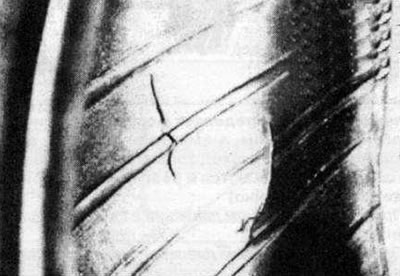


The carcass tear is visible from the inside of the tire

The carcass tear is visible from the inside of the tire


Worn outer side of the tread (front tire). Fast cornering. Tires can be swapped for rear tires.

The outer sides of the tread are more worn than the middle. The tire has been used for a long time with low pressure.

Uniform smoothing of the tread pattern The shock absorber is probably faulty.

Uneven wear (in different places). Wheel unbalanced. Contact a workshop.

Severe wear in one place. Braking with a locked wheel. Short-term locking and certain wear of tires (flattening) cannot be prevented even by the anti-lock system.
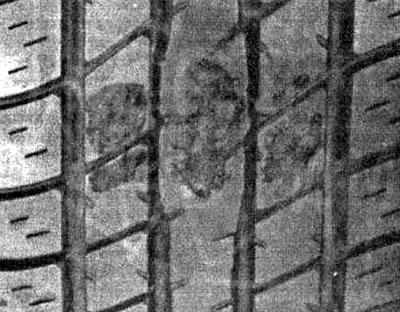
Traces from braking with a locked wheel: with an anti-lock braking system, such a picture is…

Traces from braking with a locked wheel: with an anti-lock braking system, such a picture is impossible


Severe wear of the middle part of the tread pattern. Occurs due to frequent driving at maximum speed. Under the action of centrifugal force, the tires bulge, so they wear out more in the middle. This effect is most pronounced on the rear wheels, and also when the tire pressure is too high.
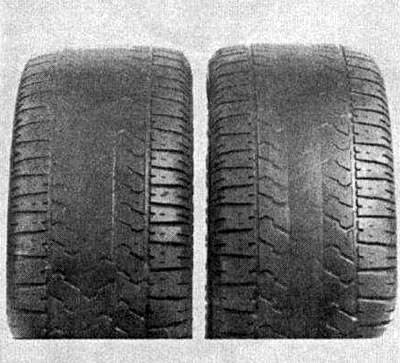
Severe wear of the middle part of the tread

Severe wear of the middle part of the tread


Curved profile. A slanted profile indicates incorrect wheel installation. Light alloy wheels can also have a negative effect on wheel installation.
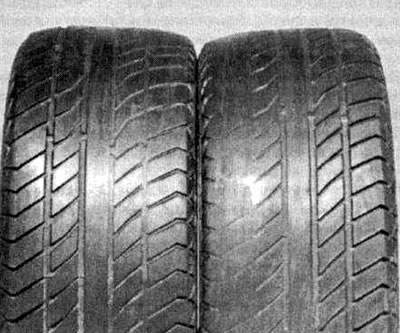
Curved profile

Curved profile


Wheel imbalance manifests itself in the form of vibrations of the steering wheel or front end. The reason is the uneven distribution of mass within the wheel, which also causes increased tire wear. The imbalance must be corrected in a workshop. In the workshop, the wheel is screwed to a balancing machine, which shows the imbalance. Uneven rotation of the wheel is corrected using lead weights, which are installed in different places on the wheel rims.


Static imbalance A is manifested even when the wheel is spun with the car raised and then allowed to stop. The center of gravity will be at the bottom. A wheel with static imbalance jumps while driving, and the shock absorbers wear out faster.

Static imbalance B is only apparent when the wheel is rotating quickly. The overweight point is not in the middle plane of the wheel, but is shifted to the outside or inside. As a result, when driving quickly, the wheel makes angular oscillations and wobbles.
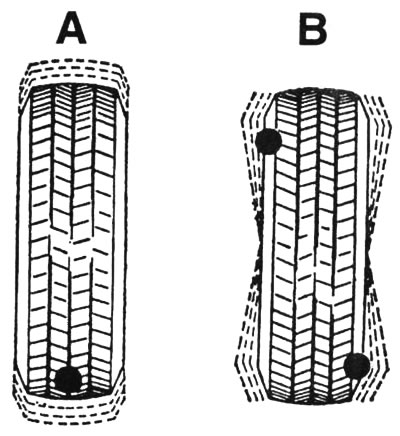
Wheel imbalance

Wheel imbalance
The article was checked by auto expert Alexey Ivanov
This article is available at russian, bulgarian, belarusian, ukrainian, serbian, croatian, romanian, polish, slovak, hungarian

Share information:
Previous articles
Audi A4 B6: Suspension and wheels
Next articles

Wheel replacement
Checking tire pressure
How to extend the life of your tires
Tires and Wheels — Design Description


Similar articles on other Audi car models:
Checking the technical condition of the oil pump Audi 80 B2 (1979-1986)
Checking the condition of a V-belt or poly V-belt Audi 100 C4 (1990-1994, petrol)
Checking the condition of the tires and their pressure Audi A3 Type 8L (1996-2003)
Checking the condition of the poly V-belt Audi A6 C5 (1997-2004)
Checking the condition of the poly V-belt Audi A8 D2 (1994-2002)
Checking the condition of tires and their inflation pressure Audi Q7 Typ 4L (2005-2015, diesel)
Poly V-belt — checking condition (petrol engines) Audi A2 (1999-2005)
Link to this page in different formats


Visitor comments

No comments yet


How much will 14 + 44 =


A4(B8, 2007-2015) 
  • General information
  • Operating instructions
  • Power unit
  • Petrol engines 1.8 l
  • Petrol engines 1.8/2.0 l
  • Petrol engines 3.0 l
  • Petrol engines 3.2 l
  • Fuel system (petrol)
  • Diesel engines 2.0 l (CA*)
  • Diesel engines 2.0 l (CJCB)
  • Diesel engines 2.7/3.0 l
  • Diesel engines 3.0 l
  • Fuel system (diesel)
  • Transmission
  • Manual gearbox 0B1
  • Manual gearbox 0B2
  • Manual gearbox 0B3
  • Manual gearbox 0B4
  • Automatic transmission 0B5
  • Automatic transmission 0B6
  • Automatic transmission 0AW
  • All-wheel drive system
  • Chassis
  • Front suspension
  • Rear suspension
  • Brake system
  • Steering system
  • Body
  • Exterior
  • Interior
  • Seats
  • Doors, locks and windows
  • Security system
  • Heating and air conditioning
  • Electrical equipment
  • Audio system
  • Power devices
  • Equipment and devices
  • Lighting and lamps
  • Electrical circuits
 
A4(B7, 2004-2008) 
  • General information
  • Introduction to manual
  • Troubleshooting
  • Operating instructions
  • Maintenance
  • Power unit
  • Petrol engines 2.0 (ALT)
  • Petrol engines 2.0 (TFSI)
  • Petrol engines 1.8 (MPI)
  • Diesel engines
  • Cooling system
  • Air conditioner
  • Fuel and exhaust system
  • Ignition system
  • Starting and charging
  • Transmission
  • Clutch
  • Manual gearbox
  • Automatic gearbox
  • Drive shafts
  • Chassis
  • Brake system
  • Front suspension
  • Rear suspension
  • Steering
  • Body
  • Exterior
  • Interior
  • Electrical equipment
  • Equipment and devices
  • Lighting and signaling
  • Windscreen wipers and washers
  • Electrical diagrams
  • Electrical diagrams (since 2007)
 
A4(B6, 2000-2006) 
  • General information
  • Vehicle Description
  • User manual
  • Maintenance
  • Power unit
  • Gasoline engine
  • Diesel engine
  • Lubrication system
  • Cooling system
  • Supply system
  • Injection system
  • Exhaust system
  • Ignition and control
  • Transmission
  • Gear box
  • Clutch and drive shafts
  • Chassis
  • Brake system
  • Car suspension
  • Steering
  • Body
  • Heating and ventilation
  • Exterior (external elements)
  • Interior (internal elements)
  • Electrical equipment
  • Power devices
  • Lighting and appliances
  • Electrical circuits
 
A4(B6, 2000-2006, petrol) 
  • General information
  • Introduction to the guide
  • Car care
  • Power unit
  • Engine repair
  • Lubrication system
  • Cooling system
  • Injection and control system
  • Ignition system
  • Power and exhaust system
  • Transmission
  • Clutch and drive shafts
  • Car gearbox
  • Chassis
  • Suspension and wheels
  • Steering
  • Brake system
  • Body
  • Interior
  • Exterior
  • Electrical equipment
  • Equipment and devices
  • Lighting and signaling
  • Power devices
  • Electrical circuits
 
A4(B5, 1994-2001) 
  • General information
  • Introduction to the guide
  • Car care
  • Maintenance (gasoline)
  • Maintenance (diesel)
  • Power unit
  • Gasoline engines
  • Diesel engines
  • Engine overhaul
  • Cooling system
  • Fuel injection (gasoline)
  • Fuel system (diesel)
  • Exhaust system
  • Ignition system
  • Transmission
  • Clutch
  • Mechanical gearbox
  • Automatic gearbox
  • Drive shafts
  • Chassis
  • Brake system
  • Car suspension
  • Steering
  • Body
  • Exterior
  • Interior
  • Doors, locks and windows
  • Heating and ventilation
  • Electrical equipment
  • Power devices
  • Equipment and devices
  • Electrical circuits
 
A4(B5, 1994-2001, petrol) 
  • General information
  • Vehicle description
  • Maintenance
  • Power unit
  • Engine repair
  • Turbocharging
  • Exhaust system
  • Cooling system
  • Ignition system
  • Fuel system
  • Motronic injection system
  • MPI and MPFI injection system
  • Transmission
  • Clutch
  • Gearbox and shafts
  • Chassis
  • Steering
  • Car suspension
  • Brake system
  • Wheels and tires
  • Body
  • Heating and ventilation
  • Body parts
  • Electrical equipment
  • Fuses and relays
  • Power devices
  • Lighting and lamps
  • Tools and devices
  • Electrical circuits
 
AudiManual.ru © 2017-2026 · Mobile version · Feedback · Sitemap: EN BG BY UA RS HR RO PL SK HU · Site search · News and articles
80 B2 · 80 B3 petrol · 80 B3 · 80 B4 · 100 C3 diesel · 100 C3 petrol · 100 C3 · 100 C4 petrol · 100 C4 · A3 Type 8L · A4 B5 petrol · A4 B5 · A4 B6 petrol · A4 B6 · A4 B7 · A4 B8 · A6 C4 · A6 C5 · A6 C5 Allroad · A8 D2 · Q5 Type 8R · Q7 Typ 4L · Audi A2 ·
This site uses cookies 🍪. Click the button to accept this fact.