



Table of contents: Wheel rims for A4 ↓ Ultra-light tires ↓ Wheel rims ↓ The most important parameters of the… ↓ Maximum permissible speed ↓ Date of manufacture and conformity… ↓ Winter tires are special tires for… ↓ Mounting winter tires on wheel rims ↓
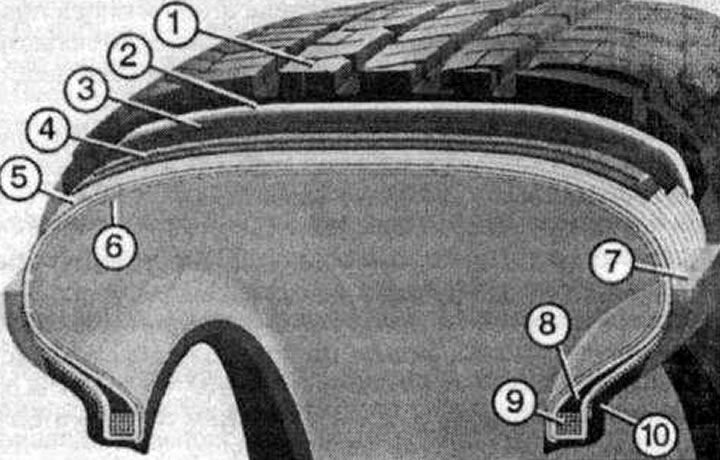
Multi-layer passenger car tire: 1 - the properties of the tire depend on the tread, tread pattern and rubber compound, 2 - base (reduces rolling resistance), 3 - nylon bandage, 4 - layers of steel cord (increase the stability of the car when driving), 5 - frame (gives the tire shape and rigidity), 6 - sealing layer (gas-impermeable inner layer that replaces the camera), 7 - sidewall (protects the frame from damage), 8 - core profile (promotes precise driving and steering), 9 - bead core (provides a tight fit on the wheel rim), 10 - side reinforcement (improves controllability and stability of the vehicle while driving).
The carcass, the appropriate rubber compound and the refined tread pattern make the tires produced today an ultra-modern product that makes an important contribution to the passive safety of the vehicle. The tires bear the weight of the vehicle, absorb small shocks from the road and transmit the forces that occur during driving, braking and driving on curves. The service life of tires on the front wheels is from 50 to 60 thousand km. However, even if the vehicle is not used intensively, the tires need to be changed after seven to eight years, as the rubber compound decomposes over time.
Tires and Wheels (excerpt)
| Tire size | Wheel rim size | Pressing depth |
| 195/65 R15 | 7Jx15 | 45 mm |
| 215/55 R16Y | 7Jx16 | 45 mm |
Wheel rims for A4
Information on the sizes of tyres and rims permitted for your vehicle can be found in the vehicle documentation. The following combinations are installed as standard: lightweight stamped aluminium wheels 7Jx15 with 195/65 R15 tyres or cast aluminium wheels 7Jx16 with 215/55 R16Y tyres. Sixteen- or seventeen-inch light alloy wheels of various designs are available as special equipment. If you wish to mount other tyres or rims, please make a corresponding note at the motor vehicle approval inspectorate. If the vehicle is equipped with a navigation system, this system must be calibrated in a workshop when changing the tyre format.
Ultra-light tires
Ultra-light tires use aramid fibers instead of steel inserts. Aramid is a polymer that is six times lighter than steel. At the same time, aramid is approximately ten times stronger than steel in tensile strength. In addition, when using this material, the thickness of the outer wall of the tire is reduced by ten percent. The ultra-light 195/65 R 15 tire is approximately three kilograms lighter than a regular tire. Firstly, this helps save fuel. Secondly, due to the reduction in rotating masses, the frequency of adjustment of the anti-lock system can be reduced, which in turn shortens the braking distance on slippery roads. And another advantage of aramid tires: they are easier to restore, since polymer materials do not rust.
Wheel rims
The size of a wheel disk in accordance with the standards is always indicated in inches. For example, the designation 7Jx 15 means a deep wheel disk (x) with a width of 7 and a diameter of 15 inches. The letter J indicates the shape of the wheel disk flange. The peculiarity of a deep wheel disk is that it has an annular protrusion (hump) on the seat shelf to improve the fit of the tire. When moving quickly along a curve, the hump prevents the tire bead from being pressed off the seat shelf into the recess.
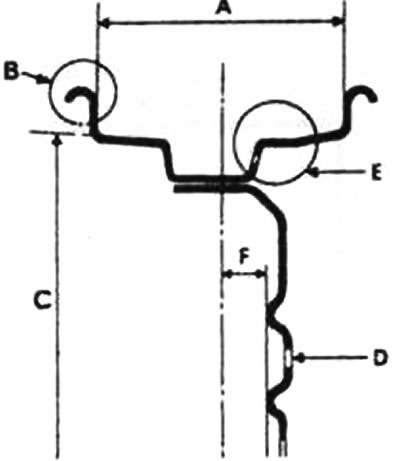
Wheel rim dimensions: A - width in inches, B - side height in inches, C - seat diameter in inches, D - number of holes, E - combination hump, F - pressing depth.
The most important parameters of the tire
On the sidewall of the tire there is a whole series of numbers and letters, with the help of which the manufacturer codes the mandatory parameters of the tire. Of course, the driver is primarily interested in the tire size. 195/65 K 15, for example, means that the width of the cross-section of the tire is 195 mm. The second number is used to indicate the ratio between the height and width of the tire. In our example, this ratio is 65 percent. The smaller this ratio, the flatter and wider the tire. The letter R denotes radial tires, the number that comes after this letter determines the diameter of the wheel disk in inches.
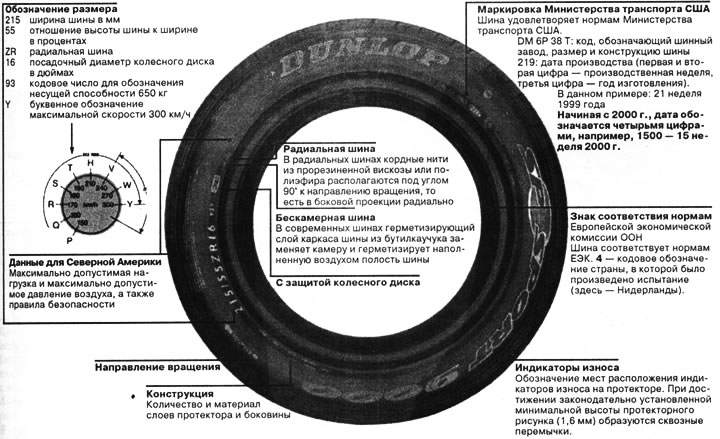
Data on the sidewall of the tire: When buying a tire, pay attention to the data on its sidewall. The new tire must fit the wheel rim.
Maximum permissible speed
Another letter indicates the maximum permissible speed. For example, a tire with the letter designation S is designed for driving at speeds up to 180 km/h, and a tire with the designation T is for a maximum speed of up to 190 km/h. Accordingly, H is 210 km/h, Y is 300 km/h. If you use regular tires for driving on muddy and snowy roads in winter, release the gas earlier, since the maximum speed for a tire with the designation Q is only 160 km/h.
Date of manufacture and conformity mark to UNECE quality standards
The manufacturing date can be determined by a three-digit number. Starting with the 1990 manufacturing year, this number is followed by a small triangle. For example, the number 187 means that the tire was manufactured in the 18th week of 1997. Tires manufactured after October 1, 1998, must have a compliance number on the sidewall according to the ECE regulations. This number indicates that the tire meets the quality standards of the UN Economic Commission for Europe. Tires manufactured after December 1999 have a four-digit manufacturing date. For example, the number 0901 means that the tire was manufactured in the 9th manufacturing week of 2001.

Quality mark: capital letter 4 and a number indicating the country of origin, e.g. 1 for Germany or 4 for the Netherlands
Winter tires are special tires for driving on snowy and icy roads
Winter tires roll on snow and ice more reliably than summer tires. Winter tires are made from a special rubber compound with a high content of natural rubber, at temperatures below seven degrees they provide better grip on the road (both dry and wet). However, for good transmission of engine power and braking force, the tread depth must be at least 4 millimetres. All four wheels must be equipped with winter tyres, as a combination of summer and winter tyres can be dangerous.
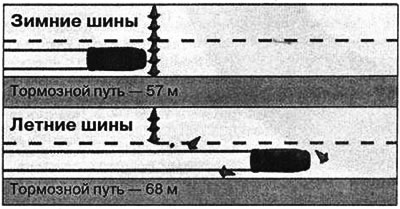
Braking with wheel lock on ice (speed 30 km/h): Comparison of braking patterns with summer and winter tires (car without anti-lock braking system)
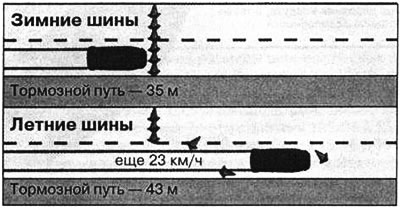
Braking with ABS on a snowy road (speed 50 km/h): Comparison of braking patterns with summer and winter tires (car with anti-lock braking system)
Mounting winter tires on wheel rims
For winter use, a narrow tire is quite sufficient. The money saved on this is better spent on purchasing a second set of suitable wheel rims. Changing tires in the spring and fall will cost you much more in the long run.
Each time the wheel is mounted, it must be balanced. Increase the tire pressure by 0.2 bar. If the permissible speed for winter tires (up to 160 km/h) below the maximum speed of your car, as a reminder stick it in your field of vision (but not on the windshield) the corresponding memo.
(The article is a reprint of material from AudiManual.ru)