



Note: The following shows the removal and installation of the injector on cylinder bank 2 on the left. For cylinder bank 1 only: remove the upper part of the air injector. filters with air flow meter. On cylinder bank 2, it is necessary to unscrew the coolant expansion tank; the coolant lines remain connected.
Remove the engine cover. Mark the compatibility of the injectors with the cylinder. Reinstallation is only permitted on the same cylinder. When working on the system. when injecting, observe the rules for maintaining cleanliness. Immediately close open connections with a special cap. Remove the return line hoses from the injectors by pressing both covers down and simultaneously pulling up on the intermediate element to release the "arrow." Disconnect the plug-in connectors on the injectors to be removed.
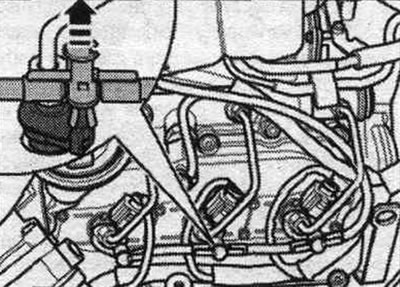
Loosen the union nuts securing the high-pressure lines "1" to the injectors using the "T40055" socket. Use the appropriate socket on the wrench to loosen the union nuts on the high-pressure fuel lines. ramp. Completely loosen the union nuts, carefully remove the high-pressure lines, and place them on a clean rag.
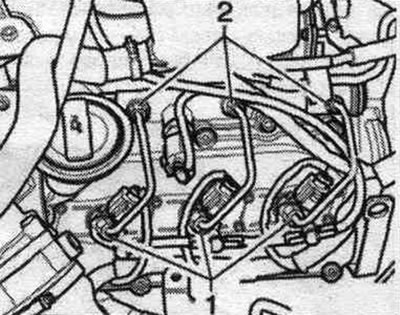
Unscrew the "arrow" injector caps. Pull the caps up and turn them 90°.
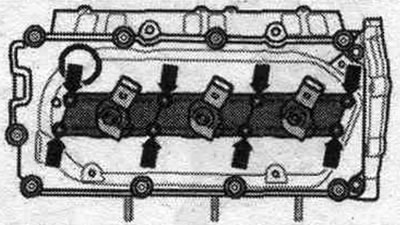
Loosen the clamps of the "arrow" injectors.
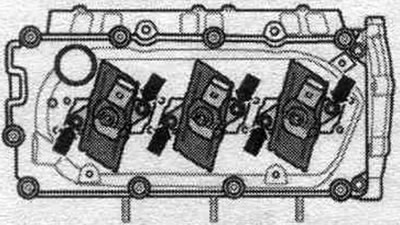
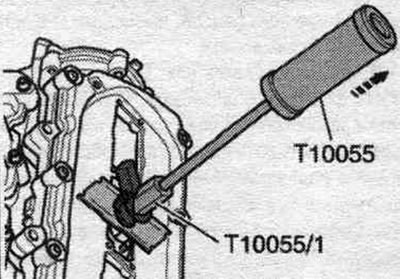
Remove the injectors using the T10055 puller and the T10055/1 adapter. Place the removed injectors on a clean rag.
Installing new injectors
When installing a new injector, it is necessary to replace: clamp, copper seal. ring, sealing ring of the injector socket, sealing ring of the return line fitting. When reusing high-pressure lines, observe the corresponding cylinder designations. High pressure lines can be reused after the following checks. Check the sealing cone of the corresponding high-pressure line for deformations and cracks. The hole must not be deformed or damaged. Lines with corrosion should not be reused.
Installation of previously used injectors
When reinstalling a used injector, the following must be replaced: clamp, copper seal. ring, sealing ring of the injector socket, sealing ring of the return line fitting. Apply rust remover spray to the injector needle. After about 5 minutes, remove any soot or oil particles with a rag. If the nozzle is heavily contaminated, its lower part should be additionally cleaned. clean with a soft brass brush to facilitate removal of the copper seal (do not allow the brass brush to come into contact with the injector nozzle channel). To remove the old copper gasket from the injector, carefully clamp the gasket in a vice so that it is clamped between the clamping jaws directly when turning. Using light twisting and pulling movements of your hand, remove the nozzle from the copper gasket. Use a scraper to clean off any deposits under the copper seal. ring. Using a plastic bushing, install a new copper seal. ring. Before installation, lubricate all seals. rings with mounting or oil. Risk of damage to the sealing surface of the injector. To remove soot particles from the injector sealing surface, clean the injector seat in the cylinder head with a rag soaked in oil or rust remover. Install the injectors. Tighten the high pressure fuel line union nuts by hand without tightening. Pay attention to stress-free installation. Tighten the high pressure fuel lines. Carefully install the connecting elements of the return lines onto the injectors using the lip seals and applying pressure (pre-check the lip seal for damage). The lock should click into place, then gently press the release bolt down. After replacing one or more injectors, the ECU must perform a "Fuel Quantity Adjustment (IMA)" and "Voltage Adjustment (ISA)" for the new injectors. Additionally, check all other injectors to ensure that all matching parameters "Injector Performance Matching (IMA)" and "Injector Voltage Matching (ISA)" are entered correctly. If the correct matching parameters are entered into the engine control unit memory, they should not be re-entered under any circumstances.
Pump fuel. system and check for leaks
To remove air, do not open the high pressure outlets, air from the fuel. the system goes away on its own. Let the engine run at idle for a few minutes. move and then turn it off again. Turn off the ignition. Check all fuel. system and connection of return fuel. highways (6 pcs.) for leaks. If the seal is broken despite the correct tightening torque, replace the faulty unit. Replacement of return lines is carried out only in a set with a pressure reducing valve. Carry out a test drive with at least one acceleration under maximum load and then recheck the high-pressure circuit for leaks. Presence of air in fuel. system during a test drive may cause the engine to operate in emergency mode. Turn off the engine and clear the fault memory. Continue with the test drive.
The original article is available on the online resource: AudiManual.ru