



In addition, the electronics participate in the dynamic driving style program (DRP). This program, based on how the driver presses the accelerator pedal, determines whether the driver wants to get maximum power from the engine or, conversely, save fuel. In the latter case, based on the multidimensional characteristic of the engine speed, which is stored in the memory, switching to a low gear ratio occurs already at a speed of 60 km/h (overdrive). If the driver gives full throttle (sharply presses the accelerator pedal all the way down), then the electronic circuit immediately switches to the sport driving characteristic and includes such a gear ratio (downshift), that the high revs required for maximum power are already achieved at low speed.
In normal driving mode, the electronics select the most suitable gear ratio in the range between two extreme values, and, in contrast to the shifting processes in a stepped automatic transmission, all changes in gear ratios occur completely unnoticeably and without jerks. In addition, the electronics recognize uphill and downhill driving and help the driver by compensating the power or, conversely, increasing the braking torque during engine braking. The highlight of this program is the so-called "manual mode", in this mode six strictly defined steps are switched in an additional gearshift or with the help of a lever on the steering wheel, and in this case, too, the switching occurs smoothly, without jerks.
The principle of operation of the variator
During the design of the Multitronic transmission, Audi engineers used a new transmission element (the so-called plate chain) we managed to create a continuously variable transmission that allows for the transmission of large forces and torques over a long period of time.
At the same time, this variator, in which the ratio between the maximum and minimum gear ratio is 6, surpasses all previous types of automatic transmissions in terms of the largest and smallest gear ratio. Thanks to the high maximum gear ratio, the variator, for example, makes it easier to start off and allows you to do without a hydraulic torque converter.
Instead, Audi uses an oil-cooled multi-plate clutch, which not only eliminates the typical torque converter transmission losses, but also enables different starting algorithms. These algorithms are selected electronically in accordance with the driver's intentions, which are again determined by how he presses the accelerator pedal.
In addition, the hydraulics were designed in a special way. The variator used a two-plunger principle, due to the division of the oil flow between the high-pressure circuit and the cooling circuit, compared to the conventional design, a pump with much less power is required. This allows for an increase in the efficiency of the gearbox and improved driving performance of the car.
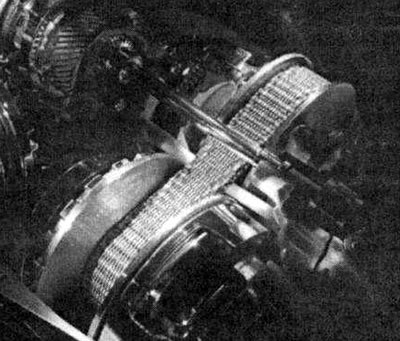
The plate chain of the variator in the Multitronic gearbox made it possible to do away with the hydraulic torque converter
[The original article is located on the online resource «AudiManual»]