



Table of contents: Gears and shafts ↓ Forward gears and reverse gear ↓
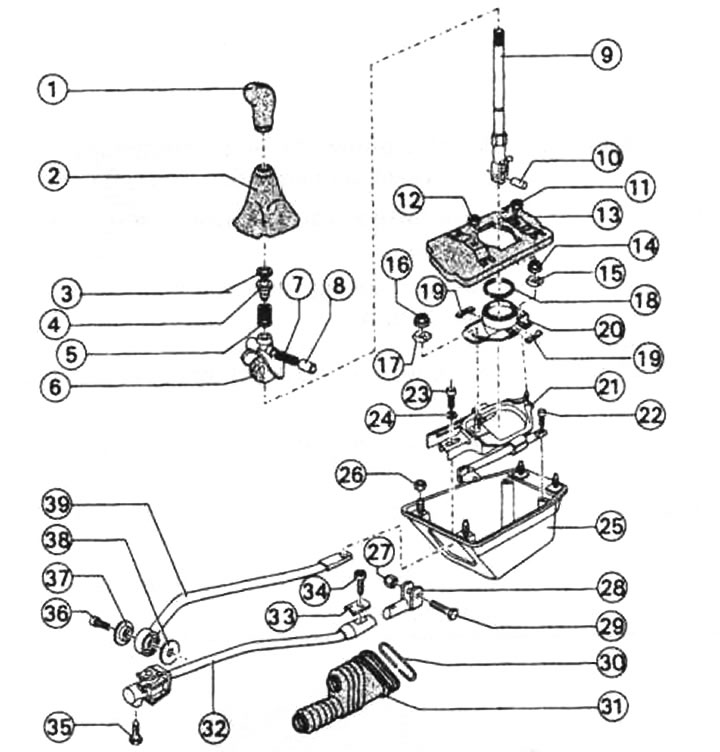
Five-speed gearbox shift levers and rods: 1 - Ball head, 2 - Housing, 3 - Snap ring, 4 - Spacer sleeve, 5 - Compression spring, 6 - Ball stop, 7 - Compression spring, 8 - Sleeve, 9 - Gear shift lever, 10 - Spacer tube, 11, 12, 14, 16, 26 and 27 - Nut, 13 - Cover, 15 and 17 - Connecting part, 18 - Snap ring, 19 - Shock absorber, 20 - Spherical sleeve, 21 - Thrust rod, 22 and 23 - Screw, 24 - Washer, 25 - Gear shift mechanism housing, 28 - Gear shift fork, 29, 34, 35 and 36 - Screw, 30 - Clamping ring, 31 - Corrugated boot, 32 - Gear shift rod gears, 33 - clamping part, 37 and 38 - washer, 39 - thrust rod.
Engine power is transmitted through the clutch to the primary (input) shaft of the gearbox. Five gears are located on this shaft (and another gear for reverse gear). These gears are in constant engagement with the corresponding gears of the secondary shaft. The gears of both shafts are supported by needle rollers, i.e. there is no rigid connection between the shaft and the gear.
Gears and shafts
The gears rotate freely until one of them, due to the engagement of a gear, engages with the corresponding neck of the gear on the other shaft. To do this, on each shaft, a rigid connection is first made between the gear and the shaft using a synchronizer locking ring, after which the gear sits rigidly on the shaft and can engage with the mating gear to transmit force. In order for the gears to engage with each other, the rotational speeds of the shafts must match. For this purpose, part of one shaft slides along part of the other shaft using friction elements. Due to friction, the shaft that rotates faster is slowed down until both shafts begin to rotate synchronously.
Forward gears and reverse gear
The first three gears are downshifting. The fourth gear is direct, the engine speed is transmitted approximately in a 1:1 ratio. When the fifth gear is engaged, the secondary shaft of the gearbox rotates faster than the engine crankshaft. Naturally, the car must also be equipped with a reverse gear. For this purpose, each drive shaft has an additional gear that changes the direction of rotation of the drive wheels to the opposite. When selecting a gear using the gear shift lever, the movements of the lever are transmitted through the gear shift rod to the shift segment, which is located on the gearbox.
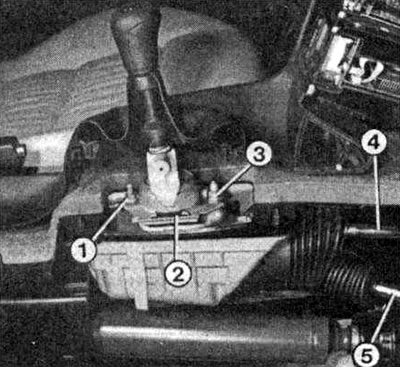
This section clearly shows the principle of gear shifting: 1 and 3 - spherical bushing fastening nuts, 2 and 4 - fixed reaction rod, 5 - gear shift rod.