



1. Unscrew the oil switch (F1) A and screw it into the pressure gauge. Screw the pressure gauge into the oil filter holder instead of the oil switch.
2. Connect the brown wire of the test device to the body.
3. Auxiliary wires In LED voltage indicator (for example, VAG 1527 B) connect to the positive terminal of the battery and to the oil switch. If the LED lights up after this, the switch needs to be replaced.
4. If the LED does not light, start the engine and slowly increase the speed. The LED should light up at an excess pressure of 1.2...1.6 bar. If the LED does not light up, the oil switch must be replaced. The oil pressure at idle speed must be at least 2 bar.
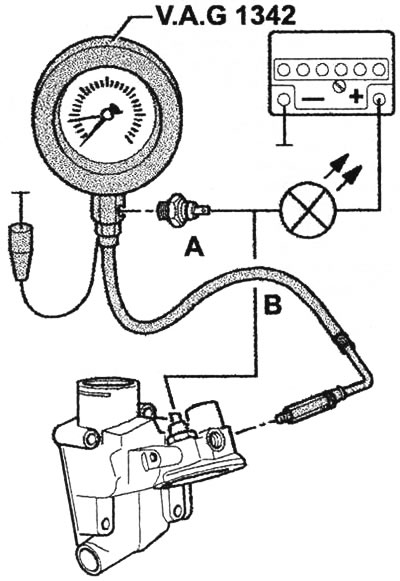
To check the oil pressure and the oil switch, a pressure gauge is required, which must have the ability to screw in the oil switch A. The LED voltage indicator is connected to the positive terminal of the battery and the switch using auxiliary wires
5. Continue increasing the speed. At a speed of 2000 rpm and an oil temperature of 80°C, the pressure should be at least 2.7...4.5 bar. If the nominal values are not ensured, mechanical faults, such as bearing damage, must be eliminated. If necessary, replace the oil filter holder with a safety valve or the oil pump.
6. At high speeds, the oil pressure should not exceed 7.0 bar. If the pressure increases to higher values, check the lubrication channels and, if necessary, replace the oil filter holder with the safety valve.
7. After completing the check, unscrew the pressure gauge and reinstall the oil switch in its place. The tightening torque is 25 Nm. If there is a leak, replace the seal (cut off the old seal with side cutters).