



Table of contents: Versatile all-season oil ↓ Synthetic oils ↓ Do not mix mineral and synthetic oils ↓ What oils are suitable for A4? ↓ Definitions and norms ↓
Oil is truly the elixir of life for an engine. It reduces friction and wear of pistons and cylinders, bearings and valve train components. It seals the narrow space between the pistons, piston rings and cylinder wall so tightly that the high pressure generated by combustion of the working mixture is transmitted to the crankshaft with almost no loss. Oil also cools the engine - for example, the pistons in the cylinders and the bearings of the crankshaft and camshaft. In addition, it protects engine parts from rust, binds dirt particles and some of the fuel combustion products.
Versatile all-season oil
Most modern motor oils are all-season oils made from crude oil. In order for mineral oil to turn into motor oil, it requires additives - special additives that make up to 20% of its chemical composition. They protect the oil from oxidation and prevent it from foaming at high speeds. One of the most important additives is an additive that improves the viscosity-temperature properties of the oil - a substance consisting of long polymer chains that swell when heated and shrink again when cooled.
Due to their action, the oil changes its properties depending on the engine temperature and belongs to several viscosity classes at once. However, this additive wears out at high temperatures and loses its properties. In addition, the oil resource is limited by water, fuel and combustion products. Liquid mineral oil does not tolerate pressure and temperature in the engine. Therefore, timely oil change is not a luxury, but a vital necessity if you want your engine to work without friction.
Synthetic oils
Synthetic oils are also made using crude oil. However, the oil molecules are split using expensive cracking technology and then recomposed using special additives according to the required formula. In principle, synthetic oil is the same natural product as mineral oil, but much more expensive. Therefore, its manufacturers promise reduced oil and fuel consumption, increased stability of the composition and slower aging of the oil when using it. Theoretically, this means that the oil can be changed less often. If you decide to use this high-quality oil, you still need to adhere to the oil change periods specified in the instructions.
Do not mix mineral and synthetic oils
When you add oil to the engine, it is usually allowed to mix oils from different manufacturers. However, it is important to remember that the properties of motor oil deteriorate quickly. Each brand of oil has a special combination of additives that can lose their effectiveness when mixed with another oil. In this regard, mixing mineral and synthetic oils is inappropriate.
What oils are suitable for A4?
In A4 petrol engines, oils according to the following Volkswagen standards should be used: VW 500 00, 501 01 or 502 00. The new VW 503 00 standard is recommended as a long-term oil specification. Oil that meets this standard is resistant to ageing and is also suitable for turbocharged engines.
If there is no oil approved for use by the manufacturer, then you can also temporarily add oil such as API-SF or API-SG. All-season oils are made on the basis of thin-flowing seasonal oil, when hot they are stabilized with the help of additives to improve viscosity-temperature properties. Due to this, the appropriate lubricating properties are provided both with a cold and with a hot engine. You can conclude whether the oil is suitable for your car's engine or not based on the specification and viscosity class.
Attention! Oils that are approved for use exclusively in diesel engines must not be mixed with oils for gasoline engines, otherwise you risk damaging the engine.
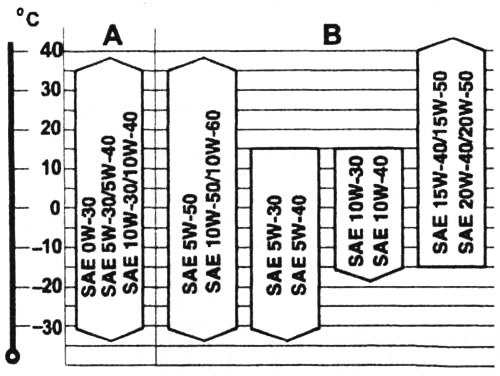
In Central European countries, all-season oil can remain in the engine throughout the year, so there is no need to change the oil when changing from one season to another
A: All-season low-viscosity oils according to VW 500 00 or 502 00 standards
B: All-season oils according to VW 501 01 standard
Definitions and norms
Viscosity. A measure of the fluidity of a lubricating oil. In winter, the engine oil must be so thin that it reaches the lubrication points immediately after a cold start. In summer, on the contrary, a thick-flowing oil is required so that the formation of a lubricating film is ensured even at high temperatures.
SAE class. Indicates the viscosity class, for example, SAE 15W-40. The lower the first number, the more liquid the oil is at low temperatures (W - winter). 0W oil can lubricate even at minus 30 degrees, 5W oil - at minus 25 degrees, and 15W oil - at minus 15 degrees. The higher the second number, the better the oil can withstand high temperatures.
ASEA — is a European standard that was introduced in 1996. This standard replaced the CCMS standard. For gasoline engines, there are groups A1 (fuel saving oil), A2 (oil for normal conditions), AZ (heavy duty oil). For diesel engines the following classification applies: B1, B2 and B3.
SSMS. This European specification consists of the letter designation G(gasoline engine) or PD(diesel), as well as numbers. The higher the number, the higher the quality of the oil.
API. This American specification consists of the letter designation S(gasoline engine) or C (diesel) and one more letter. The higher the letter in the alphabet, the higher the quality of the oil.
(The original version of the article is posted on the website: AudiManual)